
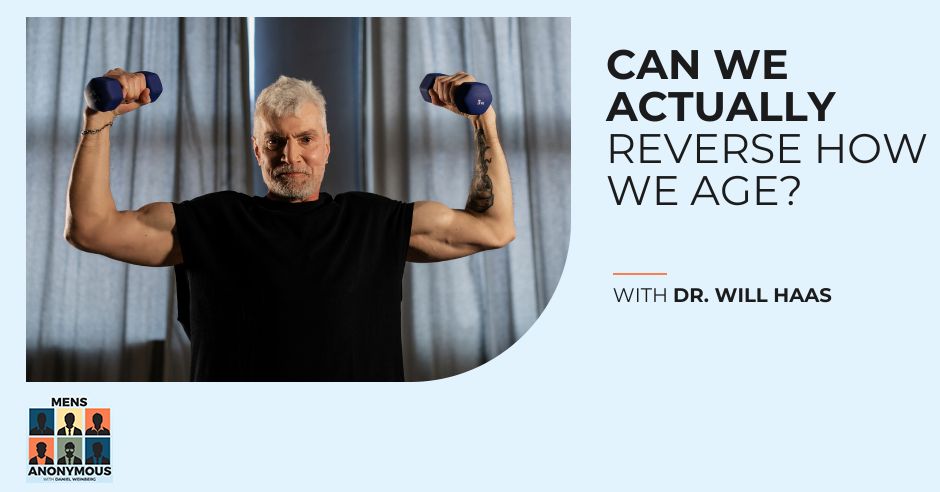
High-performing men often run successful organizations while running their physical bodies into the ground. In this conversation, host Daniel Weinberg sits down with Dr. Will Haas to unpack whether men can truly reverse cellular aging and regain peak energy in 90 days. They tackle the silent energy debt that causes brain fog, plummeting testosterone, and chronic fatigue in driven leaders. Dr. Will Haas explains how environmental toxins like microplastics and heavy metals overload natural detox pathways and crash cellular output. You’ll learn how mitochondrial energy depletion affects daily focus and why white-knuckling through exhaustion destroys long-term performance. Daniel Weinberg and his guest outline practical steps to recharge cellular batteries, fix circadian rhythms, and restore true vitality.
—
Watch the episode here
Listen to the podcast here
Can We Actually Reverse How We Age?
On this week’s show, we have Dr. Will Haas, where we discuss whether we can actually reverse how we age. Before we start the show, just a reminder that my book is out, Men’s Anonymous. It’s a USA Today bestseller, and it can be purchased from any of the online bookstores, such as Amazon.com. Give it a bash, Men’s Anonymous.
Dr. Haas, so great to have you on the show.
Pleasure to be here. Pleasure to be here, Daniel. Thanks for making the time.
I’m going to go straight in, and I want to start with something you say that I find almost outrageous, which you say. You talk about people potentially feeling twenty years younger in 90 days. Before we get into anything else, is that actually possible, or is that longevity marketing?
The 90-Day Cellular Reset Myth
I wouldn’t put it on the hero section of my website if I didn’t think it was possible. I can definitely see how people would extrapolate that as marketing hype. It’s something that I have practiced in and out for fifteen years, and I started on my own journey in my own venture. As an elite-level athlete, somebody who’s always been fascinated by health and human performance, dating back to when I was thirteen. Not to date myself a little bit, but that’s when the ’96 Olympics were. I remember just watching Michael Johnson crush these world records in the 200 and 400 meter runs, and I was just amazed by, given the right inputs, what the body is capable of doing.
That had been my life’s passion and career trajectory until I got to medical school. It was all about how you actually treat disease, not about how you actually optimize performance. That had basically just led me down this rabbit hole of just seeking. What inputs do you need to put into the body to help it perform better? Also, later in my career, what inputs did you need to remove from the body to be able to perform optimally? That’s the biggest misnomer I see in this space when I talk about the system to keep it from thriving, to keep it from healing and repairing. That’s, I think, the part where people get sidetracked.
You end up thinking it’s marketing hype because somebody’s trying to sell you something to achieve a 90-day result. The thing that I see that helps shift and make that transformation in 90 days is what noise are you removing? What potential blockers are you removing? Even for those of us who live healthy or clean, per se, there’s still a lot in our environment that is accelerating the aging process. If we remove that, it’s impressive how much transformation can happen at a cellular level. We’re going to get into cellular health in a little bit. What can shift in 90 days when you just give the body the correct healing environment?
When a 50-year-old man comes into your clinic and he says, “I’m tired. I’m not sleeping well. My brain isn’t sharp. My sex drive is in the dumps. My recovery is taking longer than when I’m doing the workout.” How much of that is genuinely aging, attributed to the fact that you’re aging?
Stopping The Accelerated Male Hormone Slump
I’d say 2 out of 3 men that come into my practice, that is half the equation. You get some of the statistics. When we hit our 30s, things like growth hormone and things like testosterone decline by one to two percent a year. That is, assuming all things are equal. Let’s say you haven’t done a good job of cleaning out microplastics from your system, things that act as xenoestrogens, act like estrogen-like activity in the body. That can suddenly go from a 1% to 2% decline to 2%, 3%, or 5%.
Let’s say your baseline, a man’s baseline testosterone, let’s say you walk around in your 30s at 400 for your total testosterone, and you now have enough lifestyle factors, be it those microplastics that I talk about, be it a high-carbohydrate diet, not enough sleep, high stress, not enough protein intake. All these sorts of things put you closer to that 5% decline mark. Over the course of ten years, that 400 has now dropped into the low 300s. It’s a combination. It’s what naturally happens as we age, accelerated by potential lifestyle and environmental factors.
What happens to us biologically as we age?
There are a lot of differences in about 11 to 12 different theories of the aging process. The one that I see the most in my practice that plays out in high-performing men is the fact that they’re undercharged.
When you say that, what do you mean by undercharged?
Diagnosing Undercharged Cellular Batteries
It’s the concept of cellular energy. Cells are not producing enough energy, specifically mitochondrial cells. It’s this concept of redox, which is recharging and basically balancing the stress on the system so it can more efficiently produce energy. Before any of this healing and optimization takes place, your cells have to be charged enough because the healing is a very energy-dependent process. If your cells are drained, like nothing that you’re throwing at them is really taking.
If I said to you, “I’m 51. I’m turning 52 very shortly. I’ll give you six months with me. Make me biologically younger,” what would you do? Where would you kick off the process with me at my age?
One of the things that I always like to do is get a baseline with my patients. Data is important. It’s one part, the numbers, and one part, subjectively, how you feel. I always like to start by doing some biological age markers. There is a battery of different tests. There are things like the Levine age score or the board’s blood age where you’re using routine lab tests that you could get at LabCorp Quest and then plugging them in through some algorithms that have been pretty well validated without having to go down the direction of spending hundreds of thousands of dollars on genome sequencing and full-body MRIs and things of that nature.
That’s where I like to start because I can kick out a number and then track and trend that. I do not want to be guessing. We want to test, not guess, in this process. There is also going to be a good intake that I alluded to on the subjective side. What is not performing well in your life? Get really clear on that to make sure that we’re actually addressing the right thing. We’re looking for patterns of cellular decline and lack of cellular energy. The common test I’m going to do with my patients is not even like a diagnostic test, just like a regular test you can do when you go to the gym.
I’ll have my patients do some interval training. Simply pick a favorite cardio, warm up for ten minutes so you do not get injured, and then go hard for two minutes, rest for a minute, go hard for two minutes, and repeat that five times. My question to them, at the end of the day, do you feel, or even 2 or 3 hours later, do you feel more charged, or do you feel more drained? If you feel more drained, that starts to become a signal for mitochondrial dysfunction, say, their energy depletion.
That sends us in a bit of a different direction as opposed to you feeling recharged after your workout. I know you’re trying to say what the actual protocol. I got to get a sense of what the underlying patterns are here. That is an example of some low-tech testing that you can do at home before you dive into the advanced blood work.
From there, I can start to paint a picture. Is it a lot of that mitochondrial energy deficiency layered on top of hormonal dysfunction, inflammation, and micronutrient deficiencies? I need to get that full snapshot and then can go in a couple of different directions. There are some common themes. We hit on one of the big common themes, which is cellular energy depletion, and I’ll then start building out a plan from there. I’m happy to now dive into that if you want to go in that direction.
We’ll go there soon. I want to focus on what I find really interesting is it seems to be like a strange contradiction with successful men, where they obsess over the performance of their companies, investments, cars, technology, etc., but they tend to run their bodies into the ground, which is very contradictory to everything else where they’re trying to perform in their life. Why are high-performing men particularly vulnerable? Why do they go down that way?
Breaking The High-Performance White-Knuckle Trap
Too often, they forget that part of their success is driven by that energy capacity and energy debt that they’re basically building. Being able to balance and manage all the things to crush it at work, to crush it at home, and to crush it in the gym. Each one of those is a subtraction from your energy bank. If you do not create the same space, dedication, in and around basically recharging yourselves, providing your body the ability to build that energy block back up.
Eventually, you run the battery down, and it just cuts out. There are warning signals in so many high performers. They’re able to just push through that. They’re able to white-knuckle through it. That’s what makes them vulnerable. What’s made them successful is the same thing that’s draining them down, and ignoring the warning light.
Did you see men who look incredibly successful externally, but physiologically they’re a complete mess?
All the time. One of the places it shows up, and we alluded to doing some advanced testing, is that I’ll see patterns of micronutrient deficiencies that are showing signs of oxidative stress and energy wear out. That might be in the form of things that people are commonly deficient in, like magnesium. It can be certain B vitamins that are really important for mitochondrial function. As B3, B5, and B6, you might see patterns like CoQ10 down. I’ll see that very commonly. A lot of these types of formulas will tell me, “I’m taking supplements.”
That’s only part of the equation. A lot of the micronutrient assessment that I’m looking at with these patients who have mitochondrial dysfunction is not just about what you take in. It’s about how much you are utilizing. If you’re pushing yourself 110% at all times, it creates a lot of oxidative stress and damage to make energy. That’s the thing that the part that gets missed is, the harder you drive that engine, the more destructive particles it’s kicking out to make that energy in the body.
Can you be fit, go to the gym five times a week, and still be metabolically unhealthy?
Absolutely. One of the areas that I’ll see is going to be early-stage insulin resistance. I’ll open up and give you a bit of my background. I was a triathlete growing up. I qualified for the Ironman Half Ironman World Championships. I got into kettlebells and competition lifting, and I have world records in my weight class and that. I was that guy who was fit, and I was still doing this through my late 30s and into my early 40s. Somewhere around like 41 or 42, I hit a wall. I remember very clearly having a conversation with one of my patients in the office, just staring blankly as she was pouring out some pretty important problems that she needed help solving. She looked at me, she’s like, “Doc, you’re scaring me.”
You just saw this blank look on my face. I literally remember trying to process through a fog. My brain just could not keep up as fast. This was somebody who had known me for many years, and she was used to quick responses and very insightful feedback. She almost had this moment of lack of confidence in someone you should rely on to help. That’s where it hit the wall. This was, again, from the outside looking in at somebody who ran a sick business. Those high-performing athletes. Again, to your point, what makes you vulnerable is your ability to push past that and keep grinding and white-knuckling at 110% at all times.
What happened to you?
I had to dive even deeper into it. Even the disturbing part was all of my training in integrative medicine, functional medicine, which is eating clean and taking supplements. I had to dive deeper, and that’s what led me down the rabbit hole, getting further into cellular medicine, or what is popularly focused on peptides. This concept of how do I repair the cell? How do I recharge that cell and just eat a healthy diet? A Mediterranean diet or whether it be paleo and taking the right supplements, was not enough anymore. I had to learn what tools I needed to use to help repair the cell from an energy standpoint.
That’s astounding. When you think about it, you’re high-performing from a health perspective. You’re high-performing. Even with that program that you’re on, there are other things at play. As well, things are changing. Just because it’s working for you, running at this pace, doing all these healthy things, does not mean that it will not change. You’re always optimizing what you need and whether you’re overexerting, and, as you said, like draining your cellular bank or not. This is like a constant even for someone who is hyper-focused on this and has a very deep understanding of how all this works.
Even someone like yourself can experience this if you do not continue paying attention and optimizing. For those who are doing very little, that just shows you what’s actually going on and how much you could be missing out on. Another component that I like to throw out there as well, which I’m curious about what you have to say, is psychological. For a lot of men, slowing down feels like weakness. Rest feels lazy. We almost wear exhaustion as a badge of honor. Is that high-performance mentality, it’s actually destroying our health if it’s not getting the correct attention. Have you had patients where you’ve effectively had to say the way you’re living is going to kill you?
All the time.
What are men doing wrong?
Can you really feel 20 years younger in 90 days? Dr. Will Haas breaks down how removing cellular blockers changes everything. Share on XSometimes they take two things that come to mind. One is going to go along the tangent and the line of thought that you were talking about, which is this discomfort with doing nothing. As an entrepreneur, physician, and physician entrepreneur, I’m very guilty of that myself. I feel uncomfortable when I’m not being productive. We have to shift our mindset around that. Which is being unproductive intentionally at times is what helps restore your cellular battery. It’s shifting your mindset from thinking, “This downtime is unproductive.”
Actually, this downtime is forced to ensure that I maintain my productivity. It’s almost a mind shift around that. The more we can get comfortable with the fact that this is intentional time, the more it is going to ensure I can continue performing at 110% at all the other times. Sometimes you cannot break that. Sometimes I’ll use a tool called neurofeedback therapy to help with that, especially for high performers who are so wired into needing to be doing something. One thing I have found that’s helpful is neurofeedback because they feel like they’re doing something even though the work is happening subconsciously.
For those who are more familiar with neurofeedback, it’s the concept of training the brain the same way you go into the gym to exercise. Except you’re exercising the brain. A lot of times, in these high-performing men, I’m trying to train the parts of the brain, and specifically the brain waves, that drive this constant focus, rumination, and ongoing thought process, your brain always spinning and never turning off. It’s called alpha waves. You have the other side, which is the calming and relaxation states, what we call beta waves.
I’m usually trying to bring down the alpha waves and bring up the beta waves. When they do make that space, the brain’s still not spinning and spinning. It’s as simple as watching Netflix and letting you watch your favorite TV show on Netflix and watching the screen brightness change and loudness change. Somebody’s actively feeling like they’re doing something even though they’re not really actively doing something. For those who need something more structured in that downtime, I find that it is a very good way for high performers to break that mentality. If they cannot just tell themselves to relax.
You’re saying watching a show can be a very healthy thing to do in terms of resting your brain. Is that what you’re saying?
As long as you’re not watching that show until midnight without blue light. Unless this is yes. I do see a lot of just having a conversation with one of my patients who was complaining about waking up feeling unrefreshed and having low energy. We just started asking some more questions like, “What’s your evening time? What’s your evening wind-down routine?” Looking like he’s like, “That’s been off lately. We’ve got hooked on this new show on Netflix, and we’re staying up till 11:30 at night.” I was like, “There’s your problem. ” There’s no peptide or magic tool I can give you. We have to fix the input that’s thrown off your circadian rhythm here.
That’s fair. Tell me, you are very into cellular health. I want you to explain to me and my audience, as if I know absolutely nothing about medicine, cellular health to me and what cellular optimization means.
We have spent time talking so far about one angle of cellular health, which is the idea of energy production happening at the mitochondria. There’s basically communication that happens between these cells that balance the immune system that balances the immune system.
When you say cells, you’re talking about you’re all encompassing all the cells in your body.
Cell types. Your immune cells, whose whole job is to purvey and fight from foreign invaders. They communicate with other cells. If your immune cells are imbalanced, that is going to communicate with the mitochondria, which produce the energy. This creates a danger response where you’re getting bombarded by these external toxins or infections that your immune system cannot regulate. That has a downward spiraling effect on other cells, like your mitochondria cells, and it can kick off and upregulate cells to create more inflammation in the body.
It’s this intricate balance between the communication of different control signals within the body. Optimizing can come in a lot of different ways. It starts with what we kicked our conversation off with, which is removing the things that are stressing the cells or overwhelming the cells, just performing the way they’re supposed to. One of the areas where I will commonly see individuals who do not know the right things and whose labs look normal is that they need to go deeper into environmental toxins. What is creating noise within the cells to perform optimally?
Uncovering Hidden Toxins Draining Your System
Heavy metals, be that microplastics, forever chemicals, or mycotoxins, mold in their system, which then creates this cascade of immune dysfunction, which then some of these toxins will directly damage the mitochondrial cells. They’re not producing more energy, which those mitochondrial cells then create these damaged proteins that kick off more cellular information. Can I see how this cascade spirals? Now your cells can no longer get into the appropriate signaling and rhythm that they need to maintain balance and homeostasis within the body.
How do we actually inherit or absorb things like heavy metals, and the things you’re talking about come from environmental factors? Give me some examples of how heavy metals get into our system to start with?
One place they can sneak in if you’re not really diligent about your supplements is supplements.
Heavy metals in our supplements.
If you’re not sourcing them correctly. Correct.
That’s crazy. You’re trying to be healthy. In being healthy, you’re making yourself unhealthy.
That’s a shocking place that I see. I had one of my patients tell me that he was basically adding a purple yam powder into his post-workout with his protein to drive that protein and to make muscle synthesis. He realized he had gone digging and thrown all this stuff because we ended up finding some concerning heavy metals in the system.
He’s like, “I’m pretty clean. I do not know where this is coming from.” He ripped through all the supplements. He found the supplement company had been cited and dinged for having trace metals in the supplement. He stopped it immediately. This is a guy who’s doing everything right. Dieting at eight percent body fat, going to the gym every day. He was doing the right things, and unbeknownst to him, he was poisoning himself.
If your post-workout feeling leaves you drained for hours, your mitochondria might be undercharged. Here's how to test your cellular energy. Share on XMicroplastics. We hear a lot about microplastics. How do we ingest microplastics into our system?
It’s not just the ingestion. Obviously, everyone can focus on plastic water bottles. You’re also getting that from plastic liners and shower curtains. You’re getting it in from the receipts. The checkout, when you go check out, that receipt paper has BPA in it. They’re all around us. I usually talk to my patients about how you cannot live in a bubble. You’re trying to find the areas, the 80/20, like where can you remove most of your exposure? Be okay with the rest of it because our bodies do have the innate ability to detox.
We have the liver, we have the kidneys, we have the lymphatic system, and we have the ability for our skin to sweat. We can clear these toxins. The problem becomes when these toxins overwhelm our detoxification capacity, kicking off a cellular cascade. If you cannot detox these toxins building up, and the immune system gets dysregulated. That inflammation kicks up, and we damage the mitochondria. You can see how this shows up in common patterns.
Now you’re talking. You’ve dropped mitochondria at least 30 times so far in our conversation. I know personally, I actually take a lot of different supplements with my doctor that are purely focused on mitochondrial function. Why do not you explain what mitochondria are and why they’re so important or how we operate as humans.
It’s the whole premise of our conversation today around cellular energy. The mitochondria are these little cells that are always dubbed the powerhouse of the cell. If we recall from science class, their whole job is to create ATP, which is the currency of energy in our body. There are some other functions to them. That’s the main function. To create ATP is simply from two things, oxygen and nutrients. The foods that we eat are taken in. We talked a little bit earlier about some key nutrients that are important for mitochondrial function.
CoQ10, magnesium, and niacinamide are transconverted into NAD. Nicotinamide adenine dinucleotide is one of the things that is thrown out there on social media a lot. The mitochondria need those nutrients, and then it needs the oxygen. Basically, we’re not going to get too far into the weeds on science to create this electrical current that creates this turbine effect to kick out energy. That’s effectively what these mitochondria are, what they’re doing, and what inputs they need to thrive and function.
I want to talk about some of the other factors. Insulin. Talk me through the importance of insulin sensitivity. Why are we always looking at insulin and then blood sugar management, etc.? Talk me through a little bit of that.
There are a couple of layers to the insulin piece, and we can definitely make a connection back to the mitochondria that we’ve been talking about, which is that too much insulin can feed forward into this oxidative stress picture. Oxidative stress is the balancing of what I call basically free radicals in the body, these radioactive particles that get kicked off from producing that energy. Think about the mitochondria producing energy that comes at a cost. The cost is these free radicals. These free radicals can cause damage to other cells. It can create more inflammation.
Insulin upregulates the free radical or can increase the free radical impact, and then damage the mitochondria further. There’s one piece focusing on blood sugar and blood sugar being harmful, which we can talk about. I do want to make that plug back into what we spent most of our conversation talking about, which is that cellular energy mitochondrial piece, and too high levels of insulin can be damaging to your factories that are producing energy. That can then cascade into two other problems. Spiking insulin can create a cortisol response.
You’re talking about a high-performing professional who’s running at 110% all the time, doing things that cause more cortisol release and production within the body. We know inflammation and insulin are pro-inflammatory. The part where I see where you get the strongest connection is the connection between insulin and driving body fat deposition. Insulin helps. Part of its job is to take blood sugar out of the bloodstream and deposit it into the tissues and cells, and give it to the muscles. It also gives it to the fat. If we have a surplus of sugar, the liver and the muscles can only take up so much of that sugar.
The rest of it gets deposited in your fat cells, especially the visceral fat, the fat that’s in and around your body organs. That is its own metabolically active tissue, and that’s basically spewing out inflammatory cytokines, and it’s disrupting your hormones. Visceral body fat and that fat itself take testosterone and convert it into estrogen. Now we have a connection between insulin and damaging energy. Insulin creates more inflammation, insulin crashes testosterone, or drops testosterone levels. As you can see, it’s touching so many areas of health that go towards a man feeling like he’s aging and aging more quickly.
Now I want to talk a little bit about the sexy stuff because everyone listening always wants to know more about it. I’ll jump into it. Peptides, genuinely revolutionary, or are we in the peptide wild west at the moment?
Both. We’re definitely in this period of the Wild West. I want to back up. Most people are now getting a little bit familiar with what peptides are, their origin, and the conversation. Some of this talk can be a little bit of a review, or these talks can be a bit of a review. A peptide is nothing more than a cell signaling molecule. The very first peptide that we synthesized from the human body is insulin. It’s a peptide. These GLP-1s that are in space right now, they’re not new. They’ve been around for fifteen years or longer.
Even in the testing phase. They were originally looked at as a potential treatment for Alzheimer’s. This is where a lot of the initial research was leveraged from, and found that they help improve insulin and blood sugar, and that they help improve weight, specifically visceral body fat. These are not necessarily new. The Wild West was a result of unintended consequences of the FDA trying to, in their eyes, better regulate these a few years ago by taking them out of the hands of compounding pharmacies. The cat was already in the bag.
There are people using these peptides, clinicians changing lives with these peptides in their patients before 2023, when the FDA removed them from the compounding space. That exploded this, that you had this high demand for these things. It crept into this gray market of peptides, where now there are avenues for people to make money off of this stuff. That’s why you’re seeing the peptide wild west is everyone can set up an affiliate link and make money off of these things. Generally, they have a positive impact.
Let’s disregard the Wild West for a second. Let’s say you correctly source the right peptides. Talk us through what the peptides can realistically do, and do you have them as part of your protocol for some of your patients?
Rebuilding Mitochondrial Health Beyond Quick Fixes
As I said, I’ve been using them for fifteen years in some shape, form, or fashion. The thing that I see most commonly, and that concerns me about how peptides are being used, is a replacement for conventional medications. You’re basically just substituting a peptide for the problem and hoping that fixes everything without looking at what was causing the problem in the first place. Let’s go back to the thing we harped upon in all conversations with the mitochondria. I had a patient come to me yesterday.
They said, “Here’s my peptide stack. It includes MOTS-c, which is a mitochondrial peptide.” Why did you start MOTS-c? “My peptide gal, not a doctor, my peptide gal told me it’s for energy.” I was like, “Let’s talk about what’s draining your energy here. Isn’t a mitochondrial issue.” We spent a lot of time talking about mitochondria. It’s not always the mitochondria. Here was another high-performing individual who’s balancing work balancing life with the 6 or 7 kids at home. Constantly on the go, pushing themselves in the gym, just reported a very high-stress job.
Through the exercise tests, which are when you exercise, do you feel more rejuvenated and more recharged? Do you feel flatter and more exhausted through rejuvenation and recharging every time? That was before she started the MOTS-C. It’s not just about sourcing it correctly. It’s about identifying what cellular dysfunction is happening and then choosing. How do I help the cell do what it’s doing better with an appropriate peptide selection? That’s what’s getting missed, I think, more often than not. It’s not just the peptide source. It’s how you’re using the peptide and how you are using it correctly to communicate with the cell and get the cell to perform better.
Testosterone. When is low testosterone generally a medical problem?
Two answers to that question. We definitely have some science, literature, and research showing that low testosterone can worsen metabolic dysfunction. We talked about insulin, and we skirted around this idea of metabolic dysfunction with insulin. There’s definitely a correlation between dysregulations with cholesterol and blood sugar and low testosterone. Which we know can then domino and have a negative effect on increased risk for cardiovascular disease.
There are inverse correlations between low testosterone and alcohol and morbidity and mortality. Just correlational data, right? Guys who walk around with low testosterone in life are more likely to succumb to illness and die earlier. That’s what we can see in the actual literature. To me, it’s problematic when you have somebody who shows up and says, “I’m doing all the right things. I’m going to the gym. I’m not getting stronger. I’m not building more muscle mass. The visceral body fat is not shifting. I come home completely wiped, and I’m lying on the couch, and I have zero mental capacity to be present with my family anymore.
Having even thought about having ended up being intimate with my partner. I do not know how long. ” Those are the signals to me that say your testosterone is potentially a problem here. Even if it’s in the conventional normal range. Let’s say it’s the number we talked about earlier, 400. If you’re 400 and checking every single one of those boxes, that’s a problem. We know it’s going to add a cellular-level domino and have an effect on things that you’re not experiencing today. If you’re walking around the 400 and the warning lights are flashing, we know that is going to increase your risk for metabolic disease, cardiovascular disease, and other things down the road.
Hidden toxins in everyday products and even cheap supplements could be poisoning your cells and killing your energy output. Share on XYou do work with testosterone replacement therapy, whether it’s gels, injections, or whatever it is, if so required, given the scenarios that you’ve just described.
All the time. It’s a combination of the number, the symptoms, and the patterns that I’m seeing. It’s not just numbers. It’s not just symptoms.
It’s the age as well. What’s age-appropriate, I guess, as well.
Every time we use the therapy, I’m always adjusting it to the upper limit of normal. I’m not the practitioner who is trying to drive your testosterone levels above 1500. That’s usually going to end up having a negative consequence and throw hormonal balance out of whack. That’s where I usually end up seeing guys who are like, “My testosterone’s right,” but they come to me, and they still feel puffy, they still feel inflamed, their body fat’s still higher than it should be. I usually see that’s because the rest of the hormones are imbalanced, especially the estrogen relative to testosterone.
A lot of guys, if we are working to bring that testosterone level down, come at supporting the cells alongside their hormones. We get their mitochondria charged. We get cellular inflammation down. A lot of these guys can step them down from their testosterone. We can go from these 250-milligram-a-week doses. I’ve seen it come down to 75 milligrams, and they feel better. They function better than they did at 250.
What’s a natural way of boosting your testosterone before you get onto any TRT, or what are some of the things you can do to boost your testosterone? You’re feeling like it is a little bit low.
Restoring Natural Testosterone Through Consistent Habits
Being consistent with the correct lifestyle changes, the correct lifestyle, and I would prefer that by saying being consistent. The consistency is where I see guys fall off. What am I talking about being consistent with? Consisting with the same bedtime every night, preferably before 10:00 at night. We want to get in bed before 10:00 at night so that you can spend more time in deep sleep. Why does that matter? That’s when testosterone, that’s when growth hormone is being made and released into the body. That means 10:00 during the week, 10:00 on the weekend, 90% of the time.
We’ve got to enjoy some life. They do not make weekend out every weekend on Saturday nights, staying up until 2:00 in the morning. There’s an interesting study, I think it might have been in JAMA, where they looked at one week of five hours a night, dropping young men’s testosterone by 10% to 15%. The research has called it equivalent to 10 to 15 years of aging. Going back to my earlier question that you had for me, which is, like, that house, can you really make somebody feel twenty years younger than 90 days?
If your sibling is like absolute crap, and you’re dysregulating your circadian rhythm, if I can get that back on nothing else, I can get back on track. You have the potential of boosting your testosterone production by 15%, potentially. If that’s dysregulated. It’s lifestyle, consistent lifestyle factor number one, consistent lifestyle factor number two is going to be resistance exercise training. Creating that load on your body, which then creates this response to produce more growth hormone, more testosterone.
I’m going to do a little exercise with you now. A little rapid fire. I’m going to give you a longevity treatment. You’re going to tell me, is it a game changer? Is it promising or is it mostly hype? Game changer, promising or mostly hype? Peptides in general
Thank you. You know my answer to that question, game changer.
Testosterone.
Potentially a game changer as well to give them the right circumstances.
NAD+ infusion. A drip infusion of NAD+.
More hype than game changer for most people and how they’re using it.
More hype than game changer. IV, I go in, I’m feeling down, I want to go in for an IV drip of multivitamins.
It’s not customized to your micronutrient deficiencies. If customized to what you’re actually deficient in, game changer.
It can be a game changer.
If you’re not picking from a random menu.
It’s because usually those things you see can get someone to come to your house. You see it in Vegas, or you’ll see it in major cities where you can get someone to come to your house and give you an IV drip immunity booster. It’s not geared towards you specifically. If you look at it, it’s really just a couple of different B vitamins and a couple of vitamins.
We do a lot of vitamin therapy in our practice. We do it in the context of what we actually know we’re treating, and then we do a lot of micronutrient deficiency testing, as we talked about earlier. From that, I will then customize the infusion based on what their bodies are deficient in. That’s how we set our protocols. That’s a game changer. If you’re picking off that random menu with some watered-down vitamins and nutrients.
Hyperbaric oxygen. Going into a hyperbaric chamber and doing those sessions.
Potentially a game changer used for the right things with the right dosing and frequency protocols. If you’re doing it one-off, you’re off height.
If it’s one off its height. What would you generally be prescribing hyperbaric chamber sessions for? What would you be treating?
There are a couple of areas in my practice that I use commonly. One of the big areas is going to be injury recovery, surgical recovery, because it speeds up the wound healing process. Downregulates inflammation pathways. It upregulates antioxidant pathways. We talked a lot about antioxidants and the stress on the cells from oxidative stress. This kicks off your body’s own processes, creating more antioxidants. That’s one of the go-to groups of individuals that I’m using. Somebody who’s getting ready for knee surgery, or who just came off some cosmetic surgery, or any surgery for that matter.
Pre and post-surgery, you’re saying?
Correct. You need a lot of sessions post and pre. I will definitely do some pre-sessions with patients, precondition the cells, and start to mobilize that stem cell pool. One of the benefits of hyperbaric oxygen is that it mobilizes your body’s stem cells. It’s one of the other reasons why it can be very beneficial. The other area that I’m using very commonly is going to be brain health in general, if I can create a high-level category. Somebody who’s come to me post-stroke, it’s a fantastic tool.
If I’m trying to, let’s say, say I’m trying to supercharge that neurofeedback therapy that I talked about. All right. What do the mitochondria need again? Oxygen and nutrients. With hyperbaric oxygen, you’re flooding the cells with oxygen. In fact, you no longer need your red cells or your vasculature, your blood vessels, to deliver oxygen to tissues in the hyperbaric chamber.
The pressure of that chamber is basically pushing and diffusing the oxygen through the tissues into the cells. I can spend a whole 45 minutes just hyperbaric. Again, the right patient population. The last piece to talk about is frequency. A lot of the studies are looking at five days a week. Thanks for an hour or 90 minutes. What I have found clinically is that if you can get at least two to three sessions in, you will still see a lot of benefit, especially for short-term things like injury recovery or surgical recovery.
You do not necessarily need five days a week. If you’re treating something more long-term or chronic, you definitely need a lot more sessions. Even the studies in the longevity space, that’s 40 to 60 sessions. Go look at Bryan Johnson’s protocol that he followed. He had to buy a chamber, the same chamber I have, and put it in his house to do that protocol every day.
Red light therapy.
I’d say game changer. I’m going to put it lower on my list of tools. That’s going to be my first go-to.
Cold plunges.
Say more hype than game changer.
Sauna.
Sine qua non, again, why and frequency. I definitely will recommend and use the sauna with my patients who are having some of those issues around detoxification that we talked about earlier. It can definitely be a big driver to support detoxification. You have to do that frequently. Got to be in there five days a week.
Stem cells.
Application game changer. Red application game changer, just randomly doing infusions of stem cells.
Creatine.
Consistency, game changer. Do not expect to see this night-and-day difference overnight. That’s something you’ve got to do day in, day out, month in, month out, year in, year out. To really see that benefit over the course of time.
Final one, wearing a continuous glucose monitor.
If you do nothing with that data, hype. If you do something with that data to make lifestyle changes, I think it can be helpful. I do not think people need to wear it day in and day out. They’re good for fourteen days. Watch some patterns, make some changes thrown on again, 60 days later, and see if those lifestyle patterns and changes have had a positive impact on your life or not.
I’ll finish off with a little bit of a slightly different angle now, which is where we go to the mind and stress. We talked a lot about diet, exercise, supplements, etc. My take is that when there’s too much happening inside our heads, it’s definitely going to have an impact. If I were to ask you, what do you think prolonged emotional stress physically does to the body, such as being depressed or having long bouts of feeling lonely? For example, loneliness, depression, just like being mentally not healthy, let’s say. How do you think that impacts you physically, longevity-wise, aging-wise, etc.? How much do you factor into consideration when you are managing your patients?
One of the areas I look at in my patients constantly is going to be cortisol levels. We know that high levels of stress and high levels of cortisol shrink the brain. It basically shrinks the brain. This is not one of the things to take lightly and just say, like, tongue-in-cheek, like your cortisol highs, of course, it’s high. I’m stressed all the time. Isn’t everyone stressed? This shrinks your brain. You’re having that conversation and somebody in their 50s or 60s, where, in the next decade or two of life, things like mild cognitive impairment, dementia, or Alzheimer’s start to be things of concern.
Five hours of sleep a night for one week can drop a man's testosterone levels by 15 percent. Sleep consistency is non-negotiable. Share on XThat’s huge. That’s a modified lifestyle factor. That’s not a gene causing plaques to build up in your brain. This is something that you can control to ensure that your brain does not shrink over time. If you sit in that, the brain is plastic. This concept of neuroplasticity is changeable and adaptable. It’s adaptable and changeable in a good way. It’s adaptable and changeable in a negative way. So recurrent negative thoughts can create loops and patterns in our brain that become harder and harder to get out of.
Do you think men underestimate how physically expensive it is to suppress emotion to not even like, we’re on the Men’s Anonymous platform here, and we’re all about having someone like you on is I’m trying to platform you to show the audience and let them hear from a specialist’s mouth about what’s important for one’s own health. We can talk about longevity and living longer, but you’re really focusing on how to get you to feel the best you can possibly feel. You talked about optimization. You talked about energy, trying to manage all the craziness in life.
One thing that we do not talk a lot about is things like men in particular, who keep a lot of the high-performance man that we’ve been talking about. The entire discussion is the man who’s trying to manage it all, to try and balance it all and manage it all and perform at the highest levels possible across the board. He’s not really showing.
He’s coming to the doctor, and the patient you’re getting is like, “What’s going on here?” You’re the type of doctor who’s going to push until you get the answers that you want. You might be one of the only people to whom they truly open up because you might make them feel safe, et cetera, and they can see the benefits. In general, a lot of men are masking what’s truly going on inside. My question to you is how much do you think that is affecting their physical health and the aging process, etc.
I’ve always been a big proponent of having coaches in your life. Sometimes people come to me almost as a longevity coach, if you will, a longevity coach that has over 10,000 hours doing what I’m doing and has been to medical school and residency and fellowship and spent my entire life understanding physiology and biology and how we optimize things at a cellular level, as we talked about? One of the coaches that I always ask about with my patients is who is on your team to process the chaos, the heaviness, the emotions, the turmoil, the ups and downs in your life?
Who’s on your team? Who’s your coach there? I’m a big proponent of having a therapist in the picture as a coach, especially for high performers. We are driven and driven, and we’ll put blinders on. Not processing this other stuff because we are so locked in on something that we are trying to achieve that we’re really good at just blocking out the things that are slowly chipping away at us. You need to create. We’ve talked a lot about creating time and space for cellular energy recharge. You need to create that time and space to process those emotions and feelings.
Maybe at a point in time, it needed to be blocked out. For me to accomplish this important task that I needed to do in front of me. If we never circle back on that, and if we do not have somebody to process that with, because a lot of men do not open up unless pried into. It’s almost putting yourself in that position to be vulnerable. We do not want to. Some of us do not want to actually be vulnerable. We do not want to naturally open up. We have to put ourselves in that situation with somebody who’s going to force that work with us. That’s something that I’m always asking. I’m always encouraging people to explore if they do not have that as part of their overall health team that needs to be on it.
You’ve hit the nail on the head there. It sounds like you take a very holistic approach with your clients, both physically, emotionally, mentally, in terms of sleep, and diet. You really cover the whole spectrum. I think what you’re doing is really great stuff, and I just want to say thank you for coming on and showcasing. I mean, you do a lot more than we’ve been able to capture, but to showcase some of the things you’re doing and how important it is for men to realize that one needs to take a really holistic approach to it.
There is not one magic pill, there is not one magic injection, etc. It is something that you constantly need to work on as well, just because you give them the program does not mean in six months. It’s the same program. It’s constant optimization. It’s constantly checking if you obviously have a protocol on how often they need to be checking whether it’s blood or whether it’s whatever factors you’re looking at that are part of your whole process. I highly recommend finding, to either go and see Dr. Haas or finding someone like Dr. Haas in your city. I just want to say thank you for your time and for sharing everything.
Appreciate the space for it.
Before we finish, I always ask my guests five questions. I’d like you to, and this is more personal. I’d love you to give me what comes to mind. What’s your immediate response? There’s no right answer, obviously. I’ll start off with who would you like to say sorry to, given the chance?
That caught me off guard on that one. Probably my father.
Father?
Yes, he passed away when I was in the middle of medical school. I didn’t really get a chance to see myself become the man I am today, and there are some things I wish I had said to him.
Amazing. What are you proud of being or doing in your life?
I’m proud of being a physician entrepreneur alongside being a husband and father and doing my best to balance those two. It’s not an easy task. My wife is very supportive in that, being both and trying to create the space to do both well.
When did you receive kindness while needing it most and expecting at least?
We didn’t talk about a lot of my journey as an entrepreneur, but there’s a point in time where I’d say the business calendar was attacked by one of the big insurance companies. I’m no longer in the insurance space. It was a very tumultuous time as an entrepreneur. I had somebody who had my back during that time when they could have disappeared and run when they saw trouble.
What did your mother or father teach you that you frequently remind yourself of?
My dad was a very driven individual. He wanted nothing more in life than for his sons to have a better life than he had. I took that as that manifested as he always wanted us to become. The best version of ourselves. I approached that every day, and I tried to impart that to the people in and around my life. That’s the goal here.
You’re doing it at the cellular level.
At a cellular level. We spent time talking about a metaphysical level, a spiritual level. On an emotional level, you still need to be able to show up there as your best version of yourself.
Finally, Dr. Haas, what is your superpower?
A superpower. It’s just like an everyday generic superpower. I am a very driven individual. I can lock in. I can keep pushing towards a goal and a task unresolved. That obviously comes at its own potential, potential sacrifices that we talked about here. That’s a high-level one. As a physician entrepreneur, one of the things is that my superpowers is really being able to bridge medicine and business.
I love creating treatment plans and protocols and making them accessible to individuals to help them when conventional medicine has not been able to help. That requires being able to show a clear exchange of value and what I’m trying to accomplish in your life that is outside the confines of insurance, outside that conversation of whether insurance has that conversation. I feel like I’m held to an even higher standard in what I have to accomplish because I’m asking people to invest their hard-earned dollars into themselves.
Trust that I’m going to help them on that journey and continue to walk with them on that journey, even though there may be times on that journey where they feel like they’re not making progress, that I’m going to still come at it at a different level, look at things from a different cellular angle on what levers do need to pull to help them tap into their body’s innate healing capacity.
Dr. Haas, thank you again.
I appreciate it.
Important Links
About Dr. Will Haas
 Dr. Will Haas, MD, MBA is redefining what it means to age well. He is the Founder and CEO of VYVE Wellness in Charlotte, NC, where he helps high-achieving professionals reclaim energy, focus, and vitality through cellular optimization. Board-certified in Integrative and Family Medicine, Dr. Haas blends advanced therapies—IV nutrient infusions, therapeutic peptides, hyperbaric oxygen, and red light therapy—to deliver measurable results that help patients feel decades younger. Beyond VYVE, he co-founded OvulifeMD, creating natural fertility protocols, and serves as Chief Medical Officer at Infusive, supporting wellness practices nationwide. His expertise has been featured in Men’s Journal, Daily Mail, Yahoo Life, and Woman’s World Magazine. Passionate about bridging science with practical results, Dr. Haas empowers high-performers who want more than just longevity: they want their best years ahead of them.