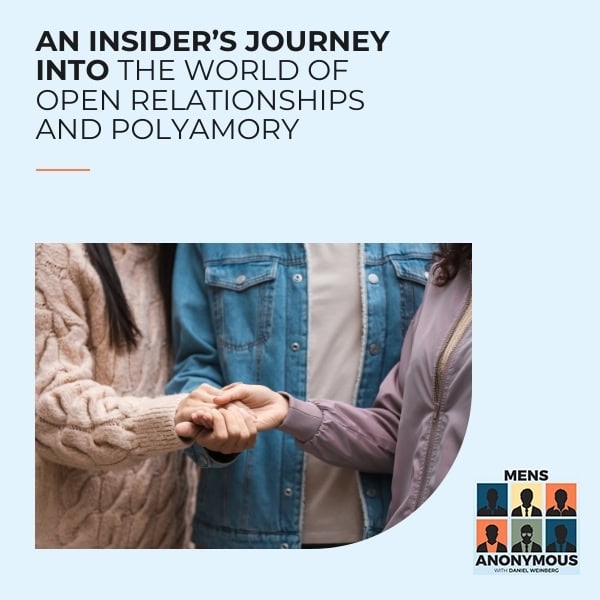

It is easy to dismiss open relationships as too complicated or messy because of the overlapping emotions, connections, and feelings. However, these can teach you to be a better communicator and shape you into a more understanding individual. Daniel Weinberg gets an insider look into polyamory and consensual non-monogamy with “The Doc.” In this conversation, he shares how he discovered the beauty of open relationships, how it taught him to become more emotionally aware, and how it shaped him into a less reactive person. The Doc also opens up on how these relationships allowed him to connect not just with the most amazing people but with his own self as well.
—
Watch the episode here
Listen to the podcast here
An Insider’s Journey Into The World Of Open Relationships And Polyamory
On this show, we have The Doc, who takes us on a journey into the world of open relationships, polygamery, and what they call non-monogamous consensual relationships.
—
Doc, welcome to the show.
Thanks, Daniel. Nice to be here.
I’m very excited to have you here. For our audience, I just want to preface. The doc is a good friend of mine has been very kind to share his personal journey. What we will do is we will admit all names of any participants in any of the stories there. It’s actually quite irrelevant. It’s more about the stories themselves. We will dive in. Where are you?
I’m in Topanga, California.
Introducing ‘The Doc’
We are going to talk about your journey into what’s often called open relationships, polyamory, and I got the other expression they use is consensual non-monogamy. You didn’t start off there. One is, which part of the world did you grow up in?
I grew up right here in Los Angeles in West Hollywood. Typical nice family upbringing, private school, very privileged upbringing, and from a nuclear family, and then a child of divorce at eleven, ended up going away for college on the East Coast and had a very typical privileged to do upbringing in LA.
A good relationship with both your mother and your father growing up?
Yeah, great relationship growing up, especially with my mother. My father and I, post-divorce, things got a little weird and complicated, but before that had a very solid relationship.
Your relationship with them today?
Mom’s one of my best friends. Awesome. We’re super tight. My dad as well. We’re close, not as close as my mom. That’s a long story and a lot of deep layers there, but they’re both in LA. I see them and still see them regularly.
You started off your relationship/romantic career, I guess, in high school, and had a high school sweetheart.
For sure. In high school, even junior high, things got even like 5th or 6th grade, there was interest started. I had, I guess, what you’d call a girlfriend in 5th or 6th grade, but nothing ever happened. It was just the label. We’re dating. Through junior high school, I had various endeavors, dating a few different girls. Probably my first real girlfriend, I would say, when I was in my senior year of high school. I was like seventeen and was properly dating a girl. I had a proper girlfriend.
Typical relationship, I guess, was of a monogamous nature, or what were your relationships? Did you have long-term relationships, or were they like short physical moves on turn?
Yeah, totally. I think I was all over the place. I’ve always like really enjoyed being in a relationship and in a relationship dynamic. I would move from relationship to relationship, I guess what we call serial monogamy, and then interspersed, when I was single, I would date and have fun flings, things like that, and then end up in another relationship up through my 20s and mid-30s. That was my MO. I had some misadventures into cheating with one girlfriend in particular, and that was a whole experience learning about God, horrible that felt.
You mean you carried on a parallel relationship?
Not another relationship, but would hook up with other girls and was dishonest about it, and there was one relationship in particular where that was happening. For the most part, serial monogamous relationships through my mid-thirties.
What would you say were the trigger events that led you to, let’s say, opening the portal to something different?
My experience was that I was in these long-term relationships for a year, two years, I think two and a half years. There was this feeling that I had where I would have one foot in but one foot out. I perceive this as some difficulty with commitment, or I was like, “What is this issue? I cannot commit.” They would feel it. There would be this tension that they would want more in the relationship. I felt like I was unable to give my full self or my full heart or whatever it was. There was this tension that would develop.
At some point, a repeated pattern that you found.
Going Through A Traumatic Breakup
Totally. There was a point where the relationship would fail. I would leave, or something would happen, and we break up. This pattern kept happening multiple times. There was one experience in particular that was like really impactful without going into too much detail, just for time’s sake. I had a traumatic breakup with a girlfriend at the time, who we thought we were going to get married. We were like, “This is it, we’re done. We’re getting married. We’re going to have kids.”
Do you guys are living in California?
This is back in New York. When I was living in New York.
Are you living together?
We weren’t formally living together, but we were spending all our time together. We’re planning on moving to Hawaii and having a whole family and life in Hawaii together. This is a very nice ideal picturesque lifestyle.
What was the age of you at that time?
I was 33. That relationship came crumbling down.
Why? Try and put the pieces together.
I guess I have to tell this story. We had moved out to Hawaii. We went out to Hawaii to investigate, explore which island we wanted to live on. I had job interviews. Got job offers.
You’re not from there. You’ve never lived there, and you both decided, “Let’s get married and let’s go make our life in Hawaii and have a really nice by the sea nature.”
Yes. Simple lifestyle, raise our kids in nature. We were out there, and something just didn’t feel right. We came back from that trip and decided we weren’t going to move to Hawaii. All of this other stuff probably that had been present under the surface that we never dealt with or I never really acknowledged or realized, all bubbled up. We had this big breakup, but then we had this pause.
We’re like, “Wait a minute, what just happened? We just had this grand plan. We’re so in love. We had this great plan to go move out to Hawaii and have this family. Maybe we need to take a beat and try to process what happened, and maybe we can still be together.” We weren’t together. In that time frame, I had gone on a vacation with some of my boys, and it was over the holidays, and I had said to her, “I want to spend the holidays with you.”
She was like, “I’m not quite ready to do that.” I was like, “I respect that. We’re not quite there.” I told her, “I’m going to go on this trip with my boys.” Go on this trip. We go to Brazil. I have this great, amazing fling with this Brazilian girl over out there. Super fun. I come back, and she and I decide to get back together. Basically, a typical story like the phone, the iPhone syncs with the iPad. She sees the messages with the girl in Brazil. There’s a huge blowout. She never speaks to me again.
Ever to this day?
Ever, yeah. When this happened, she sent me a text message with photographs of screenshots of my messages with this girl and was like, “You’re horrible. I hate you. I never want to talk to you again.” That was super traumatic. In the next six months following that, I was like, “What? There’s something to dig into here.”
For me, this was a fling. It wasn’t about love or any potential long-term relationship I was going to have with this girl, and it had nothing to do with the way that I felt about Liz. I still totally loved Liz and wanted to potentially get back together with her and repair things. For me, I was able to have this other experience. For her, I realized there was a huge disparity in the way we thought about this experience that I had.
For her, this was like no fucking way. It’s non-negotiable. I was like I started thinking about the difference between love and intimacy and sex and how they’re all different and they can overlap in different ways. For me, this sexual experience and somewhat intimate experience really had nothing to do with the love and intimacy that I had with Liz. I was like, “There’s this big difference in the way we think about things.” There was no concept of open relationships or non-monogamy at that point. I was just noticing the difference in the way we thought about things.
Just for the readers is that open relationships, the agreement that one can have a physical relationship outside of the primary relationship, and being polyamorous or being in a polyamorous relationship, are that you’re allowed to have a more emotional, deeply connected relationship with another, including your primary. I know it’s all bespoke in terms of what you agree with your partner, but there is a distinction that is usually made between something being just a physical experience versus whether you’re permitted to be in a more deeply emotional connected relationship. Is that right?

Yeah, I think that’s pretty much how I understand it as a spectrum on the one hand. I would say, and I want to speak for everybody who’s had these experiences or is in this community, because I think everybody has slightly different definitions and understandings. For me, it feels like there’s a spectrum where you can have some form of openness and freedom to have connections, sexual, physical connections with other people.
Maybe with your partner, maybe non-emotional relationships on the one hand. Monogamish, I think, is another term that’s out there, where there’s some flexibility. On the other end of the spectrum, I would say that’s where I put polyamory, where you have real emotional relationships with other partners, ongoing emotional relationships with more than one partner.
Going Down The Road Of Open Relationships
What happened with your post this? How did you even understand that there was an already proven concept or concepts or spectrum out there to even explore? What were your sources to go and let’s say go down the rabbit hole of exploring this, or was it complete self-discovery on your own? Let’s work this out.
In the aftermath of this traumatic breakup, it was awful, really painful. In the aftermath, I ended up having my first ayahuasca journey, and there was a big heart opening that happened during that experience that was pivotal. Still not thinking about the relationship, but opened my heart a lot. Subsequently, I had a good friend in medical school, and she had told me she was dating a guy who was in an open marriage. My first reaction was like, “What the fuck are you doing? That’s insane.” I’m like very protective over her. I ended up getting invited to a cocktail party that the husband and wife brew for my friend, who was their girlfriend.
When you say big girlfriend, was it his relationship with her?
It was his girlfriend, but everybody it was all out in the open, consensual with the wife. Nothing was hidden. They threw a cocktail party for her. She had just completed her PhD. I get invited. I go to the cocktail party and I’m like,” What the hell’s going on here?” I’m seeing all of them interact, and I’m having conversations with the husband and the wife, and just seeing the vibe and feeling that there was just so much love there.
I was like, “This is totally not what I expected to experience here.” Somewhere, I don’t recall exactly how far after that, but at some point there was like a little light bulb that went off for me that was like, “I wonder if one of the reasons or perhaps fundamental reason that I’ve been unable to like commit to these women and these relationships, I wonder if it’s a problem with monogamy. I’m wondering if there’s this resistance to being monogamous.”
I’m a scientist, I think like a scientist, and I’m like, “Let me explore this possibility and see what’s out there and do some reading and do some research.” I started doing some reading, doing some research, and having conversations. At a certain point, I was like, “I feel like I have enough understanding of how this might work. Try it.” I began a series of relationships with really important relationships on this path, where I was open about, “This is something I’m interested in.”
You meet someone you’re interested in, and you basically go straight up, “I’m just letting you know, I’m more interested in an open relationship.” You describe these. How did you think about it? You just as trial and error to go through a few iterations before you got to your optimal, let’s say. What did you start off with?
Precisely. At first, I was terrified, because I’m like, “I have to have this conversation with somebody upfront. I’m so afraid of being judged or perceived as.” I don’t know, whatever it is. I remember having this first conversation being like, “This is something I’m interested in. I’ve been thinking about this. I’ve been reading. This is reading these books, and here’s a book if you’re interested and you want to read about it. This is what I’m thinking about.
This is what I want to try. It was amazing because I thought that I was just going to encounter like so much negativity and women just being like “Fuck you. No way.” I was surprised that it was probably about 50% of women who were like, “No thanks.” The other 50% were either like, “I’m curious about that. Interesting. Let’s look at that.” Even, “I just came out of an open relationship, and it was way more prevalent and accepted than I thought it was going to be. The first iteration.
50% of women refuse to be in open relationships, and the other 50% are genuinely curious. Share on XWhat were the rules of the first iteration?
Each iteration, I learned a lot about what needed to happen for this to function in a healthy way. The first iteration was no rules. It was just like, “Let’s try this.”
You didn’t have explicit rules. You were like, “Let’s just explore.”
We were pretty good at communicating things and but ultimately, we never built a foundation of our relationship. It became too destabilized, and so, it just didn’t work. My big takeaway from that first iteration was, “You really have to build a foundation of trust, and respect, and there’s no way this can work without mutual trust.”
I can get burst, basically.
In my experience, a 100%. It’s like you need to develop that foundation, otherwise, it becomes too difficult.
There’s a monogamous period in the beginning to get the foundations built, and then you can open it up.
That was how it worked with that one. Four iterations later, with my long-term partner who I think we’ll probably talk about.
How Far Can Open Relationships Go
I did want to ask you, just a quick pause before you go into phase 2 and phase 3. With your friend who is dating the married guy, in that dynamic, what could she hope for in terms of developing a relationship with him, what would be the, let’s say, the end state? How far can you take it because he’s married? Unless they decide that can she be on equal footing with his wife? Where can it go? My experience with people who are in relationships is that they ultimately always want to end up being, I think my assumption is, the primary. At some point, they’re going to want to be like, “I want my primary too.”
I don’t know how not to speak for them in their experience.
I’m saying generally.
My experience is also a little limited in that I haven’t gotten or experienced a polyamorous religion that I know exists that functions well.
Where there’s let’s say deep emotional relationships with more than one.
I know people who are involved in some relationships like this, and it seems to function well, and there isn’t a scrambling to replace a partner or potentially be a new primary partner. I’m still on my journey of exploration, and I had with my long-term partner, that we’ll get to, I’m sure, we ventured into this territory, and things got really interesting in that place and also quite challenging.
Better Communication And Deeper Emotional Awareness
Give us the second iteration. See, that relationship fell over and then 2.0, how did you?
The 2.0 and these were all great, it was like even that first one ended in a way that was very positive, and I was like,” Wow.” If you’re really honest and open about these things, you can move through these emotional experiences and even breakups with love, and in this positive way, because you’re not being manipulative or hiding anything. The second iteration, it was like, “Let’s build this foundation.”
I really understood once you have that foundation, how important being honest is and the level of communication that’s necessary and the level of honesty that’s necessary not only with your partner but with yourself about, “How am I feeling about this and let me really get in touch with like my emotional field and then start to understand what those feelings are and then how do I begin to articulate those feelings to my partner in a way that’s like non-reactionary.”
Did that teach you to be a better communicator? I thought you to be be able to better express yourself, like not just factually, but more from an emotional what you’re feeling?
It’s like emotional awareness, emotional intelligence.
Can you give us some examples of how that played out? I remember you telling me a story about, and I’m not sure in which iteration we’re talking about, talking about how you were able to express anger without being violent, physical, loud, etc. Was that in this iteration, or was that down the path?
I think that was probably down the road. I’m not sure which exact experience that was, but yeah, as an example, let’s say I’m with my partner and my partner has, there’s some attraction to another guy and it’s expressed, and maybe on some evening, there’s some new person.
I’m just going to paint a picture here, give the visual. You would be at a party, a cocktail party, a dinner party, or something like that with your partner. There would be another individual there that she took a liking to in terms of, “He’s very cute, or he’s got good chat, or whatever it may be.” During the evening, she’s effectively flirting with him, engaging with him, and even showing her interest directly to him, so I’d like to say, “Not tonight, maybe another time.”
I want to know, and I think especially for the readers, because this is a very bizarre concept for most people. I want you to explain or maybe express, when that’s happening, how are you feeling, and how do you rationalize how you’re feeling and how are you okay with it? Are you finding that a turn on that another guy’s attracted to your partner? Does it excite you that to fantasize about your partner being with someone else, or do you sometimes get jealous and go, “I don’t know if I really want to share her with others?”
I think where most of my development happened was with a six year long partner that I had, where we were deep exploring this stuff together over a long period of time, where we could progress through opening up different boundaries and incrementally opening up to the point where at the end we were quite open and had other relationships with other partners. In that scenario, which certainly there were moments where she was flirting with another guy, and yeah, the things that come up are jealousy and insecurity are the main emotions that I would feel.
How did you manage that?
The first step is really owning those feelings. Rather than being reactive and getting angry or saying, “I don’t like the way you’re talking to this guy,” whatever that conversation could be, and even actually say that. Usually, we would have an experience, and then afterwards we would process.
Own your feelings of jealousy in an open relationship rather than being reactive and getting angry. Share on XYou do it like a review.
Would learn so much because when we were starting, we would have a lot of boundaries, and then we would come up, maybe it was okay, I don’t know what the boundary is, but it’s okay to flirt, let’s say, in this scenario. Maybe the next day it was like, “I was flirting with this guy, and how did that feel?”
She’s asking, “How did you feel about me flirting with the guy?”
Yeah, or I say, “I saw you flirting with this guy and it made me feel this way.” The first step was really like owning the way that I was feeling and not putting it on her, not being reactive and blaming her, saying, “You made me feel this way. It’s your responsibility. I’m blaming you for this feeling that I had.” I think step one was owning my own emotional state and not blaming her for it or putting it on her, making her responsible for it.
Once I did that, and having a safe space to communicate, I could say, “This is what I was feeling. I felt a little weird. I felt a little uncomfortable. Maybe I felt insecure.” Moving from this reactive type state to a more unreactive. A little removed, a little introspective. Where are these feelings coming from, and then being able to communicate them was actually like liberating. It was liberating to be able to have these conversations and then to feel safe just to go into my own emotional world, and then have my partner receive me without judgment.
In that process, I might say I made me feel insecure, and then it was like, “Why am I feeling insecure about this? Maybe I’m insecure that this guy’s more attractive than me, or he’s funnier than me, or
whatever it is.” That would allow my partner to then respond with reassurance. “I still love you. Like, you’re amazing. Our relationship is so solid.” That was a great dialogue that could start to happen.
Is it balanced, or in your experience up to now, who is it? Sometimes your partner finds it more challenging, sometimes you find it more challenging, or does it tend to skew towards the female struggles more with it than the male, or vice versa? In your experience, we’re talking about your own journey, what have you found that there’s been like, is it a true understanding that you guys fluctuate within a band, something like that.
It’s hard to make generalizations. I had my experience. I was surprised at how much easier it was for me to have my partner be with other guys and have other experiences. It was much easier than I thought. I think I was able to start doing that processing much quicker than I thought I was going to be able to. One of the concepts that was helpful was this idea of compersion, which is essentially taking pleasure in someone else’s pleasure or joy in someone else’s joy. I was able to find this pathway from the jealousy and insecurity into the compersion.
That’s the key ingredient for a successful open relationship.
I think it’s essential. It’s totally essential. I think it’s really challenging for some people, but for me, it came quite easily. For example, like the concept when you meet somebody new and there’s a spark and there’s this chemistry that happens, and maybe there’s a first kiss, and that’s like such an exciting experience. What a wonderful experience that we get to have in life is having these connections with people, where it’s just so juicy and great. It’s such a great part of life. In my reading and in my experiences, I realized, if there’s this partner that I truly deeply love this person and I want them to have their fullest life experience, why would I tell them they can never have that experience ever again in their life?
It’s interesting, isn’t it? When you put it like that, the monogamous contract effectively bans you, a lifetime ban on having to experience those first few weeks, months, or whatever in a relationship.
Those experiences are so beautiful and such great moments of connection with other humans, and such great potential moments of intimacy. For me, intimacy is just it’s such a beautiful thing to have with another human. Especially when it’s then there’s like physical intimacy, and it’s just yummy and juicy.
Are you ever worried that in one of those episodes that your partner will fall madly in love with another, and you’ll be permanently downgraded because that is always living on the edge?
That is one of the big fears. Yeah, but I think I certainly would have those thoughts, and I think the realization is that it doesn’t matter if you’re in an open relationship or a monogamous relationship.
That’s going to happen anyway.
It’s going to happen anyway. Maybe you open the field to more opportunities for that to happen.
I see the temptation. You’re effectively putting the temptation on the table and allowing the effects of the temptation.
A 100%.
A much higher probability, putting your science brain on, the probability that your partner will find another, because you have opened the doorway to allowing that.
I think there’s like a lesson in non-attachment there, too. If it’s going to happen, if I’m not the right person for my partner and if they meet somebody else who is the right person, if I truly love them, then I’m going to want them to be happy and be with this person. If they want to leave and be in some monogamous relationship with them. The alternative scenario is they meet somebody, they have a connection, there’s love there, and that doesn’t change anything between her and I. We continue in our relationship, but now there’s this new relationship, and it’s additive. We had this experience where she was dating another guy, and to this day, he’s a great friend of mine. We’ve become super close, and it was additive to our experience and to our lives.
Setting Boundaries In An Open Relationship
You had a six-year very deep relationship. Was marriage itself ever considered in that framework? How is that?
Totally.
Being in an open relationship or polyamorous, you can still get married to your primary partner, correct? Is that something that you still aspire? Like someone who lives like that, do you still aspire to have one main primary relationship? Is that still the goal?
That’s my goal now, for sure. In that long-term relationship, the plan was to get married, and we talked about children and marriage. That was all the plan.
You just touched on starting a family, having children. How do you envisage working for the kids? You’re obviously not there yet in terms of managing a family in this dynamic, yet, but you do know people who have a family and have this dynamic, and how aware are the children of the parents’ dynamic?
Yes. The married couple that was where the guy was dating my friend. They had two kids. I had actually ended up going on vacation with them later. We all became friends. We went on vacation with a group of people. The kids were there at that moment in time. The kids were not aware they were quite young, kids were not aware of the dynamic. I know that over the next few years, it was disclosed to the kids what was going on. Now that was their experience. For me, and what I had talked about with my partner at the time, and the way we understood things was that the relationship would breathe. It would expand and contract.
There were periods of time where you went deeper into being more open, or there were times where you’d like to contract and be just your own unit. Is that what you mean by that?
Yeah, exactly. I think we both had an understanding that if we were going to have kids, that there would be a moment during pregnancy and in these early childhood years that we would be more closed. We weren’t quite sure what it was going to look like, but that was the general sense was that we would close in those moments. We also had a big moment where we closed our relationship for about four months because we had a rupture.
We had a boundary that was broken and or crossed. We had to heal from that. In that healing process, it was clear that we needed to close and have a closed container where we could do our healing. Through that process, I was like, “I can see how over time, something like this would expand and contract and breathe and not be so rigid or prescriptive and how things were supposed to be, but let it evolve the way it is.
Can you give an example of a broken boundary because a boundary is effectively a rules of engagement that we agree this is how things are going to play out and a breach of a boundary, you can just give an example of a breach of a boundary, is effectively a breach in agreement or breach of trust that is, or it could be a miscommunication. At the end of the day, it fundamentally becomes a “We agreed on that and you took it one step further.” It’s a trust issue, surely.
It’s absolutely a trust issue. The example that comes to mind, this was the first boundary that was crossed. There were a few and also caveat, like really understanding that in this exploration, we knew that there were going to be mistakes and that we would have to learn from them and navigate some of these mistakes. I think that’s a big reframe,
Have a little bit of tolerance for that.
I think that’s a big reframe from what I think we’re traditionally ought to and what we see on TV and media. If you have one transgression or if you cheat, you’re out. It’s over, red card. It’s a pretty amazing new paradigm to be in. There was the ability to make a mistake and then to recover from that and actually learn and grow together from that. The example is that at one point, we had a boundary where if we were going to engage with another person, we would have to check in with each other to say, “This is potentially going to happen. How do you feel about it?” Consent and permission beforehand.
Relationships grow when you have the ability to make a mistake, recover from it, and learn together from it. Share on XHow do you do that if you’re like in a situation?
Let me tell the story.
“Honey, we had a really hot woman here and I’m I’m vibing her.”
You’re stealing my lines. The idea is that you create these boundaries so that you feel safe. There’s a safe container where you can explore some of these challenging experiences, but with enough safety that you can go there. This was one of the boundaries. There was one evening where I had gone home with another woman and had an experience.
Create boundaries in an open relationship so you can feel safe while doing some exploration. Share on XDidn’t check in. Non-approved woman.
Non-approved, yeah, didn’t check in. It was like, it was we were in the moment, just like you’re saying. In that moment, things unfolded. There wasn’t a great opportunity to say, “Hang on one second, let me call my girlfriend.”
At that time, that this isn’t on the go, so you effectively in that point, said, “Listen, this can happen, but I do have a partner and I just need to check in before this is going to happen.”
I didn’t, but in the past, I had a few experiences where I did that, and it was like, “Great, have fun.” In this instance, I didn’t. First thing in the morning, I called my partner. I said, “This is what happened.” It was hard. Trust had been broken, and there was a breach of contract, essentially. We had a number of conversations about it, and in the process of having those conversations, we realized it’s not really feasible to always check in before something’s going to happen because you are in the moment and you want to be in that flow.
That magical moment.
At the end of that process, we said, “Let’s lift that boundary and let’s take that boundary away.” That was part of how we would maneuver through this. Other boundaries were like, “That definitely needs to be there.” We bump up against this boundary, and this doesn’t feel good. That’s, “Let’s keep that boundary there.” You start to figure out where your guardrails are.
You’re constantly just checking in and seeing where the band and its dynamics. It’s not fixed forever. It’s talking about how it feels. Maybe we can move that boundary a little bit more because it’s a bit of a nothing burger, or bring it in because, “That actually doesn’t make me feel good.” I guess that’s the rules of the game. Is the dynamic about separate experiences, or there are also experiences where you’re bringing a third in for both of you, or does that just depend on the interest of the couple?
Both. In the beginning, in the first few years, I would say we progressed very slowly and incrementally and methodically, saying, “Let’s see these boundaries, let’s go up to the boundary, let’s see how it feels, if it feels okay, let’s push it further.” At first, it was experiences together.
It starts as experiences together.
Way more safe to start there. Incrementally as we pushed our boundaries further and further, it was like, there’s this moment where you want to go on a date with somebody and if this is a scary thing, I want to explore this pushing this boundary there and have you go on a date with somebody and have an experience where I’m not there. That was it.
You’re at home waiting for your partner to come home and feeling, “Why did I let her do that?”
I definitely remember an evening like that. It was a little challenging.
She comes home, and you’re like, “You need to hold me, darling.”
Totally. That was really important for when we did have experiences apart, to coming back, understanding what the other person needed to feel loved and safe again, and really making sure we hit those notes of giving my partner what they needed to feel safe again.
Have you ever felt guilty at all when you go off and have an experience that’s without her? Is there any emotion of guilt?
No guilt because we were very good, at least in, we had some issues toward the end when we were really exploring some deep stuff, where we were having other emotional relationships, and things started to get more complicated. For the most part, we’d have conversations, and there would be consent. “No, I want cohabits experience.” There’s total consent there. Me knowing that I had consent to be in this experience. I didn’t feel guilty. It was great. It was liberating and lovely. It was full of love. There was a lot of love on all sides.
How To Become Less Reactive
Let’s fast forward to today. We’re in May 2025. Tell me where is The Doc in terms of the relationship-wise and framework-wise. Where have you gotten into?
That partner and I, ended up uncoupling for our own reasons. We’re still super tight, very close, lot of love there. That was a few years ago. Now, I’m in a new, pretty new relationship that’s really wonderful, and we’re still in this great honeymoon phase. We’ve known each other for a few years and have been friends, and it’s been really wonderful to drop into this like a great love bubble.
Monogamous at this stage.
Monogamous right now. The general sense that I have is that I’m not rigid about what I want things to be like.
It goes by it for now, basically.
I think every relationship is different, and every person in each relationship is different. We haven’t been prescriptive of what’s going to happen with us, and I’m just in a place where I’m like open to what unfolds and really just enjoying being in love and being in a new relationship. In that building foundation stage, which is really wonderful and great.
Still have intentions to want to have children, have a family, etc. This is not a dynamic that shies away, or it doesn’t have aspirations for family. It’s like they can all be held in the same bubble.
I certainly want family and partnership, and primary partnership, 100%.
Thank you for sharing the real life of a journeyman who has found himself in this wonderful world of, let’s say, your tailor-made relationships. As you said, there are no hard and fast rules or framework that everyone follows. It’s more something that you learn along the way, of what’s going to work for you. It’s really, it’s choose your own adventure. As long as you have a consenting partner who wants to go on that same adventure with you, with a very clear understanding.
I guess the stuff I loved when we spoke initially was that this type of setup actually forced you to become a much better communicator. Number one and number two, and I think even more important, was that it forced you to become very connected with yourself and made you be very honest with yourself because it challenged you in how you feel. In doing so, the two together, being honest and connected with yourself and the communicate, I think I certainly learned some tools from you in how to become a better communicator, even though I’m not always able to put into practice.
My favourite was being able to express to your partner in a very relaxed tone and very centered to be able to say to your partner, “What you did made me feel really angry inside and really angry towards you.” To being able to say that is, I think, very difficult to get to a point. Usually, when people are angry, they can be physical, they’re going to scream, they’re going to have a very irrational interaction.
Being able to like just send yourself and be able to express yourself like that I thought can be highly effective and also will most likely end up with the best or most desired outcome you could get given that you’re almost de-escalate or like with the other that you cannot get angry at that expression of communication when someone’s saying it to you like that. They can hardly respond by being physical or raising their voices or whatever. When you’re the one who is feeling that anger, and you’re expressing it in the cleanest way possible.
I think you have to be careful because you had said, “What you did made me feel this way.” I think that is a pitfall into that reactive state because that’s also like a way of blaming. “You did this.” I think for me, what I’ve learned to do is not to put the blame and not say, “You did this. You made me feel like this.” It’s, “I’m feeling this feeling and let me try to figure out why I’m feeling this feeling. What are the events or what transpired that made me feel this way,” without putting blame, without placing blame on the other person. I think in doing that, there’s this capability of avoiding that reactivity that can so often happen when you place blame, because then you immediately get this defensive response. “I didn’t do this, you did this.”
You’re disarming the other.
That was a big tool I think that I’m still working on, but that I’ve begun to learn how to do a lot better than I can approach these conversations and some of these feelings in a calmer, less reactive way that then allows you to really engage in these interesting conversations about deep feelings and insecurities and whatever comes up there, fears.
Answering Five Quick Questions
At the end of my show, I always ask quick-fire questions. I’m going to shoot away at you, Doc. Who would you like to say sorry to, given the chance?
I thought about this one.
I’m going to comment. Can I guess?
You can guess, go ahead.
Miss New York?
I have apologized to her profusely in letters and in emails, and there’s still maybe another revisiting of that. The more I thought about it, the more I realized the answer is that I want to apologize to myself. Over the years, I’ve realized how high of a standard I’ve held myself to, and not allowing myself or wanting to allow myself to fail or make mistakes. I’m just learning how to be able to make mistakes and learn and grow from them and see them as opportunities. I didn’t realize that for a long time, and I think I did myself a disservice and caused myself a significant amount of pain in the process.
Learn to make mistakes and see them as opportunities. Share on XWhat are you proud of being or doing in your life?
I think my curiosity and adventurous spirit, and my willingness to go out into some relatively unknown or new territory, and try to learn something. It takes courage, and it’s been scary, and I’m proud of myself for challenging some of the norms and what’s expected of us, not only in the love realm, but other aspects of life as well.
When did you receive kindness while needing it most and expecting at least?
Certainly in those moments of boundary crossing, where in prior experiences and the old relationship models with that one relationship that crashed and burned, and I never got that chance to communicate and process. In my relationship, my later relationship, we’ve been talking about to be able to make a mistake and then to be received with compassion and love and kindness and a willingness to discuss what happened and unpack and process was so healing to be able to have those experiences with my partner at that time like really total game changer to realize what was possible in the world of communication and non-judgment.
What did your mother or father teach you that you frequently remind yourself of?
First thing, when I was young, everything was in moderation. That was a big one. Also, just being a kind human.
The final one is what is the Doc’s superpower besides being a love machine?
That’s the answer is I think, just my heart and my capacity for love, I think, is pretty awesome.
I think I feel that. I’d say love. I’d say you’re plus love definitely. Doc, what a pleasure.
It’s such a pleasure. Scratching the surface. It’s so deep. This topic is so deep.
I think a lot of the readers are not very familiar. It’s even more interesting.
I hope I did some justice to the way that I think about this.
You’re great. Thank you. Appreciate it.
Thanks, Daniel. Nice talking to you.
Important Links