
Raising a child diagnosed with autism is certainly challenging, but they must never be seen as entirely different from the rest. They are simply much more special. Daniel Weinberg digs deeper into what high-functioning autism looks like with Sam and Gina Mitchell, the mother-son team behind Autism Rocks and Rolls Corporation. Gina shares her powerful journey as a parent to a child with high-functioning autism, and Sam recounts his childhood struggles with sensory overload and exclusion from social circles. They also explore how Sam discovered his voice and found his purpose in podcasting and the story behind the foundation of their nonprofit organization. Discover how autism unlocks the key to resilience, self-acceptance, and open-mindedness.
—
Watch the episode here
Listen to the podcast here
Living My Autism Out Loud Together With Sam And Gina Mitchell
On this show, I have the pleasure of talking to the mother and son combination, Sam and Gina, as they take us through the trials and tribulations of parenting an autistic child.
Sam, Gina, welcome to the show.
How are you?
Thanks for having us on. We appreciate it.
It is so good to have you guys. We are going to talk to Sam Mitchell of Autism Rocks and Rolls with his mother, Gina, about the journey of autism, both from the mom’s and son’s perspective. For the audience’s benefit, I’ll go straight into explaining what autism is because it has a spectrum. This is from the Mayo Clinic. “Autism Spectrum Disorder is a condition related to brain development that affects how people see others and socialize with them. This causes problems in communication and getting along with others socially. The condition also includes limited and repeated patterns of behavior. The term spectrum in autism refers to the wide range of symptoms and the severity of these symptoms.”
Here we go. I’m going to read a list of social communication and interaction, and then I want you to tell me which of those resonate with you guys. It says, “Don’t respond to your name, or don’t seem to hear at times. Don’t want to be cuddled or held and prefer to play alone. Have poor eye contact. Have no expression on their face. Don’t speak or have delayed speech, or lose the ability to say words or sentences as they could before.
Identifying The Telltale Signs Of Autism
Can’t start a conversation or keep one going. Speak with an unusual tone or rhythm, and may use sing-song. Repeat words or phrases. Don’t seem to understand simple questions or directions.” When I read these out, they seem like they could apply to lots of people, like a large part of the general population. What were the signs for you, Gina, that you picked up on with Sam initially that led you to think, “My child isn’t like the other children in the playgroup.” I’m not sure what age it all started for you guys.
Sam had all of them.
Except for the touching.
Sam comes from a very affectionate family, so I don’t think he had a choice, but it is all of them. It was a classic textbook case of autism. His birth was pretty traumatic. I had to have a very quick emergency C-section because both of us were in danger. There have been some studies that show that for women who have gone through that, there could possibly be a connection, but I don’t know enough about that.
As Sam got older, when we looked at pictures, when we took pictures of him when he was a baby, he wasn’t looking at the camera. I didn’t pick up on that because some babies don’t know. Even when he was a toddler, he never looked at the camera. He didn’t respond to his name when he was very young, so we had his hearing checked several times. It always came back fine. We then started to see that he would have meltdowns. Meltdowns and tantrums are very different. Meltdowns can last for seven hours because it’s a sensory overload and meltdown. A tantrum is a fit because they don’t get what they want.
Meltdown and tantrums are different. Meltdowns can last for seven hours because it is a sensory overload. A tantrum is just a fit because they do not get what they want. Share on XThey don’t get their teddy bear at Walmart.
It’s usually pretty short-lived.
Did you say up to seven hours?
Yeah.
Tell me. What does it even look like? What’s going on?
It depends on how old they are. Each meltdown is different because you’ve met one person with autism, and you’ve met another person with autism. That’s what we always say, but no. It’s not just because the person on the spectrum is upset. They are upset, but it’s not that they want to get their way. It’s an overload of sensory issues. It’s a neurological thing that happens in their brain. If you and I were to walk into a gym and watch a basketball game, and the buzzer goes off, and it’s exceptionally loud, we might be like, “That’s a loud buzzer.” Times that by a thousand, that’s what somebody on the autism spectrum hears, and the volume that their brain intakes that.
It’s very amplified, basically.
Sound, touch. Sam doesn’t like tags. He doesn’t like his shirt wet. To him, it hurts.
When you say tag, do you mean the back of the shirt tag? Is that what you mean?
Any tag at all. Sam doesn’t wear jeans because of the zipper and the pockets. He doesn’t like that. We noticed those things, and then he didn’t like loud noises. We couldn’t take him to the fireworks. We noticed he started to line his toys up. He didn’t play with his toys. He organized them in very sophisticated groups. He was doing that when he was 1 and 2 years old.
At the time, we were like, “That’s not typical.” Now that I look back on it, I’m like, “That’s a pretty high-level thinking skill,” when he was one year old, to take plastic food and group all of the food that had bumps. At the time, I knew that that wasn’t typical. We put him in a special education preschool when he was three.
Did someone diagnose him as being neurodivergent or anything like that, or not?
A school counselor did.
I’m an educator. I’ve been a teacher for about twenty years here in the States and have had a couple of kiddos with autism. I was a very intuitive and observant parent. I knew something wasn’t typical. In my educator brain, I thought, “Let’s put him somewhere where the experts can evaluate him and see what’s going on.” Within a week, his preschool teacher said, “I can’t diagnose autism, but I think he’s on the spectrum.” We weren’t shocked when he was three.
I was four.
The next year, he went through the observations at school, the school where I taught. The behavioral psychologist watched him for a month. She would go into the classroom on and off for a month and watch him. We met with her, and she officially diagnosed him with Asperger’s Syndrome at the time. That has since been taken off the spectrum and put underneath it, so Sam is diagnosed with high-functioning autism. That’s how we got the diagnosis.
Before the interview, I said that how a parent reacts to that news is not wrong. You can’t beat yourself up. I went to bed for 2 or 3 days because I didn’t want to face it. I did everything right. I ate well. I exercised. I read books to Sam in the womb. He listened to music. I did everything. I was a stay-at-home mom for three years on purpose, and that was a slap in the face. I felt like I had done something wrong, and I had to get through that.
The moment that I changed was when my husband came into the bedroom. Here’s the thing. He said, “He’s going to have autism whether you lie in this bed or whether you get up. The best thing for us to do is to read books,” because we didn’t have YouTube at that time. He said, “Let’s educate ourselves,” and we did. We gave Sam every possible resource that we could and never treated Sam like anything was wrong with him, ever. Not one time did I ever lead to the thought that Sam was even different. He is different, but so am I, and so are you. Every person in this world is different, so Sam is no different than you and me.
Look at where he is from, for example.
We live in different parts of the world, and here we are talking. I’m saying that the word different, I don’t even know why we use that when we talk about people on the spectrum.
Can I chime in, please?
Yeah, go ahead.
That’s where she and I don’t see eye to eye.
We don’t agree on that.
My perspective is, I think you’ve got to be real at the same time. Do I think differently? Yes. Who do you know that’s going to talk about professional wrestling or could talk about it for twenty hours? No one else is going to, but maybe me.
In my personal opinion, you go to the stores, and you see the shirts that say, “I’m autistic. I’m different. That’s okay.” I feel like, “Why are you printing that shirt? Of course, it’s okay.”
It is okay, but I think you need to be real at the same time. That’s where we don’t see eye to eye. I think you need to be real. She doesn’t think that.
When Did Sam Realize He Is Not Like Other Children
Let’s take a step back, Sam. What’s your earliest memory of thinking that you were different?
It was just school. It was a lot of the school things I did. I would want to talk about things for 24 hours, and no one else did. For the longest time, until I was six and being read a book called Understanding Sam, which she read to me, I thought, “Why am I getting excluded? Why am I getting bullied? Why am I dealing with all these stereotypes? What I think I’m doing is right, but clearly it’s not. I don’t understand what I’m doing wrong here.” Thankfully, when she read that book, life finally made sense. There was a reason behind it. I have a medical condition.
What age was that? Sorry.
I was read the book at six.
Can you say the name of the book?
Yeah, sure. Understanding Sam. It’s a children’s book. It’s very picture-friendly. It describes it well. There was one part in the book where the parent made the child breakfast, and they hated their food being touched. For the longest time, I remember that. I remember one time, you made me pancakes and sausage. If those sausage links touched a syrup, you wouldn’t be seeing me eat those sausage links because I wanted them to be on a separate plate.
You’re very particular about that.
I’m not anymore. That grew out of the window. For the longest time, it was food on separate plates because I didn’t want the textures to taste it. If you put syrup on the sausage, it’s going to have that texture of syrup.
What was it like socially making friends and that situation as you were growing up, Sam?
That’s a funny story because socializing sucked. I went to a wonderful school. The staff was excellent. It was her school. The students were nightmare times a thousand. I was bullied, excluded, and all the stereotypes you can imagine. What happened was that I dealt with it for 15 years. When we got to eighth grade, people started to like me, but that’s because they liked her. If they like her, it’s going to feed off of me. The following year, that small popularity faded away. I was back to being a loner. I think you know this now, but I considered drinking, not to get drunk, but to pass out and sleep it off.
Sixteen years old hits, and I finally had enough. The bear finally roared, and I dealt with anger. Finally, I had had enough of the exclusion and stereotyping. What I decided to do was see what I did wrong. After thinking about it, I came to the conclusion that what I’ve been doing wrong is people-pleasing. I came to terms that people-pleasing has to stop, or I’m not going to make it. It was the best decision of my life to this day because I made friends.
By people-pleasing, what do you mean by that?
Making people happy to an extent.
I get that, but were you compromising yourself to try and make other people happy? Is that what you’re saying?
In retrospect, yes, but it was more of not compromising and playing the follower to their extent. I do what they say.
I don’t want to put words in your mouth, so tell me if I’m wrong. I always thought he tried to fit in, as we all do. I’ve always taught him, “Don’t worry about that. I don’t fit in, and I’m okay with that.” As far as that goes, he quit. He quit trying to fit in and decided, “I am who I am. I’m not going to be ashamed. I’m going to stand on the top of a mountain and tell people I have autism. I exist, and I’m not going to worry about it.” That was the best thing he could have done.
What did that look like? What did you do? How did you change your behavior?
This is a silly example, but it’s a good one. There is a trend going out. I don’t know how you do it. The kids are doing 6 and 7.
What are you talking about? Say it again?
There’s this new trend in America. They like this thing called banana ball. It’s like baseball, but more goofy. Someone did the arms motion.
It’s TikTok.
It’s a TikTok trend called 6 and 7. I look at that and think, “That is the stupidest thing alive,” because of the TikTok trends. I don’t follow the trends. I do my own thing, my time, and what I think is great. In retrospect, it’s following the beat of my own drum.
Do not follow the trends. Do your own thing. Share on XYou decided not to try and fit in and not to be a follower, but be you and do you.
100%.
How did people respond to that?
Let’s say, arrow pointers, that some were pissed, and I didn’t care. There were also some people who were happy to see who I was. I started a podcast. I joined a media club. I found podcasting. I made friends. I gained more confidence. I still kept a friend whom I had through fifteen years. Thankfully, he’s still with me to this day. Shout to him.
Also, I would say the best part is that I finally had to come to terms with how I learned on my own. My parents and speech therapists tried to teach me, but I came to the conclusion that the teaching wasn’t going to work because, in my brain, it was nagging. What I did, because I had to learn it or I wanted to make it clear, was that I learned on my own.
I learned a lot through the media. A great example of this I can think of is my family is very sarcastic, so I didn’t have a chance. It wasn’t just them teaching it. There’s a show called Cutthroat Kitchen on the Food Network. That shows where they cook, but they have to deal with sabotage. If you’re cooking a pineapple upside-down cake, you might have to cook your pineapple upside-down cake upside down, literally. The show’s host was very sarcastic. How did I learn sarcasm? Watching him.
You became self-taught in learning how to better communicate, etc. You worked it out your own way as opposed to, let’s say, traditional.
I did have speech therapy until I was in twelfth grade. That did help a little bit, but I came to terms that it’s got to be on my own. Despite their heart being in the right place and them trying their best, and I have learned some stuff from them, to me, it’s still nagging. If you come to terms with me and you come to learn about me, I don’t like being told what to do.
How Sam Started His Podcasting Career
How did you get into podcasting? You’ve been podcasting now for six years. Tell me how you got into podcasting. As I told you before, I’ve been doing this for close to a year. It requires a lot of effort. It takes a little while to get good at it as well. You’ve been doing it for six years.
It started when I joined my high school’s media club. I fell in love with it so much that I wanted to not wait until college. I’ve always believed in starting early. That’s what my parents have always taught me as well. “Don’t wait until college to start. Start early.” That’s why I created my own podcast. I knew I might learn these skills in college, but I didn’t want to wait until college.
I wanted to learn the skills or expand my skills that I’ve been taught through the media club. That’s why I decided to start a podcast. It was initially going to be about traveling, but then I realized I do travel a lot, but not enough to continue on the podcast and be episode twenty. It’d probably stop at episode ten. That was when I decided, “I have autism. I talk a lot about that.” Hence, Autism Rocks and Rolls.
Am I right that you coach other folks on autism-related matters? Is that right?
Yes. Do you want to talk a little more about the mother who had the daughter with the book clubs? This is comical, but it’s a perfect story.
I’ll back up a little bit with the podcasting. Sam does the podcast casting side, and then we have a board of directors that supports us. Sam and I are the staff. Sam is our executive director. He’s our boss. I am the president of the corporation. I do most of the legwork for the nonprofit, but Sam is in charge of his podcast, which is the foundation. Everything centers around that.
How Sam And Gina Started A Nonprofit For Autism Advocacy
For years, I wanted to express how I felt about Sam and about people seeing him, focusing on what he can do instead of what he can’t do. We had supporters. We decided to start a nonprofit. That’s where that came from. That was a lot of work to fill out the paperwork for the IRS. We had to prove to them that we were not in this for a bunch of money. We were in this because we had a mission, and we were going to complete the mission. I can’t remember where I was going with this.
What’s the nonprofit called?
Autism Rocks and Rolls Corporation.
We have a lot of irons in the fire, but the main ones we have are event planning. We do events. We always have a gala in April. We always have a motorcycle poker run in late summer, usually in August. We sell food at our local pumpkin patch. If we have a new idea, we’ll try it out.
We’ve done concerts.
Thank you. We have summer concerts in Pontiac, Illinois, and Bloomington, Indiana. We also do speaking services. I’ve spoken at places and conferences in Oklahoma City, Dells, Wisconsin, Canada, Orlando, Florida, and Washington, DC. It’s been a crazy journey.
Some of the smartest people in the world have been diagnosed with autism. Share on XWhat I’ll say, too, with the nonprofit is we have the mission of de-stigmatizing autism and showcasing what people on the spectrum can do. We’re constantly thinking, “Are the things that we are doing fulfilling that mission?” The events do. The speaking does. We decided the direction that we’re going is training and education.
Having my teacher background, I’m writing the curriculum and modules. We have two training curricula. We train emergency workers here in the United States. When they come up on the scene, and there’s someone on the spectrum, it can become dangerous if people aren’t educated. We also train bosses and HR people. We train them how to hire people on the spectrum and then how to keep them as employees because they’re very good employees.
Yet, 85% of people with autism are not being hired, including me. I’m 99% positive it’s because I’m going to be honest on the resume. I’m not going to BS. We don’t see eye to eye on that, either. I’m going to say, “I have a disability. I have autism.” I’m sure the minute they see that, they think, “No.”
It’s not legal, but it happens, for sure. We have that training going on. That’s what we do and the fight that we fight every day. It’s hard. I will not get political, I promise. I don’t want to get into this, but it’s very hard when you have important leaders with big platforms degrading them. It’s hard living in a country where that’s happening. We are taking 2 or 3 steps forward, but then when things happen, we go 2 or 3 steps back. It’s hard. It’s a fight every day.
How old are you, Sam?
23.
Tell me. Have you had any serious girlfriends in the last few years?
No. Pretty much, women leave me more than keep me. Thankfully, I have some friends in my life. When I was sixteen, I started to have one. Fifteen years before, it was just to be nice, or because she was a teacher, or because I’m on a spectrum, and I get pity.
How Autism Changed Sam And Gina’s Lives
Gina, how did the journey impact the relationship between you and your husband? Did it bring you guys closer together, or did it create a lot of tension between you guys in dealing with this? It’s a lot to deal with.
I’d say both, for sure. We’ve come a long way with autism diagnosis over the years. It wasn’t new when Sam was diagnosed. My husband is an electrician and a construction worker. He used to have the mentality of a manly man. He’s like that. He knows how he was raised, and he probably, like me, had this vision of Sam, like, “He is probably going to be like this. He is probably going to do this,” as we all do as parents.
He had a vision of being a hunter. I haven’t shot a gun in a long while. I don’t plan to.
I had a couple of kids in my class who had autism. One time, I had a young man in my class. He was a junior or a senior in high school. I remember looking at him, thinking, “Who does he remind me of?” I could not place who this kid reminded me of, and he had autism. Then, I finally realized he reminded me of Sam. He had some of the same behaviors and mannerisms. I said that to my husband. I’ll never forget it. We were on the couch, and Sam was playing with the plastic food that he loved on the floor. I said, “Doug, maybe he has autism.” He said, “He’s way too smart to have autism.” Now we know that some of the smartest people in the world have been diagnosed with autism.
Why don’t you tell me about the lady you referenced before?
Dr. Temple Grandin. She is amazing. We’ve had the privilege of speaking with her.
Interviewing her.
She has become a good friend of ours because she supports what Sam does. She was diagnosed with autism in the ‘50s, I believe. She didn’t speak until she was 7 or 8 years old. She is incredible. She has written nine books. She had a love for animals and agriculture when she was growing up. She figured out that the slaughter system all over the world, years ago, was a terrible thing. It was not the fact that the animals were being slaughtered because she’s not a vegetarian or anything, but she saw that the animals were scared, the animals were getting hurt, and people were getting hurt.
Animals were drowning.
It was terrible, so she fixed it. If you look online at her blueprints, because she thinks spatially and thinks in pictures, she created a much more humane way of slaughterhouses that’s used all over the world. There is no way she could have done that if she didn’t have autism.
You meet one person on the spectrum. That’s not me. She thinks in pictures. It’s very concrete. She’ll probably understand math and science more than me. The minute you put French in front of her, it’s going to fly through her head here. Once she sees the content, it’s like, “Not me.” Polar opposite. I do English better than science.
We have to remember that they have the same diagnosis. She and Sam have the same diagnosis, but what we have to remember is that they are different people. They have different and different challenges as we all do. Dr. Temple Grandin is incredible. I have never looked up to a person more than I look up to her.
Answering Rapid-Fire Questions
At the end of each of my shows, I always ask a set of questions. I’m going to ask the questions to you, Sam, so pay attention. I want what first comes to mind. Who would you like to say sorry to, given the chance?
Family. I know that I’ve been a pain in the butt before. I know that there have been struggles. Autism, as much as I hate to say it, can be a burden. I’m sorry for being a pain in the butt.
What are you proud of being or doing in your life?
A TEDx Talk. I was fortunate and privileged to do a TEDx talk called Controlling Chaos with Structure. We had to do it virtually because of COVID, but it’s still qualified as a TED Talk.
It’s called Controlling Chaos with Structure?
Yes. It’s on my website, too. AutismRocksAndRolls.com.
When did you receive kindness while needing it most and expecting it least?
Probably doing the podcast. The fact that you get people saying, “Thank you,” for helping me understand myself, did I expect that? No. It’s always good to get it, but even if I didn’t get it, I would’ve done it regardless.
What did your mother or father teach you that you frequently remind yourself of?
Hard work pays off. I do things the hard way. People say, “Work smarter, not harder.” That phrase drives me bananas. I can’t do it that way. I’ve always worked hard. At a CEO class, I got up at 6:00 AM in the morning each day for it. I didn’t have to do that, but I wanted to do that.
Some of us got up at 5:00 to drive him.
The final one, which I’m most curious about, is what is your superpower?
The creativity of the content and ideas I come up with. It’s out of the box. You think I would not be creative. Yet, here I am, making a podcast with new content every day that has 23,000 or 22,000 downloads.
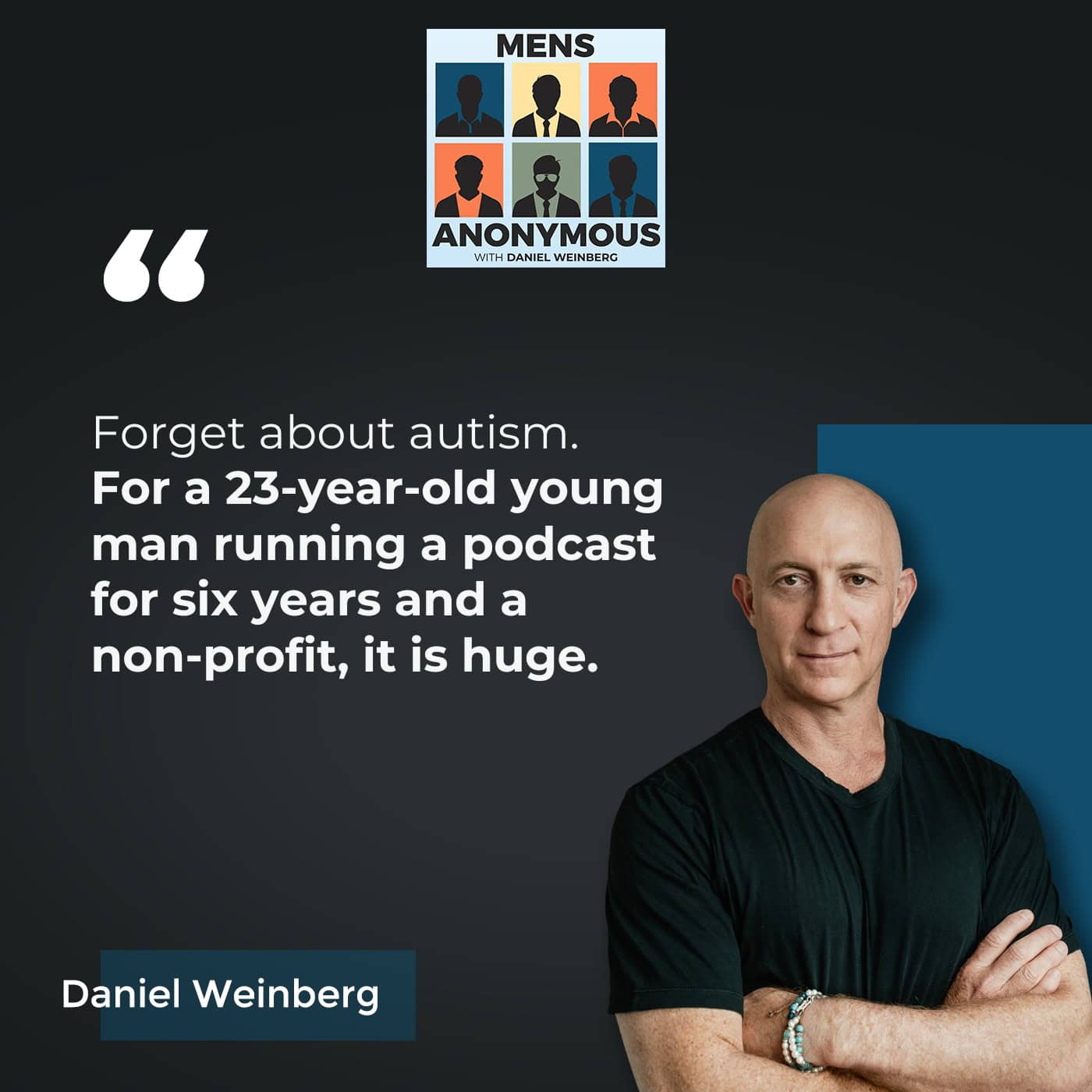
It’s insane. Sam and Gina, thank you so much. I appreciate it. You’ve shed a new light and a completely different perspective than what I expected. I didn’t know what to expect. It seems to me that you’ve evolved a lot further than you would have because of your parents’ contribution and efforts to make that journey as best for you as possible. You blow my mind with what you’ve been able to achieve for such a young man. Forget about autism. You’re a 23-year-old young man who has been running a podcast for six years, and you’ve got your own nonprofit. That’s huge. I want to say well done. Congratulations, and keep going because you’re doing a good thing.
Thank you. We try to do something good.
We try every day.
Important Links
- Autism Rocks and Rolls Corporation
- Autism Rocks and Rolls Podcast
- Understanding Autism: Controlling Chaos with Structure
- Understanding Sam
About Sam and Gina Mitchell
 We’re Sam and Gina Mitchell, the mother–son team behind Autism Rocks and Rolls Corporation. We created this organization to show the world that individuals with autism can thrive, succeed, and make an impact.
I’m Sam, the founder and host of the Autism Rocks and Rolls podcast. As an individual with autism, I use my platform to share my experiences, challenge stereotypes, and encourage others to embrace their strengths. My goal is to help individuals with autism feel supported and to help neurotypical audiences better understand the power of neurodiversity.
I’m Gina, Sam’s mom and the organization’s executive director. I support our mission through operations, outreach, and advocacy. I want families and caregivers to know that individuals with autism can accomplish amazing things when they’re understood and accepted. Together, we work to educate, inspire, and celebrate every unique voice.