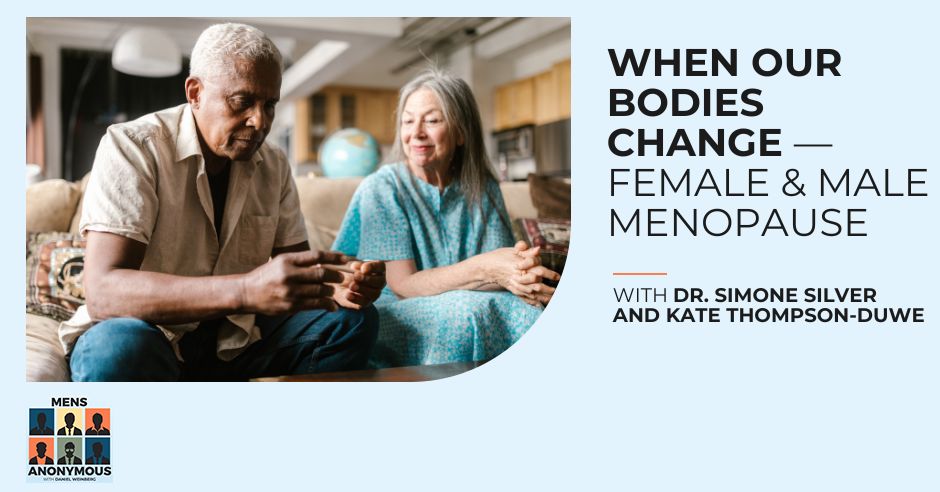
Midlife brings massive physiological shifts that can disrupt energy, intimacy, and confidence when you don’t know what’s happening. In this revealing conversation, Daniel Weinberg sits down with Dr. Simone Silver and Kate Thompson-Duwe to unpack the hidden realities of midlife hormonal health for both women and men. Dr. Simone Silver breaks down the chaotic transition of perimenopause alongside the silent, overlooked reality of male andropause. Kate Thompson-Duwe shares her lived experience and highlights how open communication can bridge the divide between partners when physical changes start to surface. You’ll learn how shifting hormones impact libido, sleep, and mood, and why these biological shifts demand proactivity instead of shame. Tune in to discover practical tools for navigating this transition together so you can step into your authentic authority as a couple.
—
Watch the episode here
Listen to the podcast here
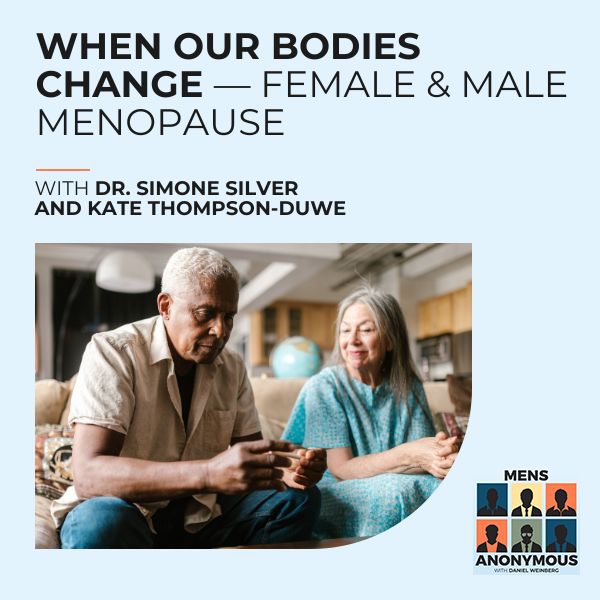
When Our Bodies Change — Female & Male Menopause with Dr. Simone Silver and Kate Thompson-Duwe
We are talking with Dr. Simone Silver and Kate Thompson-Duwe. We’re talking about menopause, male menopause, sex, identity, and relationships.
Welcome to the show.
Thank you so much.
It’s good to have you guys here. There’s a period in our lives where both men and women start changing, sometimes at exactly the same time. A woman may be entering perimenopause while her partner is experiencing his own changes in testosterone, energy, libido, and confidence, and neither necessarily understands what is happening to the other. I thought together with Kate, it would be a good idea to have a specialist in the area to come and explain to us what is going on with a woman.
Both for women and also for men to understand what their partners are going through. On the flip side to maybe help explain what one subject, which is not spoken out, is what’s happening to men at the same time and what can women do to, to basically understand and help their partners go through it.
That’s a good place to start, but let’s start with the women because there’s a lot more information, knowledge and discussion there. Why don’t we start with, there’s a lot of different terms that we hear. I’m not sure even most women understand, to be honest. Talk us through all the different menopausal names, such as perimenopause, menopause, post-menopause, etc. Why don’t you help us understand? Give us a one-on-one lesson on that, and we’ll go from there.
Decoding The Chaos Zone Of Midlife Hormones
That’s a great one to start with. Let’s umbrella the midlife journey. The midlife is the time where these changes start to happen. It averages in our 40s, but for some women, it starts earlier, and we say start to be aware late 30s. It would encompass this journey of transition through perimenopause and then menopause and beyond. To break it down, let’s start with menopause. Menopause is the time where a woman’s ovaries no longer make her main hormones, estrogen, progesterone, testosterone, the main sex steroids of the body.
If a woman still has been having periods by this point, she would not have had periods for twelve consecutive months. I personally giggle and feel a little bit resentful about the medical definition of menopause because it’s silly. It’s made in hindsight. To say, “You’re now menopausal. You can wear the badge of menopause because you’ve ticked off a calendar for twelve months of no periods. Now we can treat you.” It’s not what actually happens or should happen in real life.
We have a definition, but it’s not applicable to lived experience and reality. We encourage women who are having irregular cycles and symptoms to seek help way before twelve months of no periods, but that is the formal definition. Menopause can be natural. It’s a natural process of aging of the ovaries. It can also be surgical where some women have to go in for an operation. Their ovaries are removed and they can be put into a state of hormonal deficiency overnight. They’re different ways.
Perimenopause is a different thing. Perimenopause is a long lead up. The journey leading up to menopause. In fact, I said long. That’s not particularly accurate because it can be a different length of time from woman to woman. We’ve certainly seen, in some cases, it can be as long as fifteen years before menopause. This is radical, because your women, your partners are potentially living in the state of, we call it the chaos zone, hormonal chaos. For fifteen years, that’s going to impact a relationship. What happens in perimenopause in a simplistic point of view, chaos is a great word.
There’s an early phase and a late phase. In the early phase of perimenopause, there’s a lot of fluctuation, particularly in estrogen. Lots of highs and lows. Progesterone for most women is starting to decline at this point. That’s significant because progesterone for women is an incredibly calming, grounding hormone. A lot of the very early symptoms or experiences of perimenopause are not specific. Things like, “I’m not sleeping so well. I’m feeling restless. I’m getting irritable. I can’t focus as well.”
It’s progesterone related. I’ve heard expressions like the experience of brain fog, which you’re saying not concentrating or being irritable or tired or not sleeping well.
The thing that has to preempt this conversation as well is that we mustn’t forget that the hormonal journey started way before puberty. A lot of the hormones before perimenopause are also causing the same or similar symptoms. That’s why this conversation is so important. It’s so difficult to understand, as Simone’s explaining, where you are in the journey because you don’t know which hormones are causing what.
You get irritable and crazy around your period. Is it the stress? Is it another issue that’s going on? Is it a lack of sleep? It’s very difficult to untangle, and this is the very reason why people get lost in this journey. It’s very noisy and very multi-layered, and they don’t know where to start or where to turn.
For me, for example. Let’s say, the buzzword from a longevity perspective. I’m proactive about my health. I go and do my blood twice a year for full reading. Can women do the same to understand where they are in that cycle?
The answer is yes and no. It’s not as cut as that because hormones are tricky. A lot of the time, hormone imbalances speak to us in symptoms and experience. They don’t always translate onto the blood test result. Imagine, blood tests are quite crude. They look at the tip of the iceberg and hormones are a lot more nuanced and subtle. We do run tests and we can look. We can look at the pattern over time, but I would always encourage other practitioners to never place the full weight of the answer on the blood test. Rather, listen to the woman.
If her cycles are changing and she’s got brain fog and she’s not feeling herself or she’s got mood change or sleep disturbance. There is likely a hormonal change going on, no matter what the bloods say. Having said that, though, the further down the journey a woman goes. The closer she gets to menopause and the more deficient her hormone cup is becoming, because it happens over time, that’s when it’s easier to pick up on bloods. Bloods are often misleading in the early stages of change to pick up nuanced change.
In your experience, how in tune are women with themselves when it comes to, whether they know they are going through perimenopause or hitting menopause? Again, I’ve tested the waters somewhat. If I asked my mother, she said she never experienced any symptoms or it didn’t happen for her. I hear some women saying hot flushes, not sleeping well, and being irritated. For some, it happens and for others, it doesn’t. Hence, why I’m trying to understand how women know when they’re going through what you’re even describing.
The short answer is they don’t. That’s why conversations like this are so important. Firstly, it’s becoming more spoken about, which is amazing. Even though it’s becoming more spoken about, it’s becoming spoken about in those terms. It’s the hot flushes, the foggy brain, the waking up at 2:00 AM, the irrational, and irritable mood swings, even though we already had those attributed to us because of our period.
Overcoming The Silent Shame Of Physical Aging
It’s such a textbook definition and it’s so much more nuanced than that. A lot of women start realizing that there is something happening, or something a bit off, and that’s what we’re going to talk about. They either don’t necessarily want to acknowledge it because it’s seen as such a negative thing, even though it’s so not. In fact, I believe it’s quite liberating in a lot of ways. They either don’t want to acknowledge it and they certainly don’t want to discuss it because that’s making it real. They try and avoid it a little bit.
Are they not wanting to acknowledge it or talk about it because it’s a sign of no longer being a young woman?
There’s a lot to be said for, as a woman, as a mother. I know a lot of women choose, especially these days, to not have kids. As a mother, a big part of my femininity is being a mother and childbearing. The three things that I am the most proud of in my life, is that I’ve given birth to three incredible children. My fertility is so innately ingrained in my femininity, and the woman’s shape.
Everything about us reminds a man that we are fertile beings and we are able to procreate and give birth. There’s a lot probably subliminally to be said for, when you are no longer able to give birth, are you still as much of a woman? I know now that, but maybe a lot of women are a little bit scared to admit that they’ve passed over into that next stage of life. That’s why we need to talk about how many benefits there are around it, and don’t just focus on the negativity. It’s seen as such a negative bad thing. You go through it and then you disappear into the shadows, and never to be spoken of again. It’s not like that.
That’s one aspect of it. Slowly, there is this beautiful narrative pushing back that in fact this is not the time of decline and this is not the time of shriveling away. We need to flip the perspective and the mind shift because the opportunity of the midlife is to become more, fuller and physiologically and psychologically on all levels. It doesn’t have to be the beginning of decline. You would know a lot about this because you’re so invested in your own longevity journey. In addition to that, for some women where the symbol of loss of fertility may not be as important, it can often be a case of being just lost in the noise.
What I see a lot is women are divorced from their bodies. They’re operating out of their heads because they are working. They are moms. They are caregivers. They’re nurturers. We’re living on autopilot ten times. Everything is accelerating. The sense of self-awareness and the ability to tap in truly, slow down and connect is not there. I would encourage, and we’ve had this discussion many times, how important it is to teach people to connect again, because the body speaks. It is so intelligent. We just don’t listen if we’re living up here. We can get a wealth of information and it can be life-saving as well.
What I’m hearing is that it’s quite challenging for women to even understand what’s going on with themselves, even with all the information out there, etc. For some women, it’s a bit taboo. They don’t want to talk about it because it reflects on where they are. I’m curious. Do women openly speak about it with each other? Do they share it, or they too also don’t want to talk too much about it because of shame or not wanting to feel or look less feminine?
It’s becoming more spoken about now, which I love. Everything is becoming more spoken about now, which is amazing. It used to be very much kept behind locked doors, or speak to your doctor if you need to, but just endure and don’t complain, whereas these days. I certainly have conversations with friends. I have conversations with Simone endlessly about these topics.
Women are far more open to discussing these things these days, which is amazing. It’s important because we can then share experiences. I certainly have conversations and my group of friends has a wide variety of ages as well. Everyone’s in a different stage, which is super interesting. We speak openly about who’s going through what, but the most important message and the one thing that I love the most about Simone, and we’ve done a couple of episodes on my show as well, speaking about this. That she has coined the phrase for the work that she does, which is the artistry of health.
The reason being because it’s so individual. It’s all plus sides to talking about this too much, because what I go through is not going to be the same as what any of my friends go through. We can certainly share a lived experience. We can share what we’ve learned from the people that we work with and the people that we know, but it’s not necessarily going to be the same woman to woman.
The thing that I always try to tell people, and as Simone said, it’s about trying to get back down into your body and your head but connecting more so that you are able to listen to what’s going on. Even what you’re hearing, even if those aren’t perimenopause or menopause or post-menopause related, if your body is telling you something, it is going to be shouting it out loud in terms of some symptom. Whether it’s libido or brain fog.
I want to go into this then because I’m curious. I’ve heard about hot flushes, but help me understand how menopause, perimenopause or menopause affects anxiety and mood. I’ve got a list. We’ll go one by one. Let’s start off with anxiety and mood. Give me some high level on how you’ve seen it impact your patients or your peers, Kate.
Anxiety and mood is part of life.
I’m talking more about whether you could isolate whether perimenopause or menopause has a particular effect on it or not.
For most women. Having done this and listening to women for many years, anxiety and mood is top. It’s a top complaint. In fact, I’d love to challenge this idea. We think of menopause, hormone change, and hot flushes. We’ve said that many times. It’s not the most common symptom. The three most common symptoms are mood change, including anxiety and sleep disturbance, weight gain, and libido.
I was going to ask. Let’s run through that list. The top three you’re saying are anxiety, mood, weight gain, libido. One question I do want to ask because it talks about anxiety and mood change. Before we go into this list. Do you think that if we were to look at how an indigenous tribe in the jungle was living away from all of modern external factors? I’m going down to the purest, let’s say, how we would operate biologically without today’s everything else nonsense. Would women in that tribe experience perimenopause and menopause in the same way that a modern-day woman would? Is there a difference because of how we live in modern society?
I want to hear the answer to that as well.
I want to know how biologically we are. When you’ve studied anthropology, how are we pre-programmed as women to what happens in the purest form? No medication. No antidepressants. No paracetamol. No nothing. Only normal.
They’re two interesting conversation spinoffs from what you’re saying. We’ll tackle the first piece, which is how menopause will be experienced in a calm, peaceful society without all the modern stress, number one. Number two, which is a question I get asked a lot, which is, “Simone, menopause is a natural part of life. Why should I take hormones? Many years ago, there were no hormones.”
That was one of my follow-up questions because there’s very strong arguments on both sides with regards to hormone replacement or not. Hence why I asked that question.
We know that stress impacts, can impact, and in fact does impact women’s hormones and our experience of hormone change. We have lots of science behind this, lots of mechanisms to explain it, but for the sake of our audience, a nice way to think about it would be, imagine you have a cup full of sparkly juice. We’ll call it mood juice, so it’s your mood cup. If you’ve been stressed, chronically stressed for years or even months, that cup is going to deplete slowly over time.
When you hit the time of female hormone change, like perimenopause or menopause, it will itself deplete that cup. If you go in with an empty cup, you’re going to bottom out very quickly. If you go in with a full cup, there might be hits, but you’re still going to have some juice in the cup, if that makes sense.
Hormone drops in midlife aren't a sign of decline. They're a call to get proactive about your body. Share on XI want to understand that because when you look at how we used to live, and I go back to, I call it the tribe, just to make it in the jungle. It’s the tribal society. There’s nothing else. They don’t have the external stress other than like a predator coming by. Let’s just say beyond that. They don’t have that. They’re not depleted in that sense. My understanding is in those societies, they don’t experience very highs and lows.
They don’t have manic depression. They don’t have any of that. They don’t have the concept of unhappiness. There’s different levels. It more goes around a bar that goes like, “This as opposed to very highs and lows.” How am I to understand how women would experience it in that setting? Is it the same as modern-day women experience it or not?
More balanced.
It should, in theory. There’s individual variation, and we all have genetics that are separate to our environment, and sometimes connected. In theory, it should be an easier transition process without the onslaught of external stresses. We do know that the environment and the psychology, our mindset, directly influence biology, directly influence our levels of inflammation, our hormone fluxes, our experience of pain, etc. It has a huge impact, no doubt.
Also, I would imagine there’s a lot less expectation on women as they get older because in a more rural environment, 50 is seen as much older than it is here. Thank God. It is also women are probably allowed more to sit back and live with it, be with it and live through it as opposed to keep pushing to a normal extent whilst going through all of these extra changes.
That would bring forward some interesting cultural discussions. Also, culture might color the experience of menopause and so forth. Stress or that lack thereof will implicate or impact a woman’s experience and it should be less turbulent for sure.
I’m going to go through the list and you can give me some high-level comments because I know it’s different for everyone or whatever. We’re anxious and in a bad mood. There’s sleep disruption at the gathering. Would that be like the patience that you have? Is that when you have sleep disruption? Does that go on for a period of time where they’re waking up regularly so they’re not getting deep sleep REM? Is that what’s happening?
The take home there is to recognize that hormones like estrogen, progesterone, testosterone are intertwined with neurochemicals like serotonin, dopamine and so forth. There’s the mood connection and similarly the sleep connection. Sleep can be hugely impacted.
Agreed.
Memory and concentration is the brain fog we’re talking about. When women describe the brain fog, why are they experiencing that? What causes brain fog for the women when they’re going through this period?
There are different mechanisms that are thought to contribute. Some are related more to inflammation because as hormones fluctuate, they have a relationship to the immune system as well. Again, the concept of hormones affect every single tissue in the body. As they change, we go through whole body changes in every tissue.
More inflammation around the cells, the actual direct impact that estrogen and progesterone have on the brain itself have been shown. What the data currently shows us is that the greatest change to cognition or experience of brain fog probably happens in perimenopause, settles somewhat after menopause, but may never return to function before perimenopause began.
The other thing you talked about, you said weight and body composition. Does this usually lead to weight gain or can it go both ways?
I’ll speak to the medical and then you’ve got to speak to the experience because women and weight is such a sensitive thing.
I don’t know if I want to go there.
For men and women, this is a pivotal topic because men go through their midlife changes, which we’ll chat about. They lose their testosterone. Women go through their midlife changes. These hormones, testosterone, estrogen, and progesterone, have direct metabolic impact, meaning when we lose them, we have more insulin resistance. We have a redistribution of fat to the belly. Men get this also as they lose their testosterone. That belly fat is the worst because it makes inflammatory molecules that directly increase our risk for things like heart disease and all sorts of inflammatory diseases down the line.
Protecting Your Cardiometabolic Health And Energy
There’s a distinct biological phenomenon that happens in the midlife change for men and women that is called the cardiometabolic transition. That directly puts us at risk for disease. That’s just one component. Aside from the other physical components like libido and so forth, and the psychological ones that no doubt we will get to.
I wanted to say, I don’t know that there is a one size fits all answer for this at all and it’s such a sensitive topic. There is an impact that the hormone changes have on a woman’s body, specifically on her appetite, on her inclination to get up and train, but if there’s one thing, and I’m going to keep on saying the same thing over and over again, that is imperative as young as possible for any woman is to get so in touch with her body. That she understands and feels as things start to change because things like weight training just become so much more important for a million other reasons than how you look as you get older.
A focus on protein and your nutrition becomes so much more important and all of these things. There’s so many of them happening at the same time that if you wait until you’re at the point of gaining weight from menopause, probably because of the other things that are going on. It’s going to be a much harder journey to catch up with in terms of general aging, osteoporosis risk. All of the reasons that you want to have extra muscle, as well as just general health. We all know this. As you get older, you go through serious health problems, challenges, changes, and setbacks. The fitter and healthier you are, the more likely you are to get through it and to be okay on the other side. For me, it’s all about extreme proactivity.
What it sounds like is, as you get older, what you’re suggesting is that women need to exponentially accelerate their proactiveness in focusing on their health because of all the changes that are accelerating in them.
Also, men. You’d rather be ahead of the curve if possible.
Talk me through with another area, which is they talk about, the impact of sexual desire, vaginal dryness, and painful sex. Talk me through that area. What do you recommend patients of yours who experience this? What can they do to alleviate it or improve their situation?
In two broad categories, when we talk about sex at the midlife and sex disruption for whatever reason, and there are many, is extremely common. I’m so glad we’re talking about it. It should be spoken about a lot more. For women, the two major complaints are a loss of desire. A loss of libido drives appetite for sex is one. Separate to that, sexual function might be impacted by things like pain from vaginal dryness or changes there.
Is that common? Only so I understand. Talk me through how common some of these things are, because you talked about mood, weight, sex desire. That was your top three. Try and help us understand how common these are when it comes to sex, libido, pain, vaginal dryness, all that stuff. How common is that?
Navigating Intimacy When Libido Takes A Hit
I would say that low libido or change to libido is almost a universal experience. I’ve met one or two patients in my whole career that were not impacted. It’s huge. Vaginal dryness and pain is not universally experienced by all women, but it’s common. There’s going to be some experience of discomfort related to vaginal health or bladder health by most women, I think up to 70% going through hormone change and transition, but very easily treatable.
Declining testosterone and estrogen directly impact metabolism. Strength training and clean fuel are essential. Share on XThe take home there for vaginal dryness and pain is the vagina is a tissue like the skin. We serum our skins and we moisturize our skins. We look after collagen in the skin. The vagina needs the same. It has a biome like the gut. It has a microbiome. When estrogen drops, the tissue becomes less hydrated. There’s less collagen, but also the biome changes. The natural bugs that live there change.
Women are more prone to things like thrush and bladder infections. Often, what we see is women who get recurrent bladder infections are going to their GPs and getting script after script for antibiotics and just applying vaginal estrogen would treat the root cause of the problem. This bunch of symptoms is very easily managed with local estrogen creams or pessaries that are applied and they are encouraged.
What they do is they help the area flourish, basically.
It plumps up the tissue. It builds up the collagen again. It’s effective and also safe. The resounding message from the menopause societies around the world is vaginal estrogens are safe. They don’t carry the same risks that we might talk about with systemic HRT or other forms of HRT.
Can you have too much of it?
You can have too much of anything.
I’m saying if you have excessive amounts of vaginal estrogen. Does it have negative effects?
Potentially, but not with the huge risk caveat that we might be worried about. We wouldn’t want too much because it can also affect things in the other way. Maybe there’s too much lubrication or other symptoms, but it’s generally considered a good supportive measure for women to consider.
I’m going to start bringing in the male perspective, and we’ll start going in that direction. I’d say from the man’s perspective, and I cannot say I’ve experienced this in my relationship, but I understand it exists very commonly. From the man’s perspective, if affection or sex suddenly diminishes, it’s very easy to interpret that as rejection. She’s not attracted to me anymore, especially if you’ve been in a long-term relationship. You’d be married for twenty years or whatever. You’re in a long-term relationship. She’s not attracted to me anymore. She doesn’t love me anymore. The relationship is starting to die. How often is that interpretation completely wrong?
I’m going to sound like a stuck record, but again, it’s all about communication because it’s something that I think about quite often. It’s how spontaneity in your life changes as you get older. Myself and my husband used to be the most spontaneous. The wildest, the craziest, and the most fun. It does change. It has to change. As you get older, you have children. You start businesses. You buy houses. You buy whatever. You have layers and layers of responsibility that is piled upon you.
That automatically impacts how spontaneous you’re able to be. You can’t just quickly pack a bag and go away for the weekend or go out all night or go out for dinner and end up staying out all night. Things like that are, in my experience, intrinsically linked to the amount of fun that you have with your partner, which automatically changes as you get older and as you are together for longer but so does the level of communication and the level of comfort.
Things like that, if the attraction feels like it’s diminishing, if the frequency of sex feels like it’s less than it used to be, just communicate and talk about it before you start to assume what’s going on, like, “He doesn’t like me. He thinks I’m ugly.” I would have thought this was more a female thing, but maybe I’m wrong.
I’m going to ask you guys some advice. You got to give me some advice here, and this is for all the readers. This is for all the male readers. Suppose your wife or partner is going through perimenopause or menopause. Tell the male readers out there, what we shouldn’t say or do in that situation to save us from being killed.
Don’t say, “It’s your hormones.” It’s like when you get your period and there’s nothing worse than a man being like, “Is it that time of the month?” You obviously don’t want to patronize.
I want you to give us real advice and tips here on what not to say or do. Tell me what genuine support looks like without treating your partner as if she’s ill? Tell us what we should do. We’re going to get the best, we’re going to support our partner in the best way we can without coming off as inauthentic or an asshole or not understanding. Tell us seriously what we should do.
I would say it’s just getting involved. It’s showing a real interest in wanting to know what’s going on, as opposed to just trying to avoid it. Traditionally, a lot of men don’t want to talk about this stuff. They just let that carry on. They’re like, “I don’t want to know. That’s the mom’s job.” I would say it’s a deep and real interest in understanding what’s going on. There’s nothing wrong with being like, “My love, I don’t know what the hell is going on.” Genuinely acknowledge and admit that you do not know anything about what menopause is, because I can promise you.
I could tell you now. I’d say 95% to 99% of men have no fucking clue. Zero.
The knowledge of puberty is rudimentary at best. The knowledge of menopause is non-existent. It’s not something that was spoken about back in the day. I would say it’s that simple. It’s like, “I don’t know what the hell’s going on, but I would like to. Please talk to me. Tell me,” because the chances are also the woman doesn’t have all the answers, but she would as hell love the support.
I’d also say the big one would be what I just said before, which is the sexual desire dropping off. That’s got to be a big one in a relationship given how key physical relations are to a healthy, well-balanced relationship. Help me understand how I should respond or what I can do or how I should view relationships if my partner says to me, “I just don’t have the desire anymore. I don’t feel like having sex anymore.”
Men start losing testosterone in their late thirties. Staying silent under high pressure only deepens the crisis. Share on XI’m 52. This could happen anywhere between mid-40s and mid-50s, which is very young from my perspective. I completely understand the idea and concept of hormonal changes happening and genuinely losing physical desire or libido. How best to manage that? Both as a couple, but from the man’s perspective, especially if the man still has a high libido.
We need to tease out this topic because libido is huge. Hormones are just a part, then there’s more. We can chat about them more. In the hormone space, the tragedy of this in relationships in the midlife is that couples turn away. The woman’s experiencing libido drop. Very often, the man as well. They’re both stressed for different reasons. They turn away from each other, then we go into that narrative in our minds where it’s like, “The relationship’s ending. I’m not attractive anymore. He doesn’t like my new belly or whatever it is.” Almost always, it’s not the truth. That’s a story going on in our heads almost always.
We’re lacking the communication and the courage to turn around and say to our partner. I discuss this with patients all the time. I say, “Tell your partner, ‘It’s not you. I adore you. I love you. You’re sexy.’ That’s all there. There is a physical change happening in my body, which I can’t control mentally, and I’m working with it, or I’m going to be proactive, and I’m going to be curious about it and not shame it.” Try and mold it and go on a journey, because sometimes, it’s not just about fixing hormones. There are other things that we speak about often about connection. Women’s sexuality is so much about connection to femininity. There are layers and layers. Hormones are just the tip.
Maybe there are other forms of intimacy to work on before you get straight back into fixing the number of times you’re having sex every week. Also, as Simone’s saying, for a woman, there’s so much mental stuff going on when it comes to intimacy. It’s so much simpler in my understanding for a man. It’s a physical need. It’s a physical act. It’s a physical release. For a woman, before you get to that stage, there’s so much emotionally and mentally happening.
If she’s going through changes, she’s a little bit scared. She’s a little bit unsure. If she’s put on weight, she’s feeling self-conscious. We need to feel amazing about ourselves in order to feel turned on and want to have sex. There could be so many things going on with her that maybe it’s work on the intimacy of, she comes home from work and there’s a beautiful dinner there with candles and wine. You have a good conversation. You kiss, you dance, or whatever. There’s so many other things that maybe could be done again proactively before you start thinking, “There’s a problem because we didn’t have sex this week.”
I’m going to flip the script a little bit now. We’re going to now talk about a subject that I’ve never heard spoken about. Kate and I have been talking about it for almost half a year now, back and forth, trying to find yourself to come and talk to us about it. Which is what I would call male menopause. Given the work that I’ve been doing in this space with the show and writing a book. I’ve spoken to so many men. I speak to men about all different things like, traumas and being sexually abused.
I know this male menopause exists but I have to say, it’s most probably the one subject that I’m yet to find another man open up to me about and say, “I’m experiencing that.” It could be because maybe they don’t even know this thing exists and maybe they’re ashamed and all the above. I can imagine symptoms being energy dropping off, motivation, muscle mass dropping, sleep affected, mood, and confidence. You also have erectile dysfunction, sexual desire, and testosterone levels going down, obviously. Talk me through. Is there a real thing called male menopause? When does it happen? How much do we know about this subject? There’s very little conversation around this subject.
Unmasking Andropause And The High Cost Of Male Silence
Correct. I feel strongly for all the men out there. You should not be left behind in the discussion. The world is going bonkers for menopause. It’s fantastic, but we should not be leaving the menopause behind because it’s as real. It looks a little bit different, but it’s also happening. It’s a real thing. The medical term for it is called andropause. Androgens meaning male hormones, andropause. You guys start to go through changes and particularly drops in testosterone also from your late 30s.
It’s just a little bit slower and more subtle. Men start to lose about 1% to 2% of their testosterone every year from their mid-30s. Then by the mid-40s or certainly early 50s, that can manifest as true deficiencies. Testosterone is vital for men’s vitality. It is essential. Men are going to feel it without it. Mood changes in serotonin are huge.
The passion point for me here is often this experience of andropause is happening alongside massive strength. Men in their 40s and 50s are often climbing at the top of their corporate game. The responsibility is at an all-time high. They often have families and they’re responsible financially. We have seen so devastatingly, quite a few suicides in this category.
A lot.
Men are feeling overwhelmed, and they are feeling like they can’t speak up and they can’t ask for help. It reminds me of when we talked about CPR for the person who’s choking that can’t communicate well. We’re taught that when men start to choke, they tend to die more than women because they go to the bathroom to choke in silence because they’re so proud. That’s just such a great analogy.
We need to change the narrative for men. And women need to step up here. We need to give men permission. We need to be prepared to shoulder. We need to be prepared for real male masculinity, which to me is vulnerability. That’s strength. It’s not the stiff upper lip until I break down. This needs to change. It’s a health crisis.
My understanding with regards to men, what’s available to them is you go and do your bloods. You can check all your levels when it comes to things like testosterone. There are testosterone gels that are prescribed or testosterone injections, which has a little bit more controversy around them. I know of men who are using that to counter it, but as we age our testosterone levels go down naturally over time and our libido drops off. Is there like a point where men should accept that libido is gone or can we always do something about it? Again, what’s the natural arc of what men should experience and accept?
I don’t think there should be a point for men or women at which they accept that libido is gone completely. I could be wrong. I saw something, but I can’t remember where it was, about the rise of STDs in old age homes. That there’s so much rampant sex happening in all nations, which I love. How amazing is that? It should be acknowledged that it’s so much more nuanced than seeing someone that you’re attracted to, falling in love, being in the mood all the time, and just having sex 2 or 3 times a day. It’s wonderful because the rest of your plate is relatively free and empty. It changes, but it doesn’t need to go away.
For me, this is a little bit of a mind-body conversation. From a physiological body side, the pure hormone is the cup full or empty. There is a reality that as we age, our physiological capacity, the buffer, the capacity of the body wanes. It is part of the arc of the natural process due to slow down, the waning of it or build with everything.
If you think about someone older, they sleep less. They eat less.
Midlife shakes up our identity for a reason. It's the ultimate chance to drop the mask and rebuild on your terms. Share on XIt’s a multi-system experience. There’s this background of this multi-system change happening. That’s a reality. We can’t steer away from that, but we can. We’ve learned through longevity medicine, we can slow down or accelerate it. If we look at the mental side of libido, why should appetite for life, joy, spark and an appetite for sex or pleasure ever disappear?
I get it in theory but you have patience and you’re connected to reality. I want to hear. Give us a little bit of color around like, do you have a lot of patients who are, in their 70s, still having a healthy sex life? Is that normal?
It’s absolutely normal and possible, but also not to shame that often, in older males, erectile dysfunction is a common experience. It is part of aging. There shouldn’t be shame. There are interventions that we can offer and communication with your partner. That’s a great issue. A lot of men who are older feel pressured to be like the stud they were in their twenties. That’s not viable for women to hold men to that either.
Women probably don’t want that from men at that stage anyway. It’s from the woman for sure.
Depends if she’s on testosterone.
I want to ask you ladies then. What do you wish men would better understand about women as it relates to this whole subject matter? I want some practical takeaways here for the readers of what can men understand better to show up as better partners when it comes to everything related around the peri, meno, post, as well as it pertains to desire, libido, and how they feel in the relationship. What can men do better to understand?
For me, it’s, as I said already, it’s just getting involved. It’s stepping up and acknowledging that something is happening and they want to understand it and they want to be a part of it. It’s probably going to change every day or at least every week. It’s not going to be, I’ll give you the answer, and then in six months’ time, it’s still going to be the same. Not a chance. It’s going to change consistently and frequently.
It’s about wanting to be involved in the understanding and the journey without being patronizing and being like, “Sorry, love. You’re obviously having a bad hormonal day.” That’s probably putting yourself at risk. I certainly wouldn’t recommend that. It’s about wanting to be involved and wanting to understand. Also, because I’m a firm believer as a mom that we are setting examples for our children. I want to know that when my daughters and my son grow up, that’s the relationship they’re going to have where it’s an ongoing conversation.
It’s like, “I can see something’s going on. Tell me about it. Let me understand. Let me get involved.” I think and I know the impact that will have is only going to be positive on the relationship, on the sex life, on all of that, to have a partner that is wanting to be involved, wanting to understand, not just wanting to stand back and not look in that direction and hope it goes away.
Holding Space For Your Partner Without Playing Fixer
We all, men and women, want to be seen and be heard. That can only happen when we can truly hold space for each other. Hold space, just listen, and look. Look at your partner. You don’t need to fix the problem. You just need to hold the space, be the container, and understand that there’s a journey happening here.
For most of us, being able to be that space holder is a little bit about transcending ego. The ego in us goes, “It’s about me. I’m not good enough anymore. I’m not attractive to my partner.” Do the self-work to get beyond that triggering or that wounding. It’s often not about you and it’s understanding that. Each of us has a journey that begins with ourselves before we bring it back to the relationship.
Also, having said what we’ve said about men in this experience. We’re more likely to be setting up a foundation that’s going to enable the man to feel more comfortable to discuss what he’s going through if we’re discussing it, because the chances are, he’s going through something that he doesn’t know. He doesn’t know if he wants to talk about it or think about it or go to a doctor about it. Again, the more you speak to your partner, or if you don’t have a partner, speak to the people closest to you. It’s not something that you should be going through alone.
There are so many people. On my own personal hormone journey, my experience now, having met Simone and working with her, is completely different to the experience it was before when I was going to a host of different people. Also, probably doing something right, but certainly something’s wrong. There are people out there that are there to help. The journey doesn’t have to be as awful and solitary as it used to be.
It’s very interesting, Kate, how you framed the effects on how you felt with regards to your femininity. I would say, conversely for men, if you think about it. Male identity is built around strength, sexual performance, ambition, relevance, being needed, etc. That’s that masculinity. When the male goes through andropause, and testosterone drops off or whatever. All those characteristics come into question.
Hence why there’s a lot of shame around talking about it and even sharing it with your partner because you’re worried that your partner looks at you for those things. To make the woman feel safe and protected and whether there’s the polarity of masculinity with femininity. From the man’s perspective, let’s say, for him to drop the ball on that.
In a way it’s letting your partner down as well because you’re not able to perform at the same level and be able to deliver those things which you think you need to be delivering to the woman. You were saying how it affects your femininity. It affects the male’s masculinity, feeling virile, or feeling like the man, the protector, the strong one in the relationship.
The key word there was he thinks. It’s the man’s perception of his role. The one thing that we haven’t spoken about with midlife, menopause, manopause, andropause, etc., is the positive perception that comes on the other side of it, which is such a sense of freedom, authority and liberation. I wish I could remember which culture it was or which country. It’s because it’s seen as this, it’s celebrated as a stage of midlife because you come out the other side stepping into your authentic self.
There’s a lot to be said for the stage of life that one is in, from let’s say early to mid-40s and onwards. At which point, you don’t give a shit about other people’s opinions. You’re past the stage of worrying about proving yourself. You generally have. One of the primary areas that you are feeling insecure about is this, that we’re talking about. If you can take on that role of authority or that feeling of authority with your partner in this context as well, it’s a good stage of life to be in because you’re living your truth. You’re feeling like yourself. You’re not trying to impress. You’re not trying to be anything other than who you are. This conversation is testament to that.
We’re having a very open conversation about something that people didn’t even want to talk about previously because it’s something relevant and it’s not seen as anything concerning to put yourself out there. If you can own that in your relationship as well, and again, as we keep saying, communicate. Talk about what it is. I’m pretty sure your partner isn’t going to turn around and be like, “But you’re not fulfilling the role that I’m expecting you to.” It’s not like that. Both sides are changing and you can enter a whole new era together in an ideal world.
I definitely want to add to that because I feel so strongly about this as well. We must understand that the changes that are happening in the midlife go far beyond the physiological and strongly into the psychological realm. The challenge is often our own sense of identity is challenged at this time for many reasons. One of those is the identity of the masculine and the identity of the feminine and the archetypes we’ve built around that. You alluded to something called the authentic self, which lives underneath all those narratives and conditionings.
Reinventing Your Identity Past Outdated Archetypes
This has fascinated me for years more than the hormones do. I see in my office the journey that people go through inevitably involves a reckoning and a reinvention of self. I find this so curious that this goes with the midlife. The midlife comes with challenge and change. Change is hard to navigate. We all feel a bit destabilized by change, but there is an incredibly rich opportunity because the invitation is, be destabilized, go through a wobble, and in that, rediscover, relearn, invent, because that’s how we invent.
We don’t reinvent when the house is perfect. We need it to be knocked down into rubble and we go, “Let’s build this thing up and build it differently.” I just think that is magnificent. The hard part of that though, is any process of awakening or crisis, we have all these terms, or just getting back in touch or learning what the authentic self is. It’s not easy. It takes courage because conditionings and narratives are strong. Archetypes are strong. This is what we’ve believed in our whole lives.
It’s not an easy process for each individual. Often, as we’re talking about, couples are going through it at the same time. Again, there must be an individual journey and a combined journey in any relationship. I often say to women, who say things like, “I’ve lost my libido. I’m on testosterone. It’s a little bit better, but still. I don’t feel sexy and I’m just doing it because I know it’s good for a marriage.”
I say, “Let’s go and discover. What is the sensual self of yours? It’s not just about sex and genitals coming together. There’s a world of sensuality using the senses. How you respond to texture and touch. What’s a visual feast for you, art, creativity, music?” There’s a whole arena and psychology for us to explore. This is the magical opportunity of the midlife. It’s an invitation to heightened awareness if we allow it to be.
Let’s finish up with what’s the one conversation couples should be having during this stage of life that most aren’t having?
Everything we’ve said. The fact that life is changing and we are inherently changing. A lot of the change is completely unknown. We don’t even have a reference to fall back on because I can promise you our parents didn’t discuss it with us. Things are going to change and let’s keep talking so that we can both understand the changes as they’re happening. We are certainly not going to be prepared for them together, but we can navigate them together if we keep communicating.
Do you think women are proactively trying to engage their partners to be part of the conversation? Do you think they’re waiting for the man to notice, as you said, to be seen?
They might want to, I don’t know if they are. I don’t even think we realize how important this conversation is because the real importance of it is not just the strength of the relationship or the strength of our self-esteem. It’s creating awareness so that we feel more confident that it’s not going to impact our partner’s perception of us or our perception of ourselves when we bring it up. We’re not worried that if I were to go to my partner and say, “Things are starting to change.” He’s not going to look at me and be like, “You’re less of a woman.”
The more that we bring it up and the more we make it a normal conversation to have and a normal stage of life, like we all go through puberty. We’re all going to go through this in some way, shape, or form and some level. Let’s just talk about it and understand that it’s literally a transition. It’s not an ending at all. The more we talk about it, the easier it’s going to be to talk about. People want to talk about it. I’d still do believe that people are a little bit nervous too. They’re certainly talking about it to their friends, and if they are nervous too with their partners, it’s because of that perception that we both spoke about from both sides.
I hope this conversation helps others. Ladies, I appreciate it. It’s very interesting, and very informative. I’ve gone up the scale in my knowledge around the subject. As you said, Kate, way more conversations need to be had, especially for men to come along the journey. There needs to be more conversation around the andropause or male menopause so women understand what men are going through. Especially as you said, we’re experiencing that midlife change crisis. Whatever you want. Pretty much, it’s happening in parallel and a lot of change is going on. There needs to be a lot of understanding as to what’s going on with the other.
Thank you. We appreciate it.
Hopefully, we’ll get to do this again.
I’m looking forward to it.
Cheers.
Important Links
- Dr. Simone Silver
- Dr. Simone Silver on LinkedIn
- Dr. Simone Silver on Instagram
- Hormonal Health & Wellness Centre
- Kate Thompson-Duwe on Instagram
- Kate Thompson-Duwe on LinkedIn
- Kate Thompson-Duwe on X
About Dr. Simone Silver
 Dr. Simone Silver is a Cape Town based Integrative medicine and midlife health expert. She founded the Hormonal Health & Wellness Centre, a clinic dedicated to evidence-led integrative care in the fields of midlife medicine for both men and women and chronic stress/burnout care. She is a passionate educator and advocate and shares her thought leadership through keynote speaking both locally in South Africa and abroad. She is a great believer in self-awareness and consciousness as vital tools in both health and personal transformation and it is her mission to share with patients how to weave together the science of medicine with the soul of the people we are so that we may live and thrive in our greatest health and personal potential. She coins her perspective ‘The Artistry of Health’.
About Kate Thompson-Duwe
 Kate Thompson-Duwe is a Cape Town-based business strategist, communications consultant, serial agency entrepreneur, and wellness advocate. Through Mama Mudra and The Joy Movement Podcast she explores happiness as a biological tool, focusing on sustainable wellness, nervous system regulation, movement, and community, and hosts a podcast interviewing local and global guests on purposeful living and optimising joy. She founded Sunshine People, an experiential community event-based platform centered on music, movement, science, and well-being. She serves on the board of directors for Bridges for Music and the Black Wolf Youth Agency (Black Wolf Youth Foundation), and specialises in brand consulting, public relations, project management, leadership development, and non-profit consulting.