Daniel Weinberg sits down with author, former advertising creative director, and options trader Patrick Buchanan to challenge the popular myth that you need to search the world to discover your true identity. Real personal freedom starts when you stop waiting for inspiration and actively choose to Create Yourself from the ground up. Patrick breaks down his path from broke punk rocker to high-level ad executive, and how he walked away from corporate security to trade for one hour a day. He shares the practical W.O.L.F. framework built on willpower, order, love, and fidelity to help men escape the trap of living by other people’s expectations. You’ll hear why positive thinking means nothing without raw execution, and how to audit your daily routines when you feel stuck in a rut. It’s an honest conversation about shedding superficial armor, building inner confidence, and designing a life that fits your own definition of success.
—
Watch the episode here
Listen to the podcast here
You Don’t Find Yourself—You Create Yourself with Patrick Buchanan
On this show, we’ve got Patrick Buchanan, where we talk about how you don’t find yourself. You create yourself.
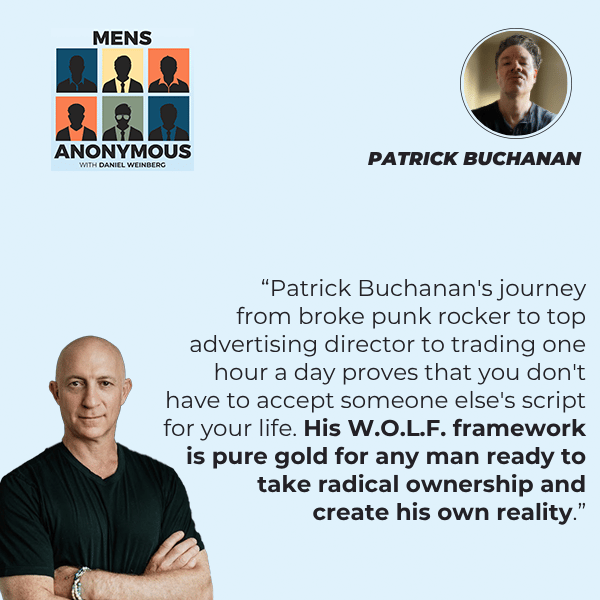
Patrick, it’s so good to have you on the show.
Thank you so much for having me. I’m excited to be here.
I’m excited to have our chat. You’ve made my head think. You talk a lot about an idea that I want to explore, which is that you don’t find yourself. You create yourself. How much can we reinvent? What happens to our fears, our habits, and our need to prove ourselves? Tell me. When you were growing up, what did you think made a man successful? What was the training or the idea that you had about what success was?
Defining Success On Your Own Terms
Personally, I think that I was pretty lucky because I had a very artistic father. My mom wasn’t an artist, but she was a great mom who was loving and supportive. Both my parents were extremely supportive of me. I was lucky because my dad especially was an artist and a hippie. Not a hippie in the traditional sense of long hair and stuff, but he was a very open-minded, progressive type of hippie.
He was very free-spirited. He instilled in me from an early age that you shouldn’t let society tell you what success is. You see all these ads on TV, or you see everybody saying, “This is what makes a successful man.” It was a school of fish type of thought. Back in the ‘80s, everybody wanted to have a BMW and be like Gordon Gekko. He always taught me, “You need to discover what is the thing for you that means success and not let society at large tell you what success is.”
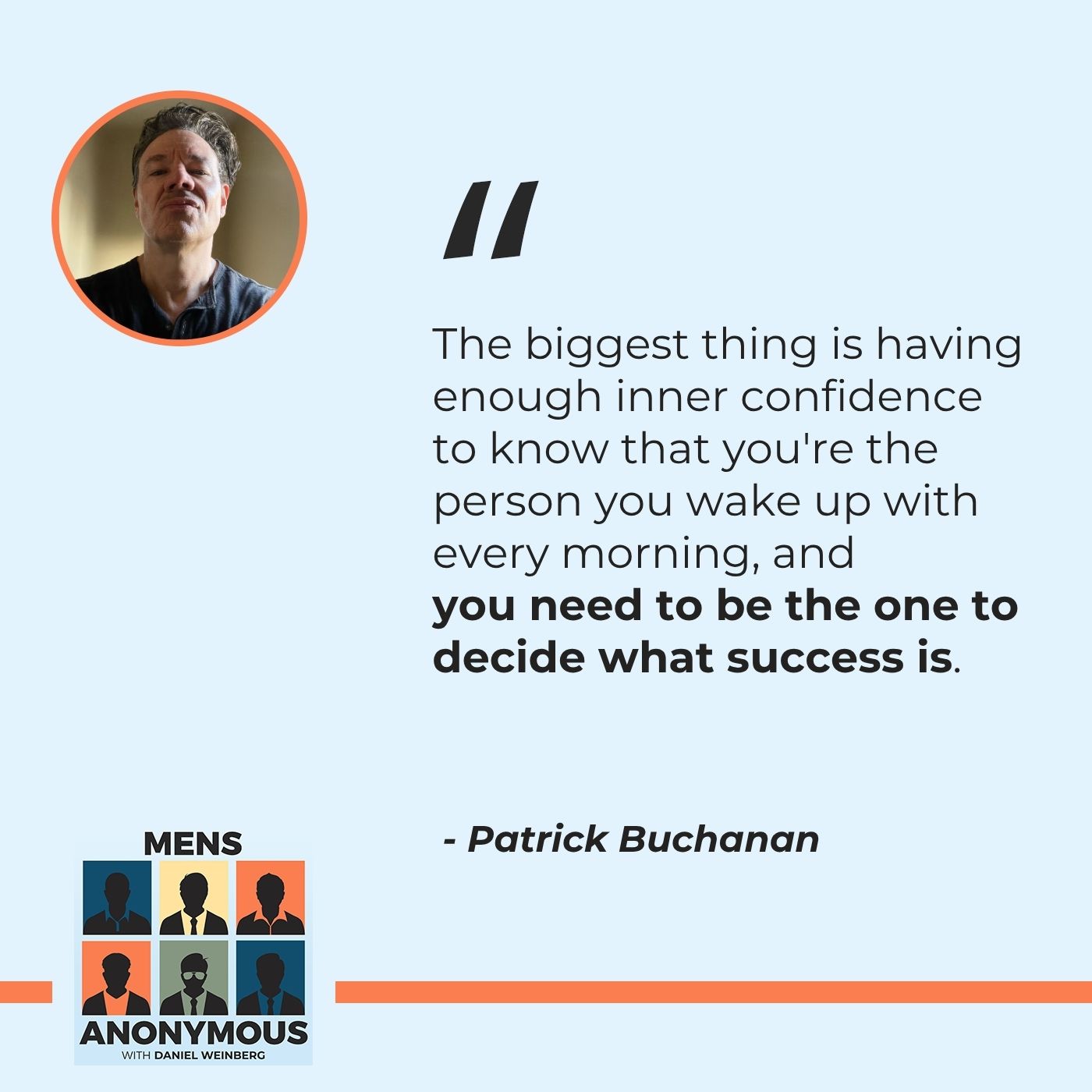
That right there is the cornerstone for everything that I’ve done in my life. The biggest thing is having enough inner confidence to know that you are the person that you wake up with every morning. You’re the person that looks in the mirror. Every time you’re looking, you’re not looking at somebody else in the mirror. It’s you. You need to be the one to decide, “What is success for me?” Take steps to make that happen.
Your first real endeavor in terms of thinking about what you wanted to do, that was music?
Yes.
When artists pursue artistry as their career, it goes a little bit against the grain of what you’re talking about, which is what’s prescribed of needing to work to earn a good living. The measure of success is often financial in terms of the reward that you could receive. Going down something like music or any other artist’s path is very high risk when it comes to that measure of performance.
Your father instilled that confidence in you that you can go for something like that, knowing that there were potential limitations on financial success. What did you think about that as a young man? Did that bother you, or did you go with your heart and say, “This is what fills my cup. I’m going to go for this?”
As a young man, I was not thinking about the future at all. As many young men or teenagers in their early twenties, there was no tomorrow. It’s only now. The fact that I wasn’t born rich and I didn’t have a trust fund waiting for me meant that it was extremely dangerous. I needed to make my own money. I did it anyway because that’s what was in my heart and my soul.
Breaking The Trap Of Material Validation
Another thing about my own personal makeup, which helped this whole path be able to take shape, is the fact that I’ve never been a particularly consumerist type of person in the sense that I don’t need a lot of material stuff to make me feel good about myself. The things that make me feel good about myself are the things that I do and the things that I create.
I’ve written books. I’ve made albums. I’ve lived all over the world. I’ve experienced a lot of things, and I’ve tried to teach people things. That’s all the stuff that makes me feel good about myself. If I have a fancy wristwatch on my wrist, I don’t care about that. Some people do. If you do, that’s fine. I’ve never told anybody, “You should care about this and not care about that.” What you care about is up to you.
I’ve been particularly lucky and fortunate to naturally not care about material possessions all that much, and because of that, I’ve been able to live, get by, and have a happy life without saying, “How am I going to afford my $1,000 a month car payment?” or whatever it might be. The natural way that you’re wired is going to instill the path that you need to take through life in order to get what you need internally. I’m fortunate that my own internal wiring is such that I don’t need to have a ton of things in order to feel happy and successful.
You jumped into music. You didn’t do pop. You went straight for the hardcore. You became a punk rocker. If you look at the spectrum of music, it’s on the more aggressive extreme side in terms of being even non-mainstream. Tell us your experience there going into punk rock. What was your motivation there?
Honestly, early on, my motivation was to escape. I was born in a little town in Nebraska, in the middle of the United States. It’s smack dab in the middle of the US. It was a boring, conservative town.
It’s rural.
It was culturally uninteresting. It’s better now than it was when I grew up there. When I grew up there, there was nothing going on. Most people around me weren’t anything like me. I knew that. Luckily, I found a couple of other guys who were also misfit outcasts who played music. We all liked wild, experimental, noisy punk rock music. We made a band and decided we were going to make records and tour all over the country. That’s exactly what we did.
Don't let society hand you a script for success. Real confidence starts when you look in the mirror and decide what matters to you. Share on XWe did not make a lot of money doing that. I knew going into that, “I’m not going to be a rock star.” I knew from early on, like, “I’m not going to be a rock star,” because I heard what was on the radio, and I knew that our music was far from that. We were never going to sell millions of copies of any record, and I was okay with that because that was what was in my soul.
I had experiences in that time in my life that I would not trade for anything. I wouldn’t trade those experiences for millions of dollars because they were incredible. If you know punk rock at all, you’ll understand the significance of a place like CBGB nightclub in New York City. I played at CBGB on my 21st birthday. That’s the greatest 21st birthday that a young punk rocker could ever have.
We played with Nirvana once when they were completely unknown at a tiny little bar in Omaha, Nebraska. I’ve got so many wild experiences. I had near-death experiences on tour, like the van catching on fire and us having to lean our heads out the windows to avoid dying of smoke inhalation. It was a completely wild time in my life, but that’s exactly what I wanted.
When I was growing up in this little town, I said, “I don’t want to be assistant manager at the local Walmart. I don’t want to be an accountant sitting in an office all day. I don’t want to do any of this stuff.” All these other people that were around me were thinking, “Success is you become a manager out of store.” I’m like, “That’s cool for you. That’s fine if that’s your idea of success. That’s not my idea of success.”
The band was my first opportunity to create the world that I wanted to live in. In the book, The W.O.L.F. Mindset, I’m constantly talking about how everybody has the opportunity to create the world that they want to live in to a certain extent. We can’t snap our fingers and decide who we want to be the president of the country, what laws get passed, or whatever, but we all have plenty of things that we can do individually on a daily basis to say, “I want my life to be more like this. I’m going to go do that and get it.” I kept on doing that throughout my entire life.
Was it one moment you knew you wanted a different life, or did that build slowly?
I never fell out of love with playing music. I still love music as much right now as I ever did at any time in my life. I still play music every day. My 30th birthday was a huge birthday, because on my 30th birthday, I said, “I need to make a real living. I have to retire. I’m going to be old someday.”
There’s one thing about pursuing your dreams and wanting to do something. The realities of life are that you might not own a home or a watch, but you do need to pay rent. You do need to eat food. You need to get by with the minimum requirements or basic essentials of life. You woke up on your 30th birthday and said, “This is getting real. I need to think about what I am going to do that’s going to help me exist in this reality that I live in.” What did you do to transition?
That’s exactly it, what you said. I had my 30th birthday. It was a huge birthday. I said, “I’m going to be an old man someday. I don’t want to die broke.” The next logical thought was, “What can I do as a career that still makes me feel creatively fulfilled somehow? How can I do something that doesn’t feel like it’s crushing my soul, but still allows me to make a decent living?”
Pivoting Careers Without Selling Your Soul
I thought about my own strengths and weaknesses, and I thought, “I’m creative. I know that. I know I’m a good writer. I’ve written my entire life.” I was always a writer. I wrote short stories. I wrote all the lyrics in the band. I wrote all the time. I thought, “What about advertising copywriting?” I know that you can get paid pretty well in the advertising business. Essentially, it’s a way to get paid by brands to daydream all day, create ad campaigns on behalf of brands, and then write scripts and ads, whether it’s a print ad in a magazine or a TV ad. I thought, “That’s the next thing that I’m going to do.”
Did you come up with it yourself, or did you speak to people to give you guidance? Was this something that you worked out yourself? I’m assuming this is the pre-internet era where you can Google what you wanted to do.
The internet was there. It was nowhere close to the amount of social media chaos that there is everywhere right now, but basic search was already a thing. I’ve always liked following the news, and I liked journalism. My first thought was like, “Maybe I could be an actual journalist.” I have immense respect for journalists, but I realized that doesn’t pay at all. That’s a terrible-paying job unless you get some sweet gig at CNN or something. If you’re an average regular journalist at a smaller outlet, you’re not going to get paid a lot of money.
I realized that in advertising and copywriting, you’ll get paid a lot more money, so I went into that. I went to the Miami Ad School, which was the best, respected ad school in the world, and did the copywriting program for a couple of years. In that time, I got to work in different places around the world as part of the internships. I did an internship in Budapest, Hungary at DDB, which was incredible. I did another internship in Manila, Philippines at BBDO, which was also amazing.
Once I graduated from that school, I got hired and bounced around all over the world at different agencies. At one point, I worked in Moscow, Russia for almost a year, which was crazy. That was when Medvedev was the president. It was bizarre then. I wouldn’t even attempt to do it now. Not at all. Back then, it was wild. Now, it would be crazy to try to do the same thing, but I did it. I worked all over the world. I worked all over the U S and many different agencies. I had a good decade-plus in the ad business before I transitioned over into day trading.
I created the world that I wanted to live in for the first time with the band, and then I said, “I need to make some money. How do I do this?” I created the world that I wanted to live in for the second time with advertising. Once I started to think, “I don’t want to have a boss anymore. I want to make my own money on my own,” I did it again and transitioned into day trading stock options for a living. That’s where I’m at right this second.
Before we go there, you’ve written a couple of books, and I want to talk about them. I want to start off with The W.O.L.F. Mindset and how you came to that. I’ve read the intro to The W.O.L.F. Mindset, which I found completely fascinating. Most personal development books tell you the same thing. They’re like, “Find yourself. Discover your authentic self. Uncover who you were always meant to be.” The W.O.L.F. Mindset rejects that premise entirely. That whole industry of, “You need to find yourself,” you say, “You don’t find yourself. You create yourself.” I want you to explain that idea in plain English. What does creating yourself involve?
Why You Must Stop Trying To Find Yourself
That’s a great question. To back up and start from the beginning, the find yourself aspect is a very beautiful thought in a romantic way. When you think about finding yourself, it’s hippie-dippy, like, “I’m going to go on a vision quest and discover who I am. I’m going to take Ayahuasca and sit in a river and a canyon stream for a while. I’ll be Jack Kerouac on On the Road and get in a car and drive somewhere where you’ll figure it out, and you’ll have this divine inspiration.” It’s beautiful in a romanticized way, like a fantasy, but the reality is there’s no guarantee that that’s ever going to happen.
You’re making the assumption in this journey of finding yourself that you will ultimately find yourself. What you’re saying is that finding yourself doesn’t necessarily end up with that ultimate state.
You don't have to stay stuck in a soul-crushing job. Audit your natural strengths and turn them into practical market value. Share on XExactly. I’ve traveled all over the world, as I know you have. You’ll take trips, and you’ll discover things about yourself on those trips. You will have those inspirational type of moments or the big light bulb moment about something. That’ll happen, but you can’t count on it happening. You can’t guarantee that it’s going to happen.
What you can guarantee is if you do an honest self-assessment and say, “Who am I? What do I want? What’s happening in my life?” and you’re honest with yourself, you can write stuff down and take stock of who you are and where you are. You can then say, “Who do I want to be? Where do I want to be?” You can create the person that you want to be and create the life that you want to have to a certain extent.
We were talking a few minutes ago about how certain things are simply beyond your control, and you can’t change them in the world. It’s the difference between taking on the responsibility and letting go of the idea of, “I’m going to wait to be inspired by some divine force,” and saying, “I’m going to be the source of my inspiration. I’m going to inspire myself and create the person and the life that I want to have.” That’s it in the simplest terms.
The W.O.L.F. Mindset, so the audience understands, is not necessarily the wolf as an animal. The W.O.L.F. stands for something. What does the W.O.L.F. mean?
It’s an acronym that stands for Willpower, Order, Love, and Fidelity.
This is the framework in which you prescribe how to create yourself. Give the audience a sense of what they can do that’s actionable using that acronym. Break down each of those letters and explain what they can do to get into, “I’m going to create for myself, not find myself.”
Mastering The Four Steps Of The W.O.L.F. Framework
The acronym flows. One aspect flows into the other chronologically. If you have any type of dream in your life to do something, first of all, you have to start with Willpower. That’s the most important first step. It’s you deciding, “I’m going to do this thing. I have this dream. I want to do whatever it is, whether it’s to start a new business, get a new relationship, move to the other side of the world, learn a skill, or anything.” It’s your first spark of what you want to happen.
You’re saying the first step is you need to think about the thing or multiple things. Whatever direction you can go in, it’s got to feed your soul. It’s got to fill your cup. It’s something that you want to do.
It’s got to be truly your own desire and not a desire placed in you from somewhere else. I say this in the book quite a lot. I taught advertising. I would get a lot of people in my class who had entirely different careers before they came to advertising. They would say stuff like, “I did the other thing because my parents wanted me to.”
I had all kinds of lawyers in the school where they were like, “My parents wanted me to be a lawyer, so I became a lawyer. I quickly realized I hated that, and I didn’t want to be a lawyer. Now, I’m here.” The first step is, is the thing that you want to do because you want to do it, or is it based on external pressure from somewhere else?
I often have conversations with people, particularly younger folk, who will say, “I don’t know what I want to do.” You’re talking about the Willpower to pursue the thing you want to do. How do you work out what that is you want to do?
That’s a great question. There are a number of ways to gauge the strength or weakness of an idea, but the first one for me is how effortless your desire is for that thing. How much do you want to do it? If it’s truly your inner desire, you shouldn’t need any help trying to make that happen. For example, when I was younger, I fell in love with music. I got my first acoustic guitar on my 12th birthday, and then I got my first electric guitar on my 13th birthday.
It never felt like effort. It felt like fun. Is that what you’re saying?
Nobody ever had to tell me to practice my guitar. Every single waking minute of my day that I wasn’t doing school homework, I was practicing my guitar. Nobody forced me to do it. That’s a good initial assessment of whether this is a thing that flows naturally to you, whatever it is.
It’s what activity you do in a day where you enjoy it, and it doesn’t feel like you’re making much of an effort. It could be anything you’re saying. Once you find that, you can use that as the base that you can work out what you can do with it. With cooking, you might say, “Maybe I’ll get into catering or become a chef,” or, “I want to get into the restaurant business.” It starts with a love for, “I love to cook.” That’s what you’re saying.
It goes back to that old saying. This is nothing revolutionary. It’s the old saying of, “Do what you love, and you’ll never work a day in your life.” It’s basically that. It’s you looking at yourself and saying, “What do I do that requires no nudging from anywhere else because I want to do it?” That’s the first step. You use your imagination and your self-assessment to say, “What do I do that’s effortless?” That’s number one.
You put that into the Willpower framework and say, “How can I turn this into a thing that’s a career or something bigger than a hobby?” Anybody can do anything, and it can be a hobby. When you turn your hobby into an actual career, that requires a bit of Willpower in the sense that you need to think about putting the pieces together. You can’t just manifest it in your mind. You need to put the pieces together.
The Willpower angle is deciding what you want to do, and then saying, “What do I need to do in order to make this happen?” That leads into Order. The Order part of it is the components of it. You can’t do anything in a chaotic way. You’ve got to put it together and figure out, “I need to do this and that in these particular steps. Step 1, step 2, and step 3.” It’s got to have a structure.
The Order part is the structure. The Willpower was the basic spark. You’re like, “What do I want to do? The Order part is like, “How specifically do I get started on doing that?” You then get into the Love angle. Love is remembering why you want to do the thing and remembering all of the people in your life who are helping this thing come to fruition, whatever it may be. Nobody operates in a vacuum.
Can you give us examples that you use in the book to represent what that L for Love is? Explain what that means in practical terms in terms of how you choose the creation of yourself using Love.
For example, if you were trying to start a business, and it could be any business whatsoever, when you get to the Love part of it, it’s like, “What’s the thing that’s driving me here?” Get into remembering why it is that you got into this in the first place. By the time you’re at the Love phase of a progression, there are going to be some setbacks.
It’s not all dream state, like, “I want to start a business. I’d love to do business.” Then, you get to the, “I’ve got to do this. This is how we’re going to structure it. This is what the business plan is,” and all the practical stuff that’s going to make it work. Then, it’s like, “I love this particular industry or sector.” It’s not going to be without its blow-ups, challenges, obstacles, issues with employees, issues with a third party, and paying the bills.
That’s exactly it. That’s the stage where you’re going to have some setbacks and some resistance. You’re going to have pain points, whatever it is. That’s where you need to remember, “why am I doing this?” It’s where you go, “what’s the why here?” There’s a part in the book where I talk about protecting your light as being so important. That’s an element of protecting your light and saying, “This is tough. I’ve got this resistance here and there, but I need to remember why I’m here.” That’s the Love angle. If you do love a thing that you’re doing, then you’ll be stronger than whatever the pushbacks are that are coming up against you.
Finally, the Fidelity part is a continuation of love in the sense that you need to be faithful to your own vision. When most people hear the word Fidelity, they think about being faithful in a relationship way, as in don’t cheat on your wife or whatever. This Fidelity is being faithful to your own vision of the dream that you’ve created and worked up until this point. You’re at the end of like, “We’re about done here. We’ve almost created this thing.” Respect it. Respect the thing that you’ve built. Don’t cheat on yourself.
As soon as things get a bit difficult, don’t jump ship.
Don’t cheat on yourself. Don’t give up your own idea of what you wanted to have happen in your life because you ran into a couple of setbacks or whatever. That’s the whole thing with Willpower, Order, Love, and Fidelity in that order. You can apply that framework to whatever big thing you want to try to accomplish and go step by step.
You talk a lot about positive thinking. When does positive thinking culture get wrong? You’re critical of the positive thinking culture. Is that correct?
I wouldn’t say that I’m across the board critical of positive thinking because I do employ positive thinking all day, every day. The one thing that I have a problem with with so much of this manifest your success type of thing is they position the manifestation almost as the finish line. My premise is that that’s the starting line.
Explain what you mean by that.
I use this example in the book also. If you’re in Miami and you decide that you want to take a road trip and go to Disney World in Orlando, you can’t simply sit there and say, “I’m manifesting myself being in Disneyland.” It doesn’t work that way. First, you think, “I want to go to Disneyland,” and then you go, “What do I need to do? Am I going to drive my car or am I going to fly there? When I’m there, how many days am I going to stay? Am I going to stay in a hotel? Am I going to rent an Airbnb? Am I going to go to the park for 1 day or 2 days?” You don’t sit there and go, “I’m manifesting myself being in Disney World.”
Treating Positive Thinking As A Starting Line
In the whole positive self-help space, you can’t sit here and think, “I’m going to think positive thoughts, and everything good is going to happen to me. I’m going to imagine myself being successful, and then I will be successful.” To me, that’s completely ridiculous. It’s not ridiculous to say, “I’m imagining myself being successful.” That’s essential. You have to imagine yourself being successful, but that’s the starting line. That’s not the finish line.
If you present the manifestation as the starting line, then the next thing is like, “What do I need to do specifically to make these manifestations of my dreams become the reality?” That’s where the work part comes in. You’ve got to do the work. It’s like anything in the world. If you think that you’re overweight and you want to lose some weight, you can’t say, “I’m manifesting myself losing weight,” and then you immediately go to McDonald’s and never go to the gym. It’s straight up logic. First, you manifest what you want to happen, and then you do the work required to make that thing happen.
You talk about feedback loops. Take us through one that used to run your life. What triggered it? What’d you do? How did you reinforce that problem?
That’s a good question. There are a couple.
Explain to the audience what feedback loops are and how to recognize them. Walk us through it.
A good example of this is that not enough people understand the idea that no one else can decide who you are. A lot of people allow themselves to be defined by what other people say of them or what their job is. You think, “I do this as my job. Therefore, that’s what I am.” In the world, it’s different than that. I use this example in the book as well.
If 100 people take a look at a red convertible sports car and you ask those people, “What is that that you’re looking at?” every single one of them is going to say, “That’s a sports car. It’s small. It looks sexy. It’s got no top. It looks like it can go 200 miles an hour.” Nobody is going to look at that vehicle and say, “That’s an SUV.” If somebody did look at that vehicle and say, “That’s an SUV,” you’d go, “You’re crazy. That’s not an SUV. That’s a sports car. It’s obvious.”
A dream needs structure to survive. Channel your willpower into clear order, protect your purpose with love, and stay faithful. Share on XWhen you look at yourself in the mirror, no one else has the power to determine what you are at all. You’re the only person who has the power to determine what you are. Therefore, if you look in the mirror and tell yourself, “I can never do this or that. I’m terrible at learning languages. I could never learn how to speak Spanish,” or, “I’m terrible with money. I could never make money,” or, “I’m a loser. I’m never going to have a relationship that makes me happy,” if you look at yourself and say those things, that’s what you are.
It’s self-reinforcing. If you keep telling yourself those things, it becomes a reality because it becomes reinforced.
The self-fulfilling prophecy idea. You have to start from a place of optimism. There are plenty of things about the world that don’t make me feel optimistic from a global perspective, but still, at the same time, I have to look at myself in the mirror every day and say, “I’m going to make this life as amazing as I can make it. I’m going to succeed with what I want to do.” That’s your starting place. That’s what creates feedback loops.
If you start with a type of loop of like, “I will be successful. I will be able to do the things that I set out to do,” you’re starting from the right place. You have to do the work. You can’t sit there and be like, “I’m going to think positive thoughts, and then everything great will happen.” That’s an example of a positive feedback loop that you get yourself into rather than looking in the mirror every morning and saying, “I’m a loser. I could never do this or that.”
I’m going to ask you for an example. Let’s take a man who feels quite inadequate. He works constantly to prove his worth in a pretty average job. He becomes distant at home with his wife and/or his kids. He feels worse about himself. If you were to give him some guidance, what’s the first behavior that he could change to get himself out of that scenario?
I feel like there are a lot of men out there who are living that life I described. They feel like they’re on the treadmill. They’re not enjoying being on the treadmill, but they don’t feel like they can get off. I’ll have conversations with guys, and they’ll say to me, “What do you want me to do? I’ve got a mortgage. I’ve got kids at school. If I don’t do this, all that stuff falls away.” They feel trapped. What I’m asking you is, how do you get them to get out of that loop?
That’s a rough spot to be in. I know for a fact also that so many guys are in that place. You even see this in advertising where there are so many ads that are built on the idea of the guy being unhappy with his life or being led around, almost as if he’s like on a leash. His wife is controlling him or whatever. Those tropes are replayed over and over in advertising all the time. You know that’s a reflection of reality because advertisers are always trying to play on what is a real thing and then use that to sell their product.
Dismantling Burnout One Piece At A Time
It all comes back to your own self-reflection of what truly matters to you. Honestly, if you get yourself in a place where you feel like you can’t get out of it, the best thing to do is to not try to look at the entirety of your life as one thing. Look at it piece by piece. If the career is not going the way you want it, look at the career specifically and say, “What specifically about the career do I not enjoy? Is there a way to either change careers altogether or to get out of this idea of like, ‘This one specific thing is not what I enjoy. Therefore, I’m going to change it up.’”
I could use myself as an example here. By the time I was well into my advertising career, I was managing other people. I had a handful of people that I would manage in every single one of my jobs. I pretty quickly realized that I did not like managing people and doing all of the business stuff of advertising, like creating budgets, doing proposals, and stuff like that. I didn’t like that aspect nearly as much as I liked writing.
When I started out, I was writing. I wasn’t the creative director. I was the writer. Then, I moved up, and I became the creative director. Certain things about being the creative director are great. Most importantly, you get paid more money. That part was awesome, but I didn’t like the fact that I had all this extra business type of stuff that I had to deal with.
If I were to ever go back to being in the advertising world again or trying to get more work in advertising, I would want to step back and take less money in order to have less responsibility of managing other people, having to do budgets, and all that stuff that I didn’t enjoy doing at all. Maybe you can’t do that. Maybe you can’t afford to take a pay cut, so that sort of thing would be off the table for you. It’s looking sideways and saying, “Is there anything that’s a lateral move where the skills that I have right now are still going to apply to this other type of position?” That’s one thing.
In your relationship, it’s important to simply let the person that you’re with be their true selves. I’m not saying that you should never ever try to have input into who they are because we’re always shaping each other all the time. If you’re in a relationship with somebody, you’re shaping them, and they’re shaping you because it’s an exchange of energy back and forth. It’s an exchange of ideas all the time.
You have to start from the place of being very honest about who you are, number one. Number two, you have to genuinely like the person that you’re with. If you don’t like the person that you’re with, I don’t think that there’s a way to save that. It’s like table stakes. If you don’t like the person you’re with, what’s the point?
A lot of guys might fall into this trap. I’ve done this at times in my own life when I was a lot younger, and I was a little bit more superficial about things. You might have a girlfriend, and you think, “She’s so beautiful and so sexy,” but you don’t like the big aspects of her personality. You’re with her because she looks so good or whatever. You can’t do that. You have to genuinely like the person that you’re with.
If you find that you’re in a relationship and you’re having a lot of problems, you have to start by saying, “Are we both being very honest with each other about who we are?” After you open yourselves up and put it all on the table, like, “This is who I am. These are my strong points, weak points, strengths, weaknesses, and all of it,” then you look at each other and go, “We like who we are as people.” That’s a foundational thing. You’ve got to get that part right first. Once you get that part right, then other things are going to be less structural problems and more specific problems.
I feel like that exercise should be done earlier on in the relationship, not deep into it when you’re crashing.
I’m going back to a thing that you should be doing way back in the beginning. If you’re already way into it and you’ve got some problems with your partner, but you do genuinely like and love each other, at that point, everything can be figured out with a structural analysis. Don’t look at things in an emotional way. Look at them in a structural way, like, “What specifically can we do to try to fix these specific problems?”
What spun me out with you was punk rock, advertising, and then the last one, which is the 25-plus year career in financial markets, specifically with options and derivatives. There you are, writing a book called Secrets of the Lone Wolf Trader: How to Make a Six-Figure Income in Five Hours Per Week, Day Trading Stock Options.
Feeling trapped in your routine? Don't view your whole life as a monolith. Break it down piece by piece and fix what doesn't fit. Share on XHow do you go from career paths such as punk rock and advertising to a completely different one like trading? I do agree there is some creative thinking when it comes to trading and options, but predominantly, it’s very much mathematically driven, numbers, and the other side or the different part of the brain. Talk us through how you got to that.
That’s a funny story. I can thank COVID for that happening. Although COVID was horrible for countless reasons, for me personally, when COVID hit, that’s the thing that allowed me to lean into the trading. At that time, when everybody started to work remotely, I was living in the Central Time zone of the United States, but the company that I was working for was on Pacific Time.
It was two hours earlier, but then the stock market was one hour later. What that meant was that by the time that everybody started working in the Pacific Time zone, like 9:00 AM Pacific, it was 11:00 AM Central Time. That means it’s already 12:00 AM Eastern Time Zone. I had all morning completely free that whole time that we were doing the work-from-home thing.
I saw a YouTube video about somebody day trading stock options, and I was like, “What is that?” I fell down the rabbit hole and started learning and teaching myself. I started watching videos about it, reading books about options trading, and I started doing it. I started doing it in the morning, and then I would transition from my trading into my normal work.
After a couple of years of doing it and becoming good at it, I suddenly realized, “I’m making as much money trading in the 1st hour of the day as I make in my entire salary of working 10 hours a day doing advertising.” Then, I thought, “This is crazy. Why even keep doing a job when I could make the same money in one hour per day?”
It was one of those moments where it was a leap. It’s a total leap of faith. I thought, “I’ll be giving up the 401(k). I’ll be giving up the health insurance. I’ll be giving up the guaranteed salary, but I think I can do it.” I went for it, and it worked. Once I started doing that and started realizing that it was working, then I said, “Let me write a book about this. Let me make a video course teaching other people how to do it.”
I’ve written 2 books about day trading, and I’ve got 2 different video courses about it. I’m running a daily live room. In the first hour of the day, I and whoever wants to join are there in the room. I drive the bus, but it’s an interactive type of thing where it’s a YouTube live stream. There’s chat functionality. If other people are there, saying, “Nvidia popped,” and I’m not talking about Nvidia, I can see it on the chat, and I can go, “Let’s take a look at Nvidia right now.” We all trade together. That’s been incredibly successful over the last couple of months as well.
That’s wild. My head is spinning.
It’s pretty crazy.
You’ve gotten to a place in your life from punk rocker to working one hour a day, making a living, and a good one at that, and helping others do the same thing. It’s a bit of a crazy story. What do you do for the rest of the day?
I try to enjoy my life. I make a lot of music. I play in a couple of bands. I make a lot of my own music here at home. I love to do photography. I love to travel. It has been a while since I’ve gone on a big trip, but I went to Kuala Lumpur, Malaysia, and Thailand. I also train Muay Thai all the time. I’ve trained Muay Thai in Thailand seven different times at camps. I sometimes spend up to a month at a time living at the camp and training Muay Thai every day. I do that.
I’ve started to do one-on-one coaching with other people as well. I only take on people that I like, respect, and think that I can help. That’s another little aspect of things. If somebody says, “I want to be able to afford another yacht because I’ve only got 2 yachts and I need 3 yachts,” I don’t want to work with that person. If somebody has a vision for their life, and I respect them, and I think that I could help them, then I work with people one-on-one as well. I’m doing all of that.
Hats off. You’ve certainly created your own path. No doubt. You’ve accomplished so much and experienced so much, which is what life is about. To tie it all together, what do you think connects punk rock, advertising, options trading, and book writing? Weave a common thread there. What would you say the learnings are that connect all those things together?
The first word that comes to mind is curiosity. I’ve always been curious about the world and about everything and everyone in it. I’ve tried to use my imagination throughout my life to say, “What’s next? What’s the next thing that I’m going to do?” You don’t necessarily have to feel like you are a part of any one tribe. It’s very specific that I called the book Secrets of the Lone Wolf Trader. I consider myself a lone wolf in the world, not that I don’t get along with other people, because I love talking to other people. I do consider myself a sociable person, but I don’t consider myself a member of a tribe.
A lot of people are very quick to say, “I’m this. I’m that. I’ve got this group that I fit in, and my group gives me security.” I’ve never needed or wanted a group to give me a type of security. When I was playing music, there were a lot of musicians I met where I thought, “You’re a terrible person,” not like I had everything in common with every musician that I ever met. There are a lot of people that day trade stock options that are completely shallow, vapid, materialistic people that I have nothing in common with. It doesn’t mean that I don’t love day trading every day.
The idea that you can only be a limited number of things or a limited set of things is very restrictive and limiting to me. The core has always been curiosity and imagination about life and the world. When you do that, all of these things, even if they seem like they have nothing to do with each other, can be very easily connected.
It sounds to me like your life is very rich.
I think it is. I’m grateful for that.
It’s amazing. Thanks for sharing all your experiences and your perspectives. There are a lot of great learnings there. Well done to you.
Thank you.
Before we finish, I always ask my guests five questions, which I’m going to ask you to respond to. They’re Rapid-fire questions. I’m going to shoot. First one, who would you like to say sorry to, given the chance?
Probably a couple of ex-girlfriends from way back in my early twenties. I’d have to say I’m sorry to them.
What are you proud of being or doing in your life?
I’m proudest of being a person who has lived a truth that I’ve created for myself. I’m proudest of being able to have the courage to know who I am and what I wanted to do and go and do it.
When did you receive kindness while needing it most but expecting at least?
That’s a very deep question. You’re putting these on me on the rapid fire. That had to have been in the past when I first realized that I wasn’t going to be a lifelong musician. That was a bit of a soul-crushing moment. At that point in my life, all I had thought about myself was, “I’m a musician. I’m a creative person. I can’t do anything else,” so I was crushed when I realized I needed to do something else.
My mom and my dad both gave me a lot of kindness, trying to lift me up and saying, “You don’t have to be a musician. You can do these other things.” They were very supportive of me when I said, “I want to learn advertising and do this other career.” They were all in. They had my back. I didn’t know what type of response I would get, but it was nothing but love and kindness at that moment. That has to be the answer to that question.
Coming back to your parents, what’s something your mother or father taught you that you frequently remind yourself of?
There are so many for both my mom and my dad, but the one thing that comes back so much of the time is my dad used to always like to say, “Sometimes, the things that you own end up owning you.” It was a thing that he said quite often. He was notoriously stingy. He never liked to spend any money on anything. The only thing that he ever spent money on was his record collection and his stereo system. He had a gigantic stereo. He was a classical music fanatic. He had every single classical composer. He had thousands of records.
He taught me the value of internal worth and not external worth. It’s the idea that you could have fifteen cars and you could be a very shallow, hollow type of person, or you could have very few material possessions and be an incredibly fulfilled, whole type of person. When he said, “Sometimes, the things that you own end up owning you,” that is a thought that I go back to frequently.
Finally, what’s your superpower?
My superpower, honestly, is believing in myself and not allowing myself to get shook off of my dreams. At every single turn, there were so many things and so many people who have said to me either explicitly or implicitly, “This is never going to work. You can’t do that. You’re not this type of person. This will never work.” I always said, “If I want to do it, I’m going to do it.” Self-belief and self-determination are probably my superpower.
That’s amazing. Thank you. I appreciate it.
Thank you so much.
I’m looking forward to more of your work out there. Such a variety of things that you’ve accomplished and things you’re writing about. It’s completely fascinating. Well done to you.
Thank you so much. It was great talking to you. I enjoyed myself.
Likewise.
Important Links
- Patrick Buchanan
- Secrets of the Lone Wolf Trader: How to Make a Six-Figure Income in Five Hours Per Week, Day Trading Stock Options
- The W.O.L.F. Mindset
- On the Road
About Patrick Buchanan
 Patrick Buchanan has spent his life doing things that don’t go together on paper. He grew up in Omaha, Nebraska feeling like an outsider, started a band at 16, landed a record deal, toured nationally, played CBGB’s on his 21st birthday, and once sat in a room with a then-unknown band called Nirvana. He went on to spend two decades as a creative director at agencies including Saatchi and Saatchi, BBDO, and Lowe Campbell-Ewald, writing campaigns for Jeep, Grey Goose, Mercedes-Benz, and Pepsi, including a Cannes-shortlisted Super Bowl spot starring Bob Dylan.
Then he quit. He taught himself to trade stock options, now works roughly one hour a day from anywhere in the world, has trained Muay Thai in Thailand, and has lived in Moscow, Manila, and Budapest. He wrote The W.O.L.F. Mindset to share the framework behind all of it: a philosophy drawn from Stoicism, Buddhism, Taoism, and esoteric tradition that starts with one premise. You don’t find yourself. You create yourself.