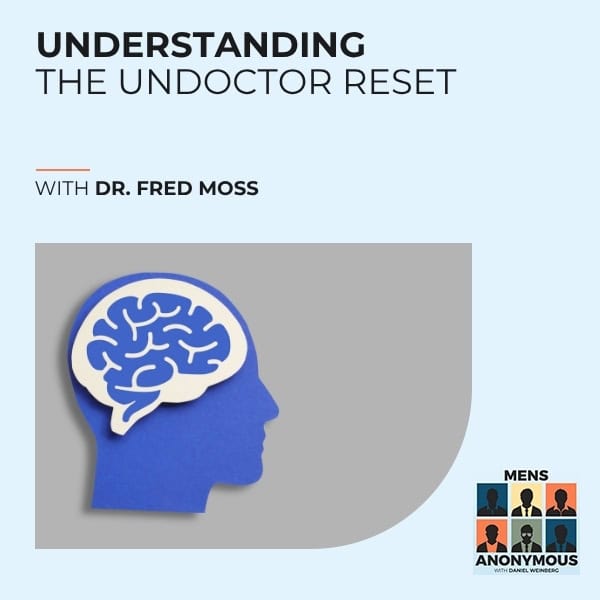
Men are often suppressed by society to never talk about their emotions or inner thoughts, and it is their mental health that suffers the most because of it. Dr. Fred Moss, a seasoned board-certified psychiatrist, shares how his so-called undoctor reset can help put an end to this stigma. He discusses how mental health issues are just a matter of self-awareness and perception, and how labeling yourself as a broken person actually shapes your lived reality. Dr. Fred also breaks down practical ways to achieve a healthier mental state without entirely depending on medication, from quieting the mind through meditation to speaking positive affirmations to yourself every morning.
—
Watch the episode here
Listen to the podcast here
Understanding The Undoctor Reset With Dr. Fred Moss
Welcome to the Movember series of Men’s Anonymous. Movember is a global movement that runs each November to raise awareness and funds for men’s health issues, specifically prostate cancer, testicular cancer, mental health, and suicide prevention. On this episode, we’ve got The Undoctor. What if your diagnosis of mental health was never real? We speak to Dr. Fred about men’s mental health.
Dr. Fred, so great to have you on the show.
Daniel. It is an honor and a pleasure, and a privilege to be with you. It’s great to see you. Let’s go.
What It Means To Be Undoctored
Let’s go. As you all know, I’m doing a Movember series. Movember focuses on all men’s mental health and men’s particular conditions such as prostate cancer, testicular cancer. In this episode, the reason why I really wanted to have Dr. Fred on the show, because Dr. Fred is The Undoctor doctor. He takes the approach to mental health, a very different way to what I have been exposed to otherwise. I thought it’d be super interesting to dig in and understand Undoctor Dr. Fred’s journey on how he got to his protocol or his method in dealing with mental health in general, and in particular, men’s mental health. Why don’t you kick off with what does it mean The Undoctor doctor?
Thank you. I just call myself The Undoctor, not The Undoctor doctor, just to be specific. You know what it means to be an Undoctor, more or less, anyone can do it. You honestly don’t need a license, and you don’t need years and years of education to be an undoctor. You don’t need to go to school. You don’t need anything but who you are. You need your heart and your soul. You need a little bit of compassion, some understanding, and a willingness to harmonically and resonantly connect with another person. That’s the whole idea of undoctors.
We all know that when we go through the world just hoping, wishing, praying, like wanting someone or a group of people to understand us, to connect with us, to resonate with us, to get us. When that happens, there’s a tremendous explosion of healing that takes place in that very second. The level that happens, the level of healing that happens when we connect, far exceeds anything I’ve ever seen in medicine anywhere at all, and certainly far exceeds anything I’ve ever seen in the mental health field.
For men, it’s especially interesting because men have so many barriers between themselves and connecting to other men. We have whatever we’ve been raised with, all the concerns that we have, our worries, our fears, our resentments, maybe our anxiety about being with other men and not trusting or not realizing that we have a man here who can be delicate, who can be kind, who can be compassionate, who can listen, who can be present.
Most of us just fear this other kind of man. That somehow, we’re going to open up ourselves and we’re going to be stomped on by some brute or something, and have our feelings hurt or have our hearts broken. Therefore, we have taken on this idea that when dealing with, or speaking to, or trying to connect, if you will, the other men, there’s only a limited number of topics that we can talk about.
Sports we can talk about, music we can talk about, women we can talk about, but as far as our own selves, as far as what’s happening internally or what’s going on with our basic selves, coming to grips with our core concerns and then sharing them with another person, men tend to be untrained in that area.
Why do you think that is? Reasons being, I’m just going to throw it out there, things like shame, the feeling of being perceived as weak or not a strong masculine, virile man. Where do you think this come from?
Yeah, I think you’re right. I think that early on, we’ve been given all these images of what a strong masculine, virile man looks like, and crying or whining or complaining, or in fact, even getting in touch with that tender underbelly of ourselves, is not highly encouraged early on. It’s like, “Toughen up. Man up. Stand up or pivot up,” the idea being that we don’t have access to our own tender feelings in a way of sharing them with others.
The truth is, we certainly have tender feelings. All of us men have tender feelings. We just don’t have access to communicating them effectively. We do what we can to sweep away the tender feelings so that we can be on the front edge and be tough, and be strong, and be virile, and don’t cry and don’t whine, and don’t be sad and don’t be scared. All those things that we think is part of what we’ve been trained through television, through media, through maybe our parents or our older sibling, what it means to be a man.
Even men have tender feelings. They just do not have access to communicate them effectively. Share on XWhat it means to be a man is not to indulge ourselves with all of these tender experiences, but instead, be tough and strong and roaring and growling and farting, and all those things that are man-like and we just have not been programmed in that direction. Our default is not to share with other men. Other than those circumscribed topics like sports, drugs and alcohol, and then women and music. Those are some of the topics that you can be pretty sure the average so-called man would be willing to interexchange with you.
As far as your concerns, your feelings, your worries, your resentment, your discomfort, your tenderness, that takes a little bit more courage to want to share that with another man because I think we’ve been programmed to be fearful that we’re going to be stomped on or smothered when we speak our truth about our tender selves.
What the undoctor does is really recognize that, seeing that if you’re having trouble communicating with someone, that’s not your fault. If you’re having trouble negotiating and navigating this crazy world of yours, that’s not your fault too. To do Krishnamurti, he had said, “It is no sign of mental health to be well adjusted to a profoundly sick society.” That’s what we’re talking about here. We don’t blame a log for burning in the fire because that’s what logs do in a fire, but we give ourselves heat for burning inside of the culture that we’re living in.
We don’t realize that the culture itself is nearly impossible, if not impossible entirely, to negotiate effectively. We don’t give ourselves the opportunity to see that we’re all bumbling, we’re all stumbling, we’re all tumbling through life, and none of us know what it means how to live life adequately. There’s no recipe book, there’s no template, there’s no owner’s manual to this.
We go through life and we get kicked around pretty hard inside of our being. It’s hard. It’s challenging. There are a lot of obstacles to being alive. We, as men, somehow have a little cork in a bottle about willingness to share our underlying concerns, including concerns of being hurt or worries, regrets, resentments, etc.
Why Mindset Is The Problem, Not The Medications
The repercussions of having that cork in the bottle leads to, I guess a lot of these men’s mental health issues that we see, where we see things like suicide rates going up, depressed, morbidness, etc. You have a very strong position on the diagnoses of mental health on the spectrum, ADHD, and bipolar. I’d like you to try and help us understand your position on and where that comes from.
I’ve been a psychiatrist for about 36 years. In 2006, I did something radical. I was really sick and tired of giving people diagnoses and giving them medications, because I feel like both of those are traumatic and damaging in their own right. Once we start feeling like we have a diagnosis, we’re basically agreeing that we’re afflicted, we’re affected, we’re defective, we’re different, we’re ill, we’re somehow deficient and we have a syndrome, something like this. That causes a lot of difficulty.
Same thing with medications. I haven’t seen medications do what they’re marketed to do for the most part. Before we go too far, let’s speak to your crowd who are really happy with their therapy and with their treatment plan and with their medications, and they wouldn’t trade it for the world. To all of them, I just say, by all means, please keep doing what you’re doing. If you’ve reached a space where you wouldn’t trade something for the world in your life, good for you. That’s amazing. This life doesn’t often offer that experience. If you have that going on, I’m not suggesting that medicines are wrong for you, or that your therapy or treatment plan, it doesn’t fit you.
This is really a conversation for the hundreds of millions of people who don’t have that experience going on, who are feeling undiagnosed, underdiagnosed, untreated, overtreated, mistreated, undermedicated, overmedicated, mis-medicated, etc., and want to understand what’s going on. The medications have always been an issue for me. I was pretty sure they weren’t doing, in fact, what they were marketed to do.
In 2006, I had a couple of thousand outpatients in my practice, and I began to take many of them off their medications with their consent. I took them entirely off the medications that they had been on for months and, many times, years and they got better. All of them. They got reliably and profoundly better, like predictably better. In most cases, their diagnosis actually disappeared in that process. They no longer had what they thought they had that they were thinking they needed medicine for.
Their diagnosis dissolved. This was an indicator of course, that the medications weren’t doing what they were counted on to be doing. In fact, they may have been inducing, increasing or perpetuating or even causing the symptoms they were marketed to treat. This was a problem for me. Once I started getting people off medicine, I wanted to scream that from the mountaintops like, “Yeah, I took people off medicine and they got better.” I wanted to tell everyone.
I had a violent impulse to go to the top of the mountain and just shake everybody, like, “Stop doing this because we’re making people worse.” That doesn’t work to be violent. It doesn’t work to scream to have a rant from the mountaintop. People weren’t really listening to what it was I had to say. I had to chill a little bit.
What about your peers, like psychiatrists within the industry that are your peers, when you would broach this subject?
They know I’m right. I don’t get very much pushback. They know I’m right. They wouldn’t take the medicine, I bet.
Isn’t that interesting?
They wouldn’t dare take the medicine that they prescribe. They know better. They know it causes lots of problems. If they just want to be open and interested and honest about it, of course, they know that. They know the stuff is powerful and that it causes many issues. They wouldn’t take it on a bet. They wouldn’t give it to their children. That isn’t how it worked.
This is what we’ve been taught by the companies and by the industry and by school, and even by the insurance companies. We hear what we hear. The problem is the medications are not the problem. The diagnosis is also not the problem. The industry, big pharma, that’s not the problem. Doctors, they’re not the problem. Insurance companies, that’s not the problem. Authorizations, pharmacies, that’s not the problem. None of those things is the problem.
The problem, as I backed off and tried to find a calm way to introduce this to the public, the problem is that people don’t come to a psychiatrist to find out if there’s something wrong with them. They come to a psychiatrist to find out what’s wrong with them. They have already determined in no uncertain terms that there’s something wrong with them by the time they show up behind the door. Once you show up knowing there’s something wrong with you, you’re only coming for confirmation.
A confirmation and a solution. “Tell me what to do with my problem.”
Not even a solution, because these people really don’t expect a solution, because we all know these medicines don’t cause a solution. Even the medicines don’t actually promote themselves or market themselves as a solution to a problem. At the very best, they’re marketed as containers or slowing down the deterioration that’s inevitable. When we are diagnosed with a psychiatric condition, we don’t think it’s going to go away. We think that we now have it, and now we have a greater propensity for relapses, for instance.
We think we have a condition and now we’re saddled with it because we had it once, we’re going to have a greater chance of going down that same rabbit hole. What if none of that is true unless we call it true? In other words, it’s just a passing phase in reality, and it doesn’t represent a diagnosis. Psychiatry is the only field that I know of in all of medicine where if someone comes to my office for an initial evaluation, and I let them know that I think they’re good, that they’re okay, they get pissed. They don’t want to hear that they’re okay.
In fact, when they say that they’re okay, they say things like, “Why would I come to see you to hear that?” If you go to an oncologist, if an oncologist tells you you’re okay, you’re pretty excited. If a cardiologist tells you you’re okay, you’re down. If an orthopedic surgeon tells you you’re okay, you’re like, “Cool.” If a psychiatrist tells you you’re okay, you’re like, “Quack. I’m going next door. I’m going to go find my doctor who knows there’s something wrong with me.”
Why is that?
Without being derogatory, I think the primary reason for that is we all have an interest in relinquishing the responsibility for the parts of our lives that aren’t going as well as we wish. We all do that. In fact, I’ve already made several mistakes today. It’s only early in the morning, as you know. If I could blame you for any of those mistakes, I would do it in a second. It’s your fault. If I didn’t have this show, I wouldn’t have had to hurry and trip over myself and spill my tea. It’s your deal. What we do is we relinquish the responsibility for the parts of our lives that are not going as well as we wished, or you’re clumsy or we’re sad or worse, maybe resentful or regretful or blame and shame, like you talked about before, feel guilty.
When we get saddled with a diagnosis that we then agree to take on into the world, like ADHD or PTSD, or social phobia or anxiety, or major depression or bipolar disorder or autistic spectrum disorder, when we start getting those alphabet soup diagnoses, we can say something like, “That’s not me. That’s my condition. That’s not me. That’s my ADD. That’s not me. That’s not PTSD. That’s not me. That’s my ASD, that’s my BPD, that’s my BAD, that’s my schizoaffective disorder. That’s my GAD, that’s my MDD.” We get that we have, in some ways, a place to go to explain the areas in life where we’re not performing at the highest level.
Are Any Of The Alphabet Soup Diagnoses Real?
Let me ask you, do those conditions exist, though?
They obviously exist because you were talking about them. They exist. People treat them as if they exist, then they exist. The only reason they exist is because someone has given them a label, and other people have agreed to follow that label. What if none of us actually have an inherent condition? You have one condition, Daniel. I actually have been watching you during this whole talk, and I am confirmed that you have one condition.
What’s my condition? Alive?
Are you ready? You’re getting close. Your condition is Daniel Weinberg.
Yeah, it is.
That’s all you’ve been and that’s all you are and that’s all you’re going to be. You’re Daniel Weinberg. That’s your condition. You don’t have something called major depression. You don’t have something called generalized anxiety until someone tells you do and you agree to take it on. Now you have it. Let’s talk a little bit about this an analogy I like to use. Let’s say you came into my office and you’re like, “Doc, I got some things going on I’d like to understand. My skin is gray. My nose is too big. I drink too much water. I eat too much peanuts, and I’m a mess in a China shop.” I start looking in my book. I’m like, “I got it. I got your diagnosis.”
You cannot have major depression until someone says that you do and you agree that you have it. Share on XYou’re like, “It’s so exciting. You’re the best. Tell me what it is.” I’m like, “You’re an elephant.” You’re like, “Cool. That explains everything. I’m so excited. I’m an elephant. No wonder I can’t hang out in a china shop. No wonder I drink so much water. No wonder I’m addicted to peanuts.” When you walk out of my office now, sure that you have a diagnosis, “I’m very excited that we have an explanation for all these weird qualities that you have,” when you walk out, guess what? You’re looking for a circus. You’re looking for chains. You’re looking for elephant stuff all of a sudden. Your diagnosis is real to you. In fact, you bring it home and you tell your family, “I talked to this great doc today, and he told me what was wrong with me. I’m an elephant.”
Your brother says, “Dude, you’re not an elephant.” You feel bad for him. You feel bad for your brother because he just doesn’t know. You know. A doctor already gave you that diagnosis. He just doesn’t know. He is uninformed, under-informed. He should be more informed. Want to know why? It’s because he’s your brother and he might have genetic qualities that have him at risk of being an elephant too.
You start worrying about him that maybe he’s going to miss the diagnosis that he should have because you’ve seen him be a mess in a china shop, too. You feel bad for him or maybe you just feel like he’s just wrong or he doesn’t know yet. You walk around and you’re pretty sure now that you walk around like you think an elephant should walk around and the world starts treating you like a man who thinks he’s an elephant.
That’s how the world treats you. Why? It’s because that’s what you’ve described yourself as. Once you’re carrying that diagnosis, then you come back to the doctor, let’s say in a couple of weeks, and you’re like, “I found out a couple of things. I’ve got a couple of other conditions. Is it associated? I have big ears, really big ears, and I have a great memory. It does add on.” I’m like, “Yeah, you got elephant type two. It’s a very rare condition. You’re a little bit different. You got a special case.” You’re like, “Yes, I’m a special case now. I don’t just have elephant. I got elephant type two. That’s exciting. That explains my whole life. Now, when I look at elephants inside of the encyclopedia or something, I’m pretty sure I’m one of them.”
The truth is, psychiatric diagnoses usually get developed after the treatment itself gets developed. The medication gets developed, and then the diagnosis is developed shortly thereafter to deal with that medication. The medications are not designed to actually cure anything. They don’t even market or promote themselves to do that.
They’re designed to squelch some particular feelings, perhaps for a short period of time, and then increase, induce, perpetuate, create or sometimes actually cause the symptoms they’re marketed to treat. When we start looking at that that’s what the medications do. We start looking at the damaging effects of thinking there’s something wrong with us when maybe we’re not.
Maybe there’s nothing wrong with us at all. Maybe like a log burning in a fire. We’re having trouble and we’re clumsy and we’re confused about how to deal with the onslaught of stimulation that we get every single second in this world, and we don’t know how to do it. We’re clumsy and we’re tripping over ourselves, and we’re saying things we didn’t really want to, and we’re mean sometimes, or we get thoughts of hopelessness or helplessness or terror or anxiety. It’s very easy to pick up a psychiatric seemingly psychiatric set of symptoms. For instance, Daniel, if me and you decided to go on a project here and come up with 100 reasons why we should be depressed, how long would it take us? Maybe like four minutes between the two of us.
Yeah. Not long.
How about anxiety? About four minutes. How about terrified? Maybe three minutes. How about hopeless? There’s no shortage of reasons to be uncomfortable in this world.
How The Paradigm Shift In 1987 Changed Psychiatry
Explain to me. I’m 51 now. This is just what it feels like to me. It feels like to me in the last, let’s call it, I’m going to be generous, last twenty years, I feel like the proliferation of all this, there are so many different types of diagnoses. There are so many types of conditions. There are so many more people that you hear about who have these.
They don’t have them. They’ve been told they have them.
They claim to have these. How did this happen?
The real paradigm shift happened in 1987. Prior to 1987, it didn’t look like this very much. It looked different. It was like psychiatrists and mental health workers were actually designed to speak to somebody and get to what’s going on in their real world and maybe connect with them. It isn’t like psychiatry was that much better then. I don’t want to shine a light like that. I just want to say that that was the purpose of psychiatry until 1987. By the time I decided I wanted to be a psychiatrist, that’s what the world looked like in front of me. At that time, that’s what I thought I was going to be taught how to do, communicate and connect with other people.
In 1987, there was this massive shift that took place and that was with the inception and the introduction of Prozac. Prozac started in 1987. That green and white capsule changed the world drastically. Most people don’t recall or aren’t old enough, or don’t know that Prozac was on the cover of Newsweek all by itself. Just a picture of the pill. That’s it.
In that article, it talked about how it might be the panacea for all human concerns. The idea was that they might even put it into the water system in Los Angeles and New York. They were hoping that this would be the thing that people would take. All of a sudden, psychiatry, which isn’t true, none of that is true, of course. We haven’t seen the world become tremendously mentally healthier, as far as I can tell. I haven’t noticed the world becoming healthier.
On the contrary, I think it’s going the other way.
It’s possible, in fact, that these psychiatric medicines are, in some ways, a culprit in our mental health getting worse because there are so many people who have decided to take medications, and maybe these medications actually make you worse. That’s the whole thing. If they do make you worse, they make you worse because you have a diagnosis. The medicines were given to you because you have a diagnosis because you took on a diagnosis.
That’s why you have to have a diagnosis in order to prescribe a medicine, so you have a diagnosis. Just on that point, people don’t realize that every single time you go to a psychiatrist, you get a diagnosis. There’s zero chance of you walking out of a psychiatrist’s office without a diagnosis and it’s never going to go away.
Now it’s in your chart and it’s there forever. Not that you should be afraid of that, but it has an impact. We don’t get paid unless we give you a diagnosis. If we say that we saw you and you didn’t have a diagnosis, then the insurance company won’t pay us. A hundred percent of the time, even on your first visit, you walk away and your doctor doesn’t have to tell you he put a diagnosis, a psychiatric diagnosis, into your chart. He wouldn’t get paid otherwise.
Looking at the diagnostic aspects of this, we start realizing that if we take on our diagnosis, if we become our diagnosis, then it’s because we thought something was wrong with us, but we’re back to that same space. What if, even though you’re uncomfortable, and even though you’re tripping over yourself, bumbling and stumbling as a man in this crazy world, like a man with other women, or a man with children, or a man with ourself, or even a man with men where there’s a significant amount of internal strife and pain just in walking through the world, we start really seeing that maybe all of those experiences, uncomfortable as they are, just represent normalness inside of the human condition?
When we call ourselves defective, even if we have this new equation that Prozac put forth with the whole notion of biological psychiatry, biological psychiatry and chemical imbalance theory suggests that there’s something uncomfortable in your world, it’s because you’re chemically unbalanced. We already know that life is extremely uncomfortable.
We look at Buddha, he sat underneath that tree for a number of days, and then he figured out a lot of things from under that tree. We still watch that and follow it and read it and listen and share it. We really appreciate Buddha. One of the things that Buddha did is he got up from his tree. When he was done, he decided, “Time to go out there and bring my stuff.” One of the things he was unable to resolve was the idea that life is suffering. He walked away. That’s one of the tenets of Buddhism is that life is suffering. He did not resolve that. It’s here, dude. It is here for real. It’s been here the whole time. It’s going to be there the whole time. It’s okay to suffer. I’m not wishing suffering. I’m not telling you to get up off your bootstraps.
The reality is that when you walk through life, it’s not all rainbows and fairies. There is very difficult times, difficult times, average times, good times, great times. There’s a whole rainbow of experiences you’re going to have. It’s not all great. Just because it’s not great doesn’t mean there’s something wrong with you. That’s what I’m hearing.
Right. That’s the undoctor approach. There’s nothing wrong with you, but we have things that can lead to greater comfort or lead to greater steadiness or lead to greater alignment, leading to greater stability and optimization. We do have some things that can do that and things not to do. Be careful what you take into your system. Be careful what you watch. Be careful what you listen to. Be careful what you eat and taste.
Be careful who you’re with because those things really do affect the mood or the context of how you’re living life. We can show you what not to do. Be careful what you eat, like for real. Be careful on what you’re drinking. What about gratitude? Are you showing gratitude to what your life is every morning? Are you waking up and listing ten things that you’re grateful for? I find that to be so effective. Are you getting outdoors enough?
Practical Ways To Improve Your Mental Health
What I’m starting to hear is you have a particular approach or protocol in introducing the patients you want to unpatient, let’s say. You just started mentioning a few things there. For readers, what are some of the easy things that they can do and walk away from this? Are there things that they can do that can improve their mental health and well-being in general? The first thing you mentioned is obviously diet, which having a healthy diet, I guess, is on the list.
Eating real foods is a good idea. Eating stuff that can’t be metabolized. Eating stuff that was made in the laboratory and has nothing at all from nature in it, you might want to double-check that one at the door. The more organic, the more earthly, the more clean your food is, it is the better off you’re going to be. I’m not saying that you need to eat vegetables and fruit only, or seeds and nuts only. I’m not even saying that you need to eat meat and eggs only. You just eat whatever you eat. If it’s really clean and then you monitor yourself and hold yourself to your own values, like why are you eating in the first place?
Are you eating as a function of your psychiatric concerns, of your psychological concerns? Are you eating out of boredom, of loneliness? If you do that, you can check that at the door too, because eating is a sacred act to keep this body alive, to keep this body going. It’s a sustainable act. What we eat and what we drink is really critical.
Of course, when we put something into our body, it truly does become us. It’s pretty important. If we’re going to eat a breakfast of Cheetos, what we’re going to have to understand that that’s going to have an impact. We had pizza last night. There are a couple of pizzas left in the morning, they’re cold. I love cold pizza in the morning. I think most dudes do. I love cold pizza in the morning, dude.
If I order a pizza and there are a couple of pieces left when I wake up, I’m all over that stuff. It might not even be bad for me. In that situation, pizza is it’s probably in the middle of the road as far as at least food that is edible and not too damaging. We start really seeing it’s not just our diet, it’s our gratitude. It’s our relationship with nature. It’s our meditation.
Are we sitting still in silence every day so that we can gather our wits about us and start realizing that we are not our feelings, we’re not our emotions, we’re not our sensations, we’re not our circumstances? You can get that only through meditation, as far as I can tell. Sitting still, sitting open, finding our mantra, holding ourselves up and just sitting quietly and exploring and watching our thoughts, feelings, and emotions go by, letting them go by and coming back to center.
Meditation offers some incredible viewpoints from which to see the world and start seeing that we are not those things. We have those things, but they’re not who we are. Meditation is a great one. Another one is creativity. Music, dancing, singing, drama, cooking, writing, gardening, these things were even one minute a day doing those things can be remarkably uplifting.
The other space is good as self-pampering. Are we taking care of ourselves? Are we getting that hot bubble bath? Are we taking those nice, sweet walks? Are we getting ourselves massages? Are we getting ourselves foot rubs? Are we doing and being with ourselves as if we are the VIP royalty that we really are in our lives?
Are we being kind to ourselves? Being kind and compassionate is also part of the package, as is being involved or creating relationships with other people. Having authentic conversations with other people from the core of ourselves, sharing things with other people in a way that is very authentic and very genuine. That’s also part of the Moss Method.
The Moss Method is twenty things that I’ve compiled that actually work to give people increased comfort. I don’t really mean to nitpick here, but it’s important when you said better mental health. It’s not better mental health. It’s more comfortable. Perhaps it’s a little bit less uncomfortable, but there’s not better mental health. The idea is that even when you’re in loads of pain and wishing that it would end, that doesn’t mean you’re in poor mental health. That just means you’re having an extremely uncomfortable experience right now.
Even when you are in loads of pain, it does not mean you are in poor mental health. Share on XWe’ve already been through the idea that there are countless reasons to be uncomfortable in the world. I’m shocked that I’m somehow able to contain myself with all the shit that we have to deal with every single day. That I’m somehow able to contain myself and have a reasonable conversation with you even right now is stunning to me. There are so many reasons to be completely messed up.
It really is. I think the world is more and more fucked up, to be honest.
There’s like an infinite number of reasons.
It makes sense to me that there are a lot more people out there having a tough time.
Of course, they are. There’s nothing wrong with that. We don’t blame a log for burning into fire.
You also mentioned there you have a routine of writing ten things that you’re grateful for. Do you do that in the morning when you wake up?
Actually, I say it out loud. I put my hand on my heart and I say ten things. I say my morning prayer. I have a morning private prayer that I say first thing in the morning. The next thing I do is I put my hand, or both hands on my heart and I say out loud ten things that I’m grateful for. It could be anything, for sure. I’m lying next to my wife, so I always say her name first because she’s here with me. I say Alexandra and then I go maybe my cats. I have these three amazing cats that teach me how to live. They pretty much taught me everything I’m saying here in some ways.
Cats know how to get this stuff done. I have three great cats who seem like they get it at a level that I’m envious of. They teach me. They’re my homeschoolers. They’re number 2, 3, and 4. Sometimes they’re in a group, they’re number two. I might go to the sun and the moon, and then I might go to my food. I might go to my friend, my mentor. I might go to podcasting, might go to the internet, might go to technology, might go to my car or the health or my parents or my siblings, any of those.
Your Doctor Does Not Know More Than You Do
It’s not hard to come up with ten things pretty quickly. I’ve now started off my day looking at the things that are going well instead of falling down the rabbit holes that are always here. I can always jump down an endless rabbit hole to hell. I can definitely do that, and so can you and so can they. If I do that, and I choose to stay in that space, and then I go to a doctor and I tell them, “Life is hopeless,” here I go. Now I got my diagnosis. Now I got a medication. I’m going to get worse over time and I’m going to think that it’s me getting worse rather than the medicines actually causing me to get worse.
I’m going to continue to take medicine because doctors are not trained to discontinue medicines. Doctors are only trained to add, increase or change your medicines. If you come in and you started some medicines and a really common second visit complaint is, “Doctor, the medicines actually help, but I’m worse.” It’s like, “How could that be? What are you talking about?” “It helped for a short period of time, and now I think my symptoms are back and they’re even a little bit worse.”
Doctors are not trained to discontinue medicine. They only know how to increase or change your medication. Share on XWhat people don’t realize is that’s exactly what you should expect by the second visit, because that’s the way the medicines work. They actually do progressively make you worse while giving you an initial hint that maybe they’re hiding or getting rid of the untoward symptom in the first place. Instead of antidepressants getting rid of depression, what they do is get rid of all emotions, including depression.
That makes you numb, basically.
No, I wish that it were numb. If it was numb, it wouldn’t mean it was getting worse. If all they did was numb it, that would be fine.
What is it doing?
It’s adding to it. It’s increasing chemically your tendency to become depressed. In fact, it’s messing with the receptor sites in such a way that the medicines are causing the symptoms are marketed to treat. The truth is, it’s not the medication’s fault. You can’t blame medicines. Medicines are a thing. They’re not a lie. I tried to callthe medicines the other day and I couldn’t find them in the phone book. I tried to call Big Pharma to blame them. No phone number.
It’s because of these things that don’t really exist. They’re made-up stories. The reason we’re taking medicine has nothing to do with the fact that a doctor ordered it for us. The reason we take medicine is because we choose to take medicine. When we start realizing that with our own sovereignty, we’re the ones putting medicine into our mouths every single day. “The doctor told me to that.” So what? Every morning, the doctor’s not forcing you. If you don’t want to take medicine, then literally, you don’t have to.
No, I understand. The individual is having the tough time, and there is a domain expert that you go to. You are the doctor, you know what to do.
That’s bullshit. That’s the whole point.
I can understand why people listen.
That’s the whole point. That’s the whole illusion, that somehow, I know better about you than you. I don’t think so. It doesn’t matter how much education I have, I don’t know better about you than you. It doesn’t matter if I’m Sigmund freaking Freud. It doesn’t matter if I’m Jung. It doesn’t matter if I’m the Wizard of Oz. I don’t know more about you than you do. There’s no way that you can tell me that I do. However, like you just said, we relinquish responsibility. We’re going to go to an authority who’s going to tell me how I work.
I give you medicine which are designed, literally, to give you the diagnosis that it’s marketed to treat. When that medicine hits your system, because you’re choosing to take it, you are thinking you’re following orders and you’re being a good patient. In fact, what you’re doing, it’s like a razor blade inside of a Band-Aid. A Band-Aid might numb it, but a razor blade inside of a Band-Aid would make the condition worse.
It would block the bleeding for a short period of time, and then blood would start oozing out the side of the bandage. When you come to the doctor and you have that going on, and the doctor and you both agree that your condition must have gotten worse, certainly not that the Band-Aid that caused it, let’s get it. It’s just a freaking Band-Aid. If we’re unaware of the razor blade that’s embedded in it, then we’re going to think that the condition got worse. When the condition gets worse, it would be absurd for the doctor to actually decide not to put a Band-Aid on it ever again because they don’t realize, and neither do you, that the Band-Aid are actually perpetuating the condition.
The fact that a Band-Aid or the idea that a Band-Aid causes a worsening, oozing only leaves the doctor three options. Add another Band-Aid, increase the size of the Band-Aid, or change to a different type of Band-Aid. That’s all we have. We don’t have to remove the Band-Aid because it’s causing damage. We’re not taught that way. We’re taught to slip around.
If you come into my office worse in a second session, stopping your treatment altogether doesn’t seem like a sound idea, except there’s only one condition where it would be a sound idea and that would be when the condition is that the treatment is causing any worsening of the symptoms. That is exactly what I’m suggesting is going on.
The whole thing is based on one important feature that we’ve already been through a couple of times. If you or the patient, the client, the customer, the recipient of my special care thinks that there’s something wrong with them. If we got to the point where we really began to deal with each other, like there’s nothing wrong with that other person. They just got to be who they got to be because they got to, even if they’re doing stupid stuff or mean stuff or bad stuff, these are just people who are doing what they think is the next right thing, given the life that they’ve had.
It starts being a little bit tricky, of course, because they’re there are really bad people out there. There are people who are doing bad things, and I’m not suggesting that get over it. They’re just doing what’s right for them. Although when we start conversations with the idea that we are lateral, two human beings negotiating the world separately and together, then we create a grounded tendency toward mutual respect.
Going back to what this conversation is really about, that’s what men need. Men need to be able to look at each other and see that we’ve had our own wounds, we’ve had our own traumas, we’ve had our own experiences, we have our own fears. We have our own heartbreak. We have our own wishes, dreams, and desires. We have our shadows, we have our lust, we have our impulses. We have all these things going on. That’s part of being men.
In order to get that with each other, my deep suggestion is to see each other not as one person having less than you or more than you, but having something eye to eye in a lateral way like they too might have nothing wrong with them any worse than you do. Maybe there’s nothing wrong with you, nothing wrong with them, and nothing wrong with her and maybe it’s just going the way it’s going. Life is what it is. Diagnoses in and of itself actually perpetuate their own existence.
How Men Can Be Men By Simply Being Themselves
Do you facilitate men’s groups as well? What’s the work that you do with regard to trying to encourage men, as you described earlier in the conversation, to really connect, to open up, to share, to take the proverbial cork out of the bottle and just allow it to flow?
I love working with men. I love being in my own men’s group. I’m not a leader of a men’s group right now, but it isn’t about being a leader. If I were a leader, all I would do is facilitate. I’ve been a leader periodically. All I would do is open the space for men to realize that this is just a group of men and no one is bigger or better than the other. These are just men working at what it means to be a man in a very difficult time to be a man, by the way.
Why do you say that?
The whole self-image and the image of society about the toxic masculine or about dumbing ourselves down or feminizing ourselves or making ourselves lose our teeth and lose our fierceness and lose maybe our aggression and lose our assertiveness. It’s difficult to show up as a man in this field because there’s so many disempowering and impactful, intrusive things going on in the world in what we eat and how we’re seen and how we’re written about how we’re seen by women. There are also men and out there who are scorching the name of what it means to be a man. When men are doing damaging things, we then all have to face what they did and own it as a brotherhood.
It’s very difficult. There are high expectations of what a non-toxic man can be or what a snag is or what are some ways of being a man that make any sense, rather than just rolling out with what’s really so. I don’t need to know what it’s like. I don’t need someone to tell me. Theoretically, I don’t need someone to tell me what standards I have to meet to be a man.
How about if I’m just myself? If I’m just myself, I guarantee that’s being a man. There it is. I don’t need some standards. “I should open the door for people or I should wash my car every day, or I should make dinner three times a week.” That type of menu item or instructions is not required. The way to be a man is to simply be yourself and guaranteed, you’ll be a man.
Answering Five Rapid-Fire Questions
Dr. Fred, thank you so much for your insights and your outlook on what it means to be a man and to be the individual that we all are. Before I finish every episode, I ask my guests a list of five questions. I’m just looking for what comes to mind first. I’m going to shoot. First question is, who would you like to say sorry to, given the chance?
The mother of my babies. My first wife.
What are you proud of being or doing in your life?
I’m proud of owning my core values at 67 years old to be able to talk like I’m talking. We’re all humans. In the face of all this nonsense, being a star, being a light at the tunnel for others, no kidding, this is all true. Nobody here is really going to argue with what I’m saying. I’m only saying that nothing is more powerful than a human connection. It’s all I’m really saying. I’m not saying anything else. I get it. There’s stuff out there that’s powerful, but ultimately, all I’m really a stand for is that there’s nothing more powerful than a human connection. I love being that guy.
When did you receive kindness while needing at most and expecting it least?
I would probably say the kindness while needing at most and expecting at least occurs more often with my present wife, my wife, Alexandra, than anywhere else. Sometimes I’m such an asshole. Sometimes I’m just such a blockhead. Sometimes I’m so silly or so misled and somehow, she more than puts up with me. She actually is kind and loving in the face and my clumsiness and I certainly didn’t expect it.
What did your mother or father teach you that you frequently remind yourself of?
Only do things that you can sign your name to afterwards.
Finally, what is your superpower?
I think my superpower is to be able to communicate effectively with people all the way from the crack house to the mansion.
Dr. Fred, thank you so much for coming on the show. It’s been a real honor and look forward to talking again.
Yeah, let’s do it. Thank you for a great conversation, Dan.
Important Links
About Fred Moss
 Dr. Fred Moss is a psychiatrist, speaker, author, and transformative coach with over 40 years of experience redefining mental health. Known as The Undoctor, he challenges the traditional medical model and empowers individuals to reconnect with their true voice, break free from labels, and heal through authentic expression and human connection. A Northwestern-trained physician, Dr. Fred has treated over 30,000 patients and has served as an expert witness, telepsychiatry pioneer, and consultant across various healthcare systems. He’s the founder of the Welcome to Humanity movement and creator of the Undoctor Reset™️ program. A sought-after podcast guest, Dr. Fred has been featured in over 100 shows and is the author of Creative 8 and Find Your True Voice. He invites listeners to reclaim their sovereignty and rediscover that they were never broken, just waiting to be heard.