
Do you know how to build a reliable buddy system to navigate life’s transitions? In this episode, we sit down with academic and renowned friendship expert Dr. Geoffrey Greif to uncover why men lose their friends and how to cultivate a more resilient social network. Dr. Greif, author of Adult Sibling Relationships, breaks down the historical and structural differences between side-by-side male bonds and face-to-face connections. Together, we explore his four categories of friendship—must, trust, rust, and just—to help you evaluate your own social circle. If you are struggling to build deeper connections or simply want to understand the dynamics of modern masculinity, this conversation offers a practical roadmap for finding your tribe and reclaiming the camaraderie that sustains us.
—
Watch the episode here
Listen to the podcast here
Why Men Lose Their Friends — And How To Rebuild A Modern Buddy System With Geoffrey Greif
Breaking The Silence: The Reality Of Modern Male Loneliness
In this episode, we have Dr. Greif, where we talk about why men lose their friends and how to rebuild a modern buddy system.

Dr. Greif, it’s so great to have you on the show.
It’s great to be here, Daniel. Thank you.
I’m excited to talk to you. You have been focusing on the structure of male friendships for many years. You’re a worldwide expert to be honest. I don’t think I’ve ever come across too many academics who have done as much work as you in space. It’s a real honor to have you here. I’m going to dive in. You’ve studied male friendships for decades. Are men lonelier now or are just more aware of it?
That’s a great place to open up. We have to look at men both in relation to their family and men not in relation to your family. Whenever somebody says men.
Are we talking about father or brother or are you talking about male friendships?
Are we talking about men who are in their twenties in their zoom room by themselves, on their sofa, communicating that way while playing games with other people. Other men, or men that are by themselves and just going online. Are we talking about guys in their 30s, 40s and 50s with a spouse or family or anything else? Whatever we say men, we’re all going to have a different image, all of a sudden, pop up. It’s important to clarify that we talked about men that are working, not working, or men in relationships with other men or women or not.
I’m personally intrigued about male friendships in particular. When I say that, this platform is about inspiring men to reach out and develop open deeply connected relationships so they can form their tribe. In doing so, it helps them come into their true masculinity, etc. I want to focus on male friendships and then, let’s break it down. Let’s say being in long term relationships, have lived some part of a good part of life.
I’d like to focus on men at my stage and how they were let’s say 25 five years ago, in terms of who you deem to be lonelier. I also want to talk about the phenomenon of those young men coming through the ranks at the late teenage years going into young adulthood. You mentioned young men playing games online, which didn’t exist 25 years ago. Why don’t we talk about those two groups and maybe help us understand whether we are lonelier now or we’re just more aware of it.

I’ll give a short answer. We’re more aware of it. We’re more willing to talk about it. Men, in general, are more willing to be vulnerable than their fathers were/are. There’s certainly a trend to greater acceptance of the other or of others in the world, certainly in parts of the Western world that are approaching. There’s much greater acceptance of men that are gay, men that are bisexual, men that are non-binary and men in all kinds of different choices that they have decided to pursue in addition to those other descriptors that I just gave.
We’re more willing. We’re more open. More people are more willing to go for therapy. Which means more or less stigma around mental health issues. Women certainly have been pushing us for many years, if we’re involved with women in an intimate way. They’re pushed us for many years to be more open physically and emotionally. I’m not necessarily saying that is the correct thing to be for every man. We have to give men the freedom to decide how to navigate that space. Certainly, if you open up the fact that men are more willing to explore their own feelings. You’re going to open up both more joy and more loneliness and sadness.
Everything gets out on the table and that’s the best way to begin to unpack this. Are we more lonely or are we more willing to express that loneliness? By expressing it, are we in fact connecting with others who are often feeling that way? It’s a little bit of this and a little bit of that. It’s the easy or complicated answer to your profound question.
Shoulder-To-Shoulder Vs. Face-to-Face: The Evolution Of Male Friendships
How are male friendships fundamentally different in structure from female friendships? That would be a good place to start the discussion to understand the structural dynamic of male friendships.
Historically, and even currently, we have what is easily called men have shoulder to shoulder friendships and women construct face-to-face friendships. This doesn’t apply to all men, but it means that men want to get together and do things together facing outwardly, like, “Let’s get together and watch sports. Let’s get together and play sports.”
We’re not as comfortable as women. “Let’s get together and talk to each other face to face over a glass of red wine in this cute new French restaurant that opened up around the block. Let’s meet for coffee.” We’re more willing to be for coffee than wine. Essentially, men have always gotten together side by side, if we want to go back to caveman times.
If you open up the fact that men are more willing to explore their own feelings, you're going to open up both more joy and less loneliness and sadness. Share on XI was just about to ask. Is that something that’s genetic? Is it the environment? Why is that?
The men were/are physically larger and stronger. If you want to protect your tribe, protect your herd, protect your village, you’re going to have people going out shoulder to shoulder. That’s a better form of protection than you and I walking out, looking at each other. If we go to hunt a saber tooth tiger, we better be shoulder to shoulder and not face to face. We might want to be back-to-back, but we are definitely not looking at each other.
We’re looking around to say, “Where do we get that beast to bring home for dinner?” While the women are taking care of children around the fire or around the village. They have to look together at each other. We have to look outwards. Whether or not that’s what is going on now, it’s more fun to think about that that’s where the history of this. The wars have been thought of physically until recently only by men and they are working on a side-by-side approach to the world. It’s fascinating.
Male friendships begin at a very young age like preschool, primary school, etc. If I was to think personally about my own experience. I grew up in Australia. The community existed within a pretty contained area. It’s a village style, let’s say. It’s like New York, with 12 million people. It’s like living in a smaller area, where we exist. You make your friends in primary school. Your friends that you have in primary school tend to maybe morphine a little bit when you get into high school.
They change again when you get into college. You have your college friends. They change again when you enter the workforce. They change again when you end up getting married and you have other couples your age. They change again when you have kids, because you start mixing with the friends and kids. Let’s say you relocate and travel.
I’ve relocated to multiple places. You move away and you start forming different bonds in the new area. I’ve settled and you maintain maybe some of those old friends, but they start moving into categories. It’s like my friend from childhood or my college friend, etc. I want to talk about the lifespan or maturity of male friendships in general. What percentage of male friendships survive a life transition? What I just described then.
Life Transitions: Why Friendships Fade And How To Pivot
If you’re going to live in a small town, you’re more likely to sustain them than if you live in a large place or a large city or if you move as much as you do. There are two ways of thinking about this. Let me throw two different disparate ideas. One is Aristotle’s definition of friendships that we could talk about.
Let’s talk about the definition of friendships as well.
Let’s also talk about the fact that we all grow up. The challenge of life is how do you grow up and stay connected to your family of origin yet form a new family. How do you balance that? Typically, heterosexual people will grow up, and they will have a spouse. They will have children, but when they have their spouse and their child, they’re forming a new family. How do I stay connected to my family of origin and my wife stay connected to her family of origin as we grow up?
The challenge of life is how do you grow up and stay connected to your family of origin yet form a new family. Share on XThere’s the issue of time. In my early twenties, if I start to date my future wife, do I have to put my friends aside because I don’t have as much time for them? It’s because I’m spending more time with her. I’m spending more time at work and then I’m spending more time with my kids. At some point, maybe at your age, when children no longer need us to drive them to the store or the mall and our jobs are secure enough. We’re not floating around in this economy. Who knows? Our marriage or relationship is secure. All of a sudden, I’m going to have a lot more free time. I’m not watching my kids play soccer anymore.
They’re often college or whatever they’re doing. All of a sudden, I have free time. I may then begin to reach out again to my male friends, but then that takes away time from my wife, my family and our couple friends. When do I have time for myself to pull up my guitar and work on my jams? They’re all these different conflicting things. They pull up two friends and say, “I need some friends in my life because the doctors said I’m not healthy. I need to get out there more. I better find a tennis partner.”
There are all these things that are imploding and exploding in terms of how we find the time. If I say to my wife on Monday night, “Why don’t we go out with Daniel and his partner on Friday?” She may say, “Why don’t we spend our time just the two of us?” We’re always trying to balance these two competing ideas or many competing ideas about time. That’s part of it. How do you grow up? Stay connected to your family of origin, to your new family that you formed maybe 30 or 20 years ago. Still have time for yourself and for your friends.
If we want to get into a definition from Aristotle. This goes back to your question and you may not agree with it and I don’t agree with all of what Aristotle says. Number one, friendships take a huge amount of work and a huge commitment or it’s not a friendship. You can only have a few friends because if they take up time, you can’t have 40 friends. We may not agree with that.
The 4 Friendship Buckets: Must, Trust, Rust, And Just Friends
I look at like this as another theory. It’s that concentric circles. You might have your five max in that first circle. The one you’re the most connected to and they just go out. They get wider and more people fall into those categories. You can call it whatever you want. In terms of like best friend group or a close friend. It’s a good friend or you can say they’re good acquaintances. They’re the people I enjoy spending time with. I see the world as everyone has concentric circles. The first concentric circle might have one person it.
In my book, I call those you must friends. We have four groups of friends, your must, your trust, your rust, and your just friends.
Let’s talk about that. There’s a good place here. Walk me through the way you break it down and define each of those categories.
Let me finish up with Aristotle. You can only have a few friends. Friendships take a lot out of you. You have to be friends with somebody for a long time to have them be your friend. Again, I don’t happen to agree with that because we live a pretty long life and I may lose friends along the way. I want to feel like I can establish a new friend. That’s the third thing.
It depends on how you define a long time. You have the time. It is the measure of time. You’ve also got how much time may be spent with that person within that time. You might be at college and you’re spending time every day with a new friend. In a not too distant way, you’ve come up with the curve pretty quick because you just spend an excessive amount of time with each other.
Aristotle also says, and again, the issue of time, “You have to have shared salt with somebody in order to be their friend.” Now, that is not the breaking of bread.
Friendships take a huge amount of work and commitment; otherwise, it's not a friendship. Share on XIt does not mean experiences.
It’s like being in the foxhole together during times of war, but more comfortably both raising a disabled child, let’s say. We’re watching our kids play soccer and we say, “By the way, I’ve got a disabled child, either on the field or at home.” You say, “So do I.” We may begin to bond around sharing salt, but behind not being able to stand our boss at work or having served together in the military. That brings people together.
The 5th thing he says interestingly enough is that you can only be friends with peers. If I have something financially to gain from somebody. I’m a university professor, let’s say. I’m not friends with the president of the university because I have something to gain from that friendship. I’m also not friends with, I’ll say, the guy that cuts my lawn. He said you should only be friends with people at your level so there’s no economic game called conflict. That’s one way of thinking about friendships.
What do you think about that component of the definition? Do you think you could be friends with someone who has another interest? Let’s say you have a business partner. Even though there’s an economic benefit to be had and you might not be equal partners. Do not think the two of you could still be good friends?
It depends how we define friendship then. If I have power over somebody, it’s hard to consider them a close friend. If I’m the dean of the school of social work, am I going to be close friends with one of my faculty who I may someday have the power to fire?
What about a very successful business that you’ve been running between 25 years and you made $100 million? You have a group of five good friends. They’re not as wealthy as you are at this point. Does that not change the dynamic between your peers?
You’re saying I was peers with them. That would be fine because they don’t work for me. I just may have hit the jackpot, but they’re livelihood does not depend upon me. I could say, “I hit the lottery. I’m going to take you all on a cruise because that’s how I want to spend my money. You guys are my best buds. You don’t stop being my buds.”
One of the issues, though, becomes if we’re all working together on the front line at the factory and I am made supervisor. That does change this. I have to say, “Daniel, you came in late today and your work is deficient.” That’s where it becomes messy in terms of peers. We’re all going to have a different take on all five of these points that Aristotle makes.
That’s why they say you should never work with friends or family. Let’s go into your full buckets.
You talked about it already, your must friends or people. If you win the lottery or you have a horrible tragedy before you. Who are going to call the first 24 hours? It may be a very small group of friends. “I got a call from Daniel to tell him this fantastically great news or this bad news. He has to know. Call him first.”
What’s that quantum of people within that group one average generally?
I interviewed somebody for the book who said all they had was one friend like that. I wouldn’t advise that. In general, as you may know, all the data show the more friends you have or the larger social network, the healthier, the happier you’re going to be. The longer you’re going to live. It makes sense that you and I go out together. You say, “Geoff, what’s that speck on your forehead?” I say, “What’s speck?” He said, “You better get that checked out.” I haven’t gone for colonoscopy and you say, “I went for one and it’s no big deal. Go for it.” That’s how friends support each other. That’s why a large network matters, but I can’t tell anybody how many friends they should have.
Does that mean extraverts have an advantage over introverts?
Extroverts have an advantage over introverts, but I happen to be an extrovert.
That’s the must. What’s the next group?
You have a large group called trust friends. Those are people who you run into at a party and you sit down with them and have a great time. You trust them. You reveal all kinds of stuff to them. Maybe because they’re not somebody that you feel particularly vulnerable with. You love talking to them. You’re spinning in different circles. You don’t see them for a year. You come back and say, “You’re at this party, too. I love talking to you every year at this party. Let’s make sure we sit together when it’s dinner time,” and you have a marvelous time. You’re just spinning indifferent hoards but you come together. Those are trust friends.
You define it as a friendship. Even if it’s just the guy, as you said, you see once a year at a party or whatever it is and you have a good time with every time.
Yes. I would call that for a friendship that you are aware of. “I’m missing Joe, but I know I’m going to catch him next year at the party.” That, to me, is a friend. Everybody has to define friendship in their own way. You have your rust friends. Old friends from high school, who may be in either of the other two buckets. They may be friends, but they may be people who you only see every five years at your reunion. They bring you back to when you were eighteen at the high school prom or graduating. They’re floating around.
Everybody has to define friendship in their own way. Share on X“I remember that friend from high school or college,” as you said. There are people that are just friends. They are acquaintances. It’s like, “Do you know John?” “I know him. Good guy.” I don’t care if I see him. I’ve never been over to his house. He’s never been over to my house but I see him on the golf course. Every so often we go out together and play golf by chance.” That’s a just friends and acquaintances.
The Steepest Drop-Off: Why Men Lose Touch After Marriage And Kids
Now, I want to talk to you about why friendships quietly collapse. I’ve got lots of friends from the past who I’m not friends with anymore. I had two best friends in primary school. One of them I haven’t seen in decades. The other one I see occasionally and I would call it a rust friend at best. They were literally my best friends at that period in my life. The question I want to ask is, why do men not necessarily replace friendships when they lose them?
There are two questions there. 1) Why do they lose them? 2) Do they replace them?
Why do they lose them?
You grew up and moved away. If this guy is living on your block, you’re going to stay closer to them, but there’s maybe nothing that pulls you together, is one option. You may not have the contact. Secondly, you may not agree with what he’s become or who he’s become politically. You may not like his life choices. He may have become a fill in this blank profession while you are in this blank profession. You just don’t care about hanging out with people in that profession. He doesn’t care about hanging out with people in your profession or whatever.
There’s so many things. You may have gotten involved with a woman who doesn’t like them and says, “I don’t mind you, Daniel, going out to the bar and hanging out with Geoff but I don’t want you hanging out with John. I don’t think he’s a good influence on you or I can’t stand his wife. You two go out together but don’t include me.”
That’s quite typical when men form serious relationships, get married where they lose friends because their spouse doesn’t like or doesn’t take a liking to those friends.
That’s not uncommon. Again, it goes back to our early discussion. If you only have so much time on your hands, and if you’ve got a spouse who is working full-time. She or he doesn’t have a lot of free time. Why would she say, “I want to spend time with you and your friends,” if she doesn’t like them?
What average age do men typically experience this steepest drop off in male friendships?
Once they get involved in a marriage or a partnership and kids, they begin to often make friendships around their kids. They’ll go to school events. They’ll be sitting in the stands watching their kids play basketball then they may become friends and the kids like each other. There’s that stage of meeting a lot of new families who are in the same situation, sharing the same salt, trying to raise a seven-year-old who plays basketball and you’re both playing basketball. They’re both playing basketball together.
The steepest drop off is when marriage and kids is when men go to the big drop off.
You’re also trying to get your work life up and running. Maybe people in their 50s have to think about their siblings and taking care of their parents. Which they don’t have to think about in their 30s when their parents are only in their 60s or 50s. There’s also that pull. If I’m 50, my parents are in their 70s or 80s, they are more vulnerable than they were and they are pulling me more towards them to take care of them.
They’re gaining because they’re not having to be pulled as much from the kids because the kids are grown up.
You’re right.
Unmasking Masculinity: Redefining Vulnerability As A Strength
Now, you developed what’s called the Buddy System concept. Explain what the buddy system concept is. If we were to design for adult men, how would you design it?
Using the basis of the four groups that I’ve talked about, the must, trust, rust, and just. If I was going to talk about it, I would start with that and help men to understand. It’s typical to have men in these four groups and to not think that every man you meet or woman, if we’re talking about friendships. We’ll talk about male-to-male friendships first then we can get female friendships. Not to expect everybody to have to be a best friend.
I can have a guy who I enjoy playing golf with, but I would never want to get together with him and his wife because maybe his political views are lousy to me or different from mine. He’s perfectly nice on the golf course. He treats everybody well. He’s fun to play with and I need a break from other stuff. He’s available Wednesday afternoon to play golf with. We have friends around different events and different things we like to do.
Try to think that you have to have one friend that meets every need. That’s where you’re going to get into trouble. The definition of friendship, though, I found out from the research that I did interviewing 300 and some men. Men don’t have the same definition of friendship. No one can consensually agree as to what a friendship is. They’re different things to everybody based on our past and maybe our present and our future. Men want people they can trust.
The trust doesn’t come up as often as it does for women who want trust much more than men do. It’s a bigger issue for women. Men want somebody who will tell it like it is to them. You’re going to tell me, Daniel, if I’m out of line. Also, they want men who have their back. You are going to support me. If you break those out, those are essentially conflicting ideas because I want you to have my back in front of the other guys. I also want you to tell me like it is.
Those are, in some ways, somewhat ambiguous or ambivalent ways of approaching relationships. It’s important to know that these are things that men want. They want somebody they can do things with. Somebody who has their back and someone who will tell it to them like it is and will be there for them when they call. People say, “If Daniel calls me at 4:00 in the morning, I’m going to drop everything because he was there for me years ago when I was in the hospital.”
The Vulnerability Struggle: Why Men Put On A Mask
Why do men struggle with the vulnerability component relative to women? You talked about a friend who can call you out and they want to know that they’ve got your back, but they’re not willing to truly open up and tell you how they are feeling. They’re suppressing their emotions. They’re putting on a mask often. Why do men struggle with that?
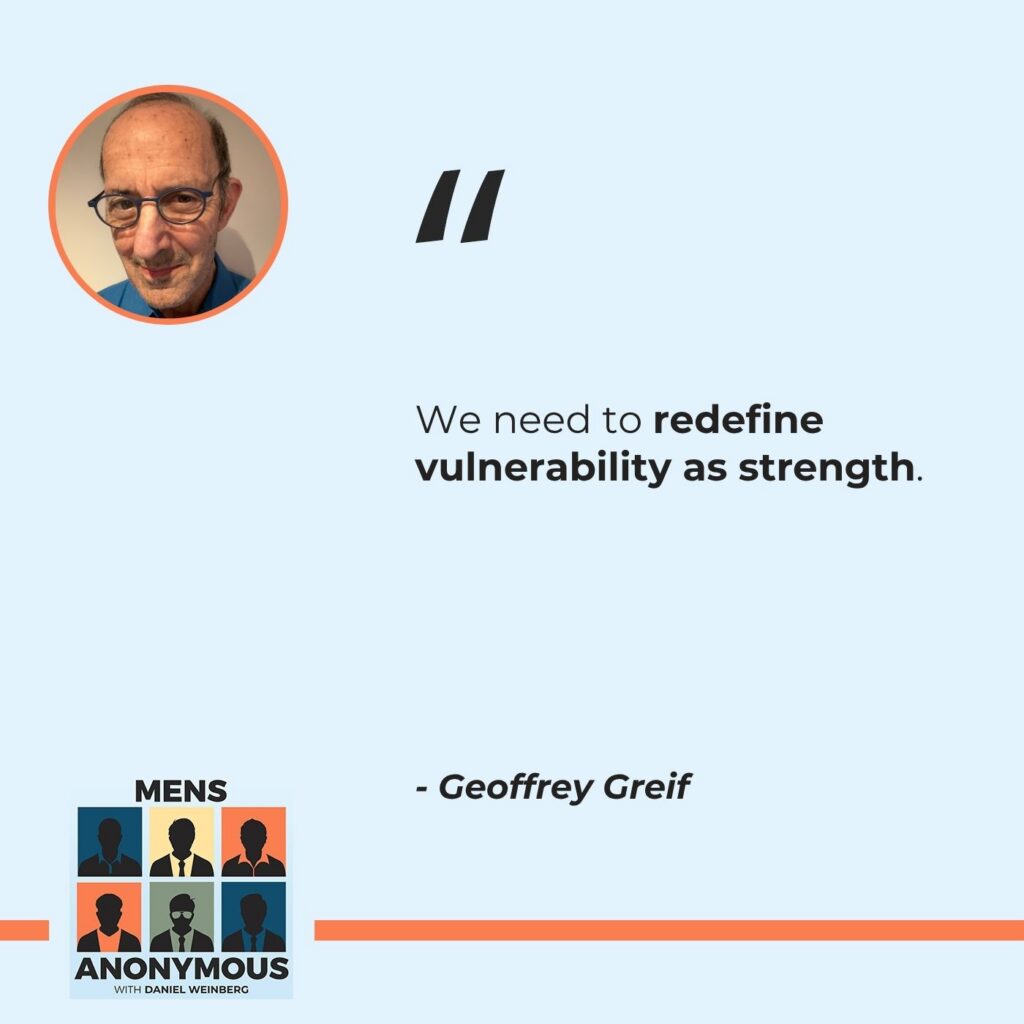
We’re not socialized to be vulnerable. We’re so socialized, unfortunately, be strong, tough, laconic and all those things that we think of as masculine trades. Now, we want to redefine masculinity as strong and vulnerable. You can be both, but a lot of people say, “I can’t be vulnerable and also be strong.” We need to redefine vulnerability as strength. It’s like, “Let me tell you what my issues are and what I’m dealing with. I’m dealing with this. I don’t know how to deal with that. I’m confused about this. This is the third item. Let me put that out to you and let me continue to move forward.” That’s being vulnerable. Openness should be seen as a strength and not as a weakness.
Tell me. If you were to give them advice in terms of one thing. Let’s say that they are readers out there who are struggling with friendship or finding friends. Which is happening a lot at the younger band. You describe a little bit early of like, the friendships are being formed. They’re playing games and talking to each other. It’s a different type of friendship, but if you were to give advice to the readers about what is something practical that they can do to get on the path of executing your buddy system concept. What would you tell them what they can do for themselves that’s actionable?
Number one, men tend to want to hang out with other men at their level of masculinity or activity. Meaning, you don’t see the chess player hanging out with the basketball player. You’re going to need to find friends that enjoy doing the same activities. There are two historic views of masculinity that I’ve talked about. Which is, you’ve got the obvious knight and shining armor who is strong and rods up on his steed and saves the damsel and distress from the dragon. That’s one thing very clear. That goes back to the strong silent type.
There’s another issue or description of masculinity of the silver-tongued board who is below the window of the lady looking up and wooing her with poetry, a song and sweet words. She lets down her hair like Rapunzel and he climbs up. Those are very different issues and I like to see more of a combination of those. That’s that issue of men tend to like to hang out with people that are the same masculinity that doesn’t speak about all men.
I’m going to want to do activities with somebody who likes doing my activities. Be it playing chess or going out and slaying the dragon. Making friends then is number one. It’s getting into that zone. Who am I looking for? Number two, it’s the ability to read. Be able to see who might you’re talking to. If I meet you at a party and I’m too emotionally open too fast. That might turn you off. It’s like, “He dropped a lot of stuff on me.” You may say, “This guy seems pretty closed off about his emotions.”
It’s a matter of saying, “I got engaged,” if I want to connect with somebody. Where they coming from and how much can I reveal about myself to connect with them. That leads to the obvious third thing, get involved in activities that you enjoy. Don’t expect people to come to your door. You’re going to have to invite them in. Meaning, you’re either going to have to be a home where people come to watch the football game, which is fine or you’re going to get out the house.
People are not going to come to you. You’re going to have to feel comfortable reaching out and that means being vulnerable. It’s hard for men to pursue other men. I was raised at a time where I was trained to socialized to go after women for dates. I wasn’t socialized to call up Daniel and say, “Do you want to get together down the bar?” You say, “Geoff, thanks but I’m busy that day.” It would take a lot for me to call you again because I don’t want to seem to needy emotionally. All those things are floating around in our heads and how any one person ever sorts that out, I have no idea.
People are not going to come to you. You're going to have to feel comfortable reaching out and that means being vulnerable. Share on XThe Connected 50s: What Separates Isolated Men From The Connected
In your research, what would you say separates the men who end up connected in their 50s and 60s? You get to 50s and 60s and you have those buckets of friends, the must and trust. What separates those who are able to create that network that you were talking about from the ones who end up alone?
It’s people who put themselves out there and say, “There’s something that is missing in my life. Do I need to go to therapy for this or do I just need to join a men’s group, a sports group, a mixed group or book club?” I have to change something in who I’m choosing to socialize with because the world won’t under me at this point. Maybe I believed it would when I was twenty but I found out 40 years later, that’s not how the world works. We could say it worked then. It doesn’t work now but we don’t have to debate that. It’s not working now. I would say put yourself out there and be comfortable with who you are and read the cues from the other person about how to connect.
Very interesting. You’ve written 150 plus papers or something on all these subjects and related subjects. You’ve been doing this for quite some time. It’s very grateful and appreciative that you’ve been out to make some time for us and share some of that wisdom with us.
It was so great to be interviewed by you. Thank you for reaching out to me, which is a great thing for you to do in general. Thanks for your show.
I finished my show off with five rapid questions. I’m curious. I’m going to ask you these questions and you just answer with what comes to you first. Who would you like to say sorry to given the chance?
My wife.
What are you proud of being or doing in your life?
I am proud of trying to feel increasingly comfortable with myself and who I am.
When did you receive kindness while needing it most and expecting at least?
That’s a difficult one. Nothing that I can think of comes to mind about receiving kindness when I expected it. Sometimes in dealing with people and being surprised that they reacted the way they reacted to me but that’s a hard question. I know that’s an insufficient response.
That’s okay. What did your mother or father teach you that you frequently remind yourself of?
My mother said, “If you’re going to agree to do this, do it graciously. Don’t just say, ‘I’ll do it.’ If you’re going to do it and say, ‘I’ll do it.’”
My final one is, what is Dr. Greif’s superpower?
The fact that I have no superpower is my superpower.
No doubt about that. Dr. Greif, thank you. I appreciate your time.
Thank you, Daniel. A lot of fun and great conversation.
Important Links
About Dr. Geoffrey Greif
 Geoffrey Greif, PhD, LCSW-C, is Distinguished University Professor Emeritus at the University of Maryland School of Social Work. His works include influential volumes such as “Buddy System: Understanding Male Friendships,” “Adult Sibling Relationships,” “In-Law Relationships: Mothers, Daughters, Fathers, and Sons,” and co-authored books like “When Parents Kidnap” and “Beating the Odds: Raising Academically Successful African American Males.” His scholarship has deepened understanding of adult friendships, family dynamics, child abduction, interracial families, and fatherhood, informing both social work research and practice. His newest book, released in May, is Interracial Marriage: How Diverse Couples Navigate Relationships at a Time of Great Divide.