
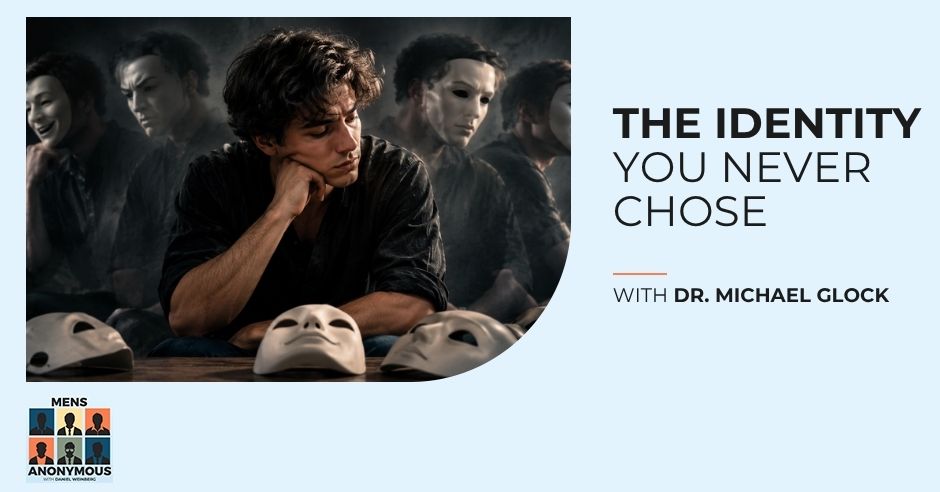
You didn’t build the armor you’re wearing today. Host Daniel Weinberg sits down with philosopher and hypnotherapist Dr. Michael Glock to uncover why high performers face a sudden midlife identity crisis. The life you constructed in your twenties and thirties often belongs to someone else’s expectations. When a personal or professional rupture hits, it isn’t the end of your story. It’s the moment you shed your old operating system and awaken to true self-awareness. Discover how deep psychology and hypnosis help rewrite unconscious patterns so you can step into true leadership.
—
Watch the episode here
Listen to the podcast here
The Identity You Never Chose With Dr Block
In this episode, we’ve got Dr. Michael Glock, where we talk about the identity you never chose. Men’s Anonymous.
Dr. Glock, so good to have you on the show.
Wonderful to be here, Daniel. Welcome.
Where are you at the moment?
I’m in Los Angeles, in Venice, Venice Beach.
Michael, I want to start with a statement from your work that really grabbed me. The identity you’re defending was built by someone else. What do you mean by that?
The Constructed Armor of Early Life
We’re going deep. I’m going straight in. No mucking around. Let’s just dive straight in. I’m a philosopher. My shtick is depth psychology, hypnotherapy. It is working with high performers, executives, CEOs, and COOs. I am deeply interested in wisdom and human development. That statement is all about this idea that the first half of your life, you have been deeply informed by what your mother and father believed in. You are mimicking what they believe, what they’ve wanted for you.
You’ve gone to school. You’ve dressed like everybody else. You do not want to be different. You’ve tried to figure out what you’re good at and where you can ply your trade. You’ve really been punching and pushing outwards, and you’ve been trying to fit in, and you have made agreements in order to get through. You have constructed yourself. You’ve constructed your own identity.
Are you saying that we are up, just so I’m clear? This is from zero to approximately what age does your thesis suggest this identity is being constructed? What would you say? As you say, 40, 45. What are you talking about?
Midlife. Let’s not connect to numbers.
I’m just trying to get an understanding of the terms of your life. This is after you’ve liked, you’ve gone to school, you’ve gone to college, you’ve started your career, you’ve gotten married, you’ve had a family.
All of a sudden, it’s up for grabs. You wonder, goodness me, is this going to be the same for the next half of my life? What have I done? Is this the right relationship? Did I even want a family? What is all this? I own a hundred-million-dollar company. It’s like crazy making. What have I done? Is this really what I wanted to do? There’s a deep question. This is the crisis that everyone goes through. Is Jonah being swallowed by the whale?
This is St. John of the Cross and the Dark Night of the Soul. This is the deep question. You might start drinking too much. Your wife might say, “That’s it, you’ve been working so hard, you’re not here at all. What’s the point of us being in a relationship? I am leaving at the end of this month.” Suddenly, there’s this massive rupture, and that rupture comes midlife, and it can happen at twenty.
Are you also suggesting, are you also suggesting based on this thesis, that it’s inevitable for everyone to experience this? For example, the midlife crisis or that break that you’re talking about, where you start moving from being a construct to finally breaking away from the armor that’s being put up. Your true self. Actually, you are reborn again after you’ve been through that first major phase in life.
That is correct. Let me use a metaphor to describe that. Going all the way back to Greece at the beginning of Western civilization, they were busy buying land, building property, building plumbing systems, doing all of that. The people were getting restless, so they invented theatre. They invented entertainment. When they invented entertainment, they invented the story, and the story has an arc, and that arc is the beginning, middle, and end. That is the fundamental story for everything. You were born halfway through. You’re mature, and at the end, you return to Stardust. The Earth itself, civilizations, and the galaxy have a beginning, a middle, and an end. Just the time scales are different.
All of my work, my thesis, how I operate, is this idea that there’s a three-act arc. If you work with me, there’s a beginning, there’s a middle, and there’s an end. The way that I like to explain it so that you are fully cognizant of what is happening is that in the beginning, there’s a moment of recognition that you’re a constructed human being and that everything you believe, act, and do is part of that first half of life. The first day with me is the beginning of the next half of your life. Today is the day.
Metamorphosis Through Personal Rupture
Understand it like this. Remember in biology 101, you were taught about the life cycle of the caterpillar. The caterpillar is born, and it has one instinct. That instinct is to eat and consume. Pretty much, that’s what you’ve done for the first half of your life. You have just eaten and consumed everything. Every shiny object, every wonderful relationship, everything. You’ve just eaten and eaten and eaten halfway through your life. It’s like you cannot eat anymore, or you’ve eaten absolutely everything that’s available to eat, and you begin to die, and in that death spiral you weave yourself into a cocoon.
We know that that’s not death. We know that metamorphosis because inside the caterpillar is DNA and RNA that says sometime in the future you are going to be a butterfly. The work that you do with me is inside that chrysalis, and you die to your old ways. This is deeply indigenous. This is the old way. This is the authentic human growth and development. At the end of working with me, you have enough strength to punch out of that cocoon with wet wings and a changed body. You are a different human being. You have transformed in the second half of your life.
It’s interesting when you say you’re a different human being. A lot of what you’re saying really resonates with my own personal journey. One thing I would want to try and challenge you on is, say, you’re a different human being. What if I say to you, you’re the same human being? You just become way more conscious.
I can run with that. When I say a different human being, that has happened on multiple levels. Let me just list them out. One of them is that you have woken up. You are no longer living.
That’s what I mean by you becoming more conscious. You are awakened.
You have awoken to the agreements that you had agreed to that allowed the construction to exist, and all of that was up until that moment unconscious. You have become conscious. Secondly, in this midlife crisis, if you are in the appropriate container, in this case, it’s my therapeutic field, and the system and the talk therapy and the hypnosis that we do together, and the homework, the journaling, and listening to the material repeatedly.
Upgrading From Operating System 1.0
What happens is that you begin to embed this new consciousness in, and you begin to catch yourself. The way that I articulate it is that in this first half of life, you are unconsciously running an old operating system. I call it 1.0, and it’s been implanted by default, and it has been created by all of the traumas, by the losses, by the adventures that have failed.
The experiences that you’ve encountered.
The identity you're defending was built by someone else. It's time to stop running an old operating system. Share on XThat’s operating system 1.0, and because we are constructed the way that we are, we have this fight-or-flight response, and throughout that first half of life, we figured out what works and what does not. Whenever we encounter a novel situation, we unconsciously trot out whatever’s worked before because we fundamentally do not want to put in the hard effort of becoming masters and enlightened. It’s like we’ll just accept that sort of morass that we’re in.
What happens is at this point where you are in a rupture and you descend into the cave of the bear, if you will, if you descend into the chrysalis, when you enter a sacred space, a temenos, you begin to reflect and you begin to become introspective and you begin to witness yourself and what caused those constructions and the stories that you made up in order to navigate those deeply difficult situations. You begin to realize that many of those stories are just not true. They are limiting beliefs. They are constructions in themselves. One of the outcomes of this work is that when you first enter this first half of life, everything is first-person. “She’s leaving me. It’s me.”
It’s very narcissistic. You feel this. The world revolves around you. In the second half of life, I articulate it in the first person. In this first half of life, you’re the first person. In the second half of life, this movement that you go through, technically, comes from Victor Turner’s work. It’s cultural anthropology, where there’s a rupture, and then you descend into the underworld where you dream, where you reflect. It’s the cave of the bear.
The Western Apache called this the looks within place. You spend a considerable amount of time in this sacred space. There’s no rank. All of your values, all of your morals are kind of up for grabs, and it’s tender. It is. Towards the end of the work, you ascend, and you return to your ordinary world, but you return with gifts. One of these gifts, as I’ve just been saying, is this move between first person and third person.
This goes back to me saying that you are different. You’ve transformed when you return to your ordinary world. One of the transformations is this concept that you are now living in third person, and you can observe yourself as you begin to run an old operating system 1.0 module, and you just choose the simplest response to whatever issue is happening at the moment. Third person versus first person, that’s one of the transformations.
Does everyone have a rupture?
You have. There are many every day.
Everyone has a rupture. There are just some people who choose not to confront it, or they just try to manage the rupture externally, let’s say.
In the first half of life, those ruptures are coming fast and furiously, but you deny them. You push them away. You exile them. You abandon them. Why do you do that? You have no mechanism. You have no mechanism to work with them. All of the existing structures in our modern Western society are failing. We do not have the systems in place to do this deep, meaningful work.
We are hypnotized. Listen, look, understand this. Part of my work is to unhypnotize you from the trance that you’re living in. You’re drinking just enough alcohol, taking just enough substances, doing just enough consciousness work, doing just enough sports to get back to work on Monday morning and then be exhausted and really hate what you’re doing or the company in town or man, whatever, and then rinse and repeat, and you do that. You never really have any deep conversations.
There’s no time when you just spontaneously cry because the sun rises coming up in the east. It’s like we are so disconnected. We are in a consumer, military, and industrial entertainment complex. It is ferocious, and we’re deep in it. You have anxiety and low-grade melancholia, popping pills just to be able to sleep, to rinse and repeat, and it’s endless.
Let me talk about the male operating system. When boys become men, that whole pathway receives an extraordinary amount of programming, as you put it. Do not cry. Do not show weakness. You need to provide. You need to win. You need to protect. You need to achieve. You need to have all the answers. What does that programming do to men psychologically?
Notice all of these examples that you just gave. That is your OS 1.0. You are being constructed by business schools, by your college, by society. That’s your cultural indoctrination. Halfway through your life, there’s a point where you realize that is really what life is about. What else is there? You go on a search. Joseph Campbell, one of the greats. The great American mythologist, he articulates this as the hero’s journey.
At the beginning of the hero’s journey, there’s a call to adventure. The first person to show up after you have accepted that call is in the first half of life. That call to adventure is there over and over again, but you deny that call to adventure. At a certain point, everything just gets too much, and there’s a massive rupture, and you are thrown out of your ordinary life. That’s when you descend into this sacred space, this underworld, this place of dreams where you begin to reconnect with your own self, your own holy other. It’s a sacred time.
What happens is, as I’ve said, this is OS 1.0. During the work that we do here together, we recognize, we identify, and we begin to create alternative scenarios of what the future could be. One of the things specifically that I do is when you work with me, and let’s just go back to Campbell, at the beginning, you have the call to adventure. The first person to show up is the mentor, the guide, the shaman, and that’s this work, and you are guided, and the journey begins.
About halfway through, you meet yourself. You meet another guide, but ten years older, and that guide, that mentor that’s you yourself, ten years older, has now accomplished and overcome and understood and woken up and made the move from being a caterpillar to launching into the world as a butterfly. Now that elder, that wise human being, is now communicating to you the true desires that are within you. It’s brought out into this sacred space.
It’s so interesting the way you’re describing it. For my own personal experience, when I had my rupture, as you put it, I coined it more of a nervous breakdown, let’s call it.
Just the word for it.
If I were to reflect on it at the time when it happened, and I, you talk about the descendants in these. When you descend, you realize you’re disconnected from yourself, is how I would describe it. I’m going to describe my experience. I felt I was disconnected from myself. You no longer know what you like.
What is up? What is down?
You no longer know what your true values and principles. You come to like, have you ever read the book, Dr. Seuss, The Places You’ll Go!?
Of course.
You come to the waiting room where you said you’re just in there, and it’s very tender, and you’re just working it all out. What you’re doing is you’re trying to work out what the things that are important to you are. What are the things you believe in? What are the things you actually like? What type of relationship do you want to have with a romantic partner and with friends? Who are your friends? Who are the people you want around you? How should you be as a son or with your parents? How do you really want to fill your time on a daily basis? What’s important to you? What’s your priority list, etc. All the stuff you’re saying, it really resonates.
Stop letting childhood defense mechanisms run your business and relationships. It's time to upgrade your mental OS. Share on XThat is the work that we do.
I’d like to ask. I’ve got five kids, again, as a father, knowing that they’re all going to go through this at some point in their life, do you believe that you could work with people at an earlier stage in their life? Within Act 1, as you describe, do you believe you can circumvent some of the journey that one goes through and help them get to Act 2 more quickly than waiting for a big rupture? Can one do that work at an earlier stage in life, or does everyone need to actually go through all the Acts themselves, and then you can help them once they’ve come to the end of Act 1? Does it make sense?
That is a really wonderful question, Daniel. Let me answer this cryptically in two different ways. Structurally, I believe that there is a way to begin to re-educate society and culture as we move forward as a civilization and become reconnected to the fundamental rhythms of the universe itself unfolding.
You’re saying that at a general level, at a high level, generally, we should be more connected with each other as humans, more connected with nature. We should be more conscious and aware of what the universe provides, etc. That’s at a higher level you’re talking about.
Let me make that more specific. Let’s just use nature. We’ve conked our Western, our modern society. We’ve concreted everything over. Most people do not even know what fresh fruits are in season at their local grocery store. We are completely disconnected. The truth is, life is nothing but suffering. Life is nothing but unconsciousness moving towards consciousness, and you require that rupture in order to make that move because without the rupture, you cannot evolve. As Carl Jung said, “There is no light without dark.”
Generativity Versus Stagnation
Dante’s Inferno descends into the depths. Even in the Judeo-Christian belief system, you have God and Paradise and the angels, and you have evil and the devil and the dark down there. It’s the two opposing polar forces. Erik Erikson, another great American psychologist, developed a developmental model for human growth, and there are seven stages in each of those stages, from zero to one and a half to three onwards, from birth to middle age to death. At the age that you and I are at now, the two opposing forces that are at work and are in friction with each other are stagnation and generativity.
Most people choose stagnation and go to the old people’s homes, and nobody goes and visits them, and they get dementia, and their bodies start packing up. The opposing force is generativity, which is, “What have I done? What have I contributed? Shall I become a mentor? The visage? Shall I write a memoir? Shall I build a documentary about this journey?” Back to your question, evolution, consciousness, requires the tension of the opposites in order to create that spark for the new thing that does not exist.
You cannot circumvent the journey.
No.
That’s the answer. As a parent or a father, speaking as a father, you basically have to prepare yourself to be more of a guide and a support structure for your children as they go through it, as opposed to trying to solve and circumvent potential pain and suffering they may have to go through. That’s what you said.
That is absolutely correct.
That’s fair.
Let me add something that will make this much clearer. Let’s go back to that phrase, that moment that I said that you returned to your ordinary world transformed, and then you pushed back on that, talking about consciousness and unconsciousness. Let me go back to that because let’s say you did twelve sessions with me and we did this work and we went through this hero’s journey from beginning to middle to end, or birth, death, resurrection. It’s the Phoenix rising from the ashes.
People come to me when they’re in trouble. They have forgotten that they are the captain of their own ship, and they have jumped overboard. Their ship is in bad shape. The sails are torn, the masts are broken, and they come to me, and I find them on a life raft in a storm-tossed ocean. Halfway through, they’re still inside the chrysalis. They’re still trying to answer all of those questions. “Who am I? Where am I going? What happened? What went wrong? Why did I become depressed? Why cannot I sleep? Anxious? Why did I take all of the blah, blah?”
At the end, there’s a resurrection. It’s a phoenix rising from the ashes. Now, back to this moment where we return to the ordinary world. You’ve now done this work. You’ve discovered yourself. You’re in third person versus first person. You’ve become conscious. You have woken up. You are now a butterfly, but still with wet wings emerging back. What has happened is that your five children have observed that journey. Up until now, they’ve not been watching that.
When they hit their rupture and their crises, they’re going to hit the bottle, or they’re going to hit the pills, and they’ve got no model for that resurrection. That’s the difference. You doing the journey yourself is what they witnessed. That is your contribution. Let me tell you, one of the other outcomes of this work to bring this full circle is that you, after doing this work, are able to be in the present moment and experience the power of now.
I write about this in my book. A hundred percent.
Beautiful.
Eliminating Past and Future Brain Allocation
That’s exactly right. I live like this. Through the process, what I realized was that how you achieve that is I look at the brain and the allocation of energy that you put out with your brain. Do you allocate? You can allocate your brain real estate, I call it, to the past, present, and the future. When you eliminate allocating any brain space to the past, because you realize you cannot change the past. You learn from it. You move on. You do not sit in and stew over it. It’s gone.
It’s a waste of time. When you eliminate that allocation, and you stop thinking about it, and you then also realize the impermanence of life, that this makes plans well into the future and believing that, “We’re going to do this and we should do that,” and when you realize that life can stop like that, things can change direction in your life in moments. Once you’ve experienced and realized that, you stop putting too much energy into the future allocation of your brain real estate because you realize it’s a bit futile.
Why are you making all these grand plans for things that may not happen? That’s time. We’ve spent so much time doing that. You realize that in your allocation, you’ve eliminated the allocation to the past. You’ve eliminated the allocation of the future. You realize I have so much capacity now, and it’s all being allocated to the present. When you do that, you realize you are so much more in the moment.
You’re so much more there with your kids when they’re doing their activity. You’re so much more there when you’re having this one-on-one conversation that I’m having with you now. I’m not thinking about anything else except having a conversation with Dr. Glock. That’s all I’m thinking about. Once you do that and you practice that in all areas of your life, that is the present of being in the present.
Daniel, I am so proud of you. You are a pioneer.
I’m definitely not a pioneer.
Yes, you are, Daniel, because you did this journey on your own. I must have men’s groups and all that. I know. This is the magic of it. You have deeply understood, and you have come to this point. The way that I like to explain it is that after this work, after the rupture, as when you return to the ordinary world with these new gifts that you have gained because of this descent into the underworld, one of the gifts that you return with is this ability to be in the present moment. In that present moment, now in the future, after having done this work, this is the outcome. No matter what is in front of you, you are present to it, and your responses are proportional, and you are no longer infected by all of those stories from the past. You are clean.
That was one of the biggest jumps for me. It’s interesting. I got the inspiration from, do you know Rick Rubin, the famous music producer.
I do not know.
Rick Rubin produced some of the greatest popular music acts around. He’s got no musical skills whatsoever. He’s got this big beard, but he did the Beastie Boys in the 80s. The Chili Peppers. He’s done all this incredible stuff, but he’ll never talk about it. He refuses to talk about the past, and he explained the way he explained it. It’s actually a waste of energy and time to talk about the past. The only caveat I would have there is that I’ll make exceptions for when you’re doing things like studying history.
When you talked about civilization. The Greeks invented theater. That’s a little bit different from you talking about your own personal experiences when you’re reading and learning about history, which is looking at the past, but that’s more in the pursuit of gaining knowledge and understanding of how things like history repeats itself and understanding the lessons from the past, if that makes sense.
I love what you said about the three worlds. What I do in the last few sessions of my work with my clients is we go through deep gnosis trance sessions in which you become a master of worlds because throughout the work we have spent time in the past. We’ve understood what the original traumas were and what the significant events were. We spend time in the present understanding what we have made of those stories and how those events in the past have impacted how we show up today, how we make love, how we interact with our staff, how we have built or broken the business.
That’s the present. We have done scenario planning, and we’ve envisaged what possible, probable, and potential futures exist, and we’ve done that throughout the work. At the very end, as you return to the ordinary world transformed, you knock on your own door of your own house, and your wife or your colleagues and your friends open up, and they are all just shocked and amazed, like, “What did you do? Did you have that surgery to make you two inches taller?”
Shocked, amazed, and a lot of the time I would say because they are anchored by what you were, a lot of people in your life or in your past life or that you’ve come across currently in. I find it difficult to accept or process what you’ve gone through because I didn’t go through it. You’ve gone through it. They do not know how to respond to it because you’re you, or I’m going to tell you are responding to them differently than the way you were.
You do not have habits that you have been engaged in that have ruptured those that have broken, so now they do not know how to relate.
That’s right. That process in itself is also quite an interesting process of whether it’s creating the boundaries or whether it’s consciously that expression saying no is saying yes to you. When you decide and realize that, for example, whose energy you want around you or whose presence you want around you. It’s not because the other person is a bad person or they’ve done something wrong to you, or it’s just that you have changed yet. You have changed, and you have just decided, “I just do not want to spend time with you.”
Not because you’re a bad person or I do not like you. It’s not where I want to allocate my energy. That process is also quite an interesting process to go through when you become, as you say, I call them my book, my Daniel version 3.0. I’ve jumped from 1.3 points. The way people respond is also, it’s not just what you’ve gone through, but you’re also having to manage the process of how the external is responding to the new year.
A hundred percent agree. Daniel, you have really done good work here.
I will continue. It does not stop. We’re doing it. We’re doing it right now. I like processing a lot of what you’ve been saying. I want to talk about anxiety. You mentioned it there before and I really want to talk about it, maybe particular because you have a very, let me call it a very provocative view of anxiety, whether it is, whether it is an enemy or a messenger. Instead of asking, “How do I get rid of this?” You’re more interested in asking, “What is this trying to tell me?”
What it brings up for me, your view there, is that when I was going through my rupture, I recall having 1 or 2 close friends say to me while I was really going through a very challenging time. I remember, and I said this a few times on my show, but I think it relates very strongly to this. They said to me, “You do not understand. This is a gift. This is a real opportunity for you.” When you’re going through it, my first instinct when they said this to me was that I genuinely wanted to punch them in the face.
I’m like, “Are you not hearing what I’m saying? I am in so much pain. I am suffering so much, and you’re telling me this is a great thing.” I read your position on it because I suffered a lot of anxiety during that period. I did not sleep easily for six months with that. What really comes to mind is the circular conversation that was happening in my head. It was unlimited. You could not turn it off, which caused a lot of anxiety, no sleep, etc. Now you say it’s not the enemy. It’s here to tell you something. When is anxiety simply anxiety versus evidence of a deeper conflict?
Reframing Anxiety as an Internal Message
Most people do not have an anxiety problem. What they have is an interpretation problem. The anxiety. Now, one of the differences between the first half of life and the second half of life is that in the second half of life, you begin to make meaning of what was meaningless. It is the meaninglessness of your life that causes the anxiety, the insomnia, the great melancholy.
Can you give us some examples? Make this practical for us. What does it mean by meaningless?
Meaningless is that I grew up. My dad had a company. He was convinced that I was going to take over that company. It was manufacturing something, but I was a musician. I always loved playing and being creative, but I spent the first half of my life becoming the CEO of that company, and it just brought me down. I never did what I really wanted, which was to be a musician, to be a producer, to be creative. I gave it all up. Now here’s the rupture. They have anxiety. They’re the provider, they’re the protector, they’re the achiever, they’re the successful executive, they’re the strong father.
Everybody looks at him and says, “This man has it all together.” Sometimes all of those identities began as adaptations. They’re adaptations. They’re not choices. They’re not coming from internal. In this moment of the rupture, you get to look at all of that and say, “Whose life am I living? I’m living my dad’s life. That’s not my life.” Now, the moment that awareness has struck consciousness, what used to be meaningless. You did not understand how your life ended. Now meaning has been made. That is the through line into the second half of life. Let me add. One other element in this. The second half of life is about learning to live life symbolically.
When you say symbolically, what does that mean?
The first half of life is all about facts and practicalities, getting an education, figuring out what you’re good at, finding your mate, and having a family. If that’s the thing that you want to do, it’s like all of the practical, logical, paying your mortgage, having your insurance, everything. That’s the first half of life.
Again, I want to pin you on this. That’s a choice as well. You have to be responsible for your own decisions. No one’s putting a gun to your head, really, in all these scenarios. It’s more of a metaphorical gun than really having a gun to your head. You make all these choices, even if they’re unconscious.
Anxiety isn't the enemy in your mind. It's a high-priority message telling you that you're living someone else's life. Share on XCorrect.
I do believe you have to take accountability and responsibility for all. They’re all your decisions. It’s even like I’ve gone through I’ve had two divorces, which is part of that disruptive, ruptured journey. Regardless, all these decisions, the decisions you made. They are. In the second half of life, you become accountable for all of those.
Both the conscious ones and the unconscious ones. As you make meaning of what was once unconscious, that is the meaning that is being made in that meaning-making function. You are becoming conscious of yourself. You are awakening in that process. That leads to living a life symbolically, and symbolic on the symbolic life in the second half of life is recognizing that everything is delivering messages. The car accident on the way to work is not just a car accident anymore.
It is a message about frantic pace, worry, sleeplessness, tension, potential divorce, everything. Anxiety is a message. One of the things that we do. Let’s just try this out. We built a relationship. You have a level of trust in me, and I have a level of trust in you. Listen, the moment that you said that, here I am, I’m in the present moment, and I’m just here talking to Dr. Glock. That was so perfect because it just sank in, and here I am meeting you in that space.
Just for a moment, I invite you to just gently close your eyelids, just close your eyelids for now, and go back to your past and that anxiety, that deep anxiety that you had. Just any time in the past, that anxiety, just feel it for a moment. Now imagine right here in the space between us, in this digital space between us, suddenly there is anxiety as if it were a being. Can you give a name to this being? Just give a name to anxiety right now. Who is it? Any name?
Joe.
Joe is in front of you. Joe has anxiety. Now look at Joe, and Joe wants to say something. What is Joe? Become Joe for a moment and just talk to Daniel. What does Joe want to say? Joe is anxiety. What does Joe want to say to Daniel right now? Speak it out loud so that I can hear it.
Joe’s saying to Daniel, “What’s wrong with you? Why are you not performing at the level you should be performing at? You’re better than this. What’s wrong with you? You’re a fail.” That’s what Joe’s doing.
Close your eyelids. Just hear what Joe said and now respond to Joe. What are you saying back to Joe?
When I was in that situation, or right now?
In truth, right now, as if it’s all real. Do not make anything up. You just heard Joe. Joe just dumped you and said, “You’re a loser.”
“Joe, you’re a loser. You do not know what you’re talking about. Joe, I do not really want to talk to you. You do not really belong in my space any longer.” That’s what I’d tell Joe.
Do you hear that? Do you hear the movement, hear the transition from the first half of life to the second half of life? It’s like you’re clear. Joe just did his own old operating system 1.0. He’s dumping on you. You have grown. You’ve passed this, and you’ve just responded. Your journey has been underlined in this interaction.
It’s also interesting, and a lot of the friends I grew up with will often reference and say, “How good was it when we were in our twenties?” or “How good was it when we were in our 30s? I wish I could be back there.” I never wish I could be back there. Personally, I think I’m living my best life now. The relationships I’ve had and the relationship I’ve with my partner now are the best relationships I’ve ever had. The relationships I have in terms of friendship and the relationship I have with my parents are the best. It’s in the best shape for me that I’ve ever experienced. Do you think that, as a rule, one’s relationships in general are much richer in the second act?
Totally. What’s happening in this second act, in this second half of life, is that you are walking towards mastery. There are many names for mastery. It’s enlightenment, it’s self-actualization, it is self-awareness, it’s Abraham Maslow’s hierarchy of needs with truth, beauty, and justice at the pinnacle. This is the journey that you’re on. This is the work. You are walking a path less traveled. This is a hero’s path. This is a warrior’s path.
Because you are capable now of being in the present moment, no longer infected by all of the stories and the habits and the go-tos from the past, you’re able to respond proportionally to whatever is in front of you, and if there is love in front of you, your heart opens, and you experience deep, magnificent love. If there is a bear in front of you that is threatening your life, you pump your entire being up, and you fight that bear with your entire life’s force as appropriate. That is magical and magnificent.
The other thing I want to talk to you about is that I want you to explain hypnosis. You focus on the use of hypnosis. I want you to explain hypnosis to me. The hypnosis that I’ve been exposed to is the bullshit you see on stage and in sleep. It’s more theatrical. I want you to explain to me and the audience and show us how change happens with hypnosis.
The other thing I want to ask you is, I’m going to set you up so you can talk about this. When I’m under hypnosis, am I recovering memories? Am I changing those memories? Am I changing the meaning attached to those memories? A cynic or a critic might claim, and I also understand that not everyone can be hypnotized, but let’s say you are capable of going under hypnosis.
Is there a risk that someone like you, as a doctor who’s conducting this, that you’re manipulating the patient’s memories to help them? If so, there’s a danger to that. I’d love to understand, because I’ve never ever really spoken to someone who practices hypnosis as a therapy. I would love you to explain it in layman’s terms, what actually happens and what you achieve by what one achieves by doing it, and the efficacy of it. There are a lot of questions in there and a lot of thought bubbles.
Let me explain this simply. I’ve developed an entire method, which I call hermeneutic hypnotherapy. Hermeneutics comes from a branch of philosophy that was originally associated with the interpretation of sacred texts. Think of the Kabbalah, think of the Koran, think of the Bible, and hermeneutics is the interpretation of sacred texts. The move that I’m making is that I’m now recognizing that you, human beings, are a sacred text. All of our health and healing have come from the prevailing construction of the day.
When we went from agriculture to an industrial society, we built machines, and then we figured out the body was a machine, and we treated the body as a machine. If something’s broken, we give it a pill or fix the bone. Moving on now to generative AI, artificial intelligence, and neuroscience is that we understand that the mind is actually a system, and I use trance. When you hear the word hypnotherapy, hypnosis, it’s actually a trance, and it is a quiet, deeply tranquil space in which the logical, rational part of your mind is attenuated down.
It’s dialed down, and in the present moment comes forward. It’s actually in neuroscience that you can see the movement of all of the energy on the sides moving to the front, so going all the way back in history. From India, you have the little bindi, you have the third eye. These are all true. This is the energy. You’re in a focused, deeply relaxed state. What I’ve done in hypnotherapy is that, you know, the first sessions are always 80 minutes.
Every session after that is a therapeutic hour, 50 minutes. In that first session, we do what I like to call a pre-induction. I enroll you in recognizing that I am in the mental. One of the things that I say is, “Have you heard of the phrase, ‘When the pupil is ready, the master will appear?’” Either you have heard that, or you’ve not heard that. What I’m saying is you are the pupil, and I am the master. I’m 70 years old. How old are you?
Turning 52.
When you stop wasting mental energy on past mistakes and future worries, your full presence becomes your greatest superpower. Share on XYou’re 52. I’m your elder. I’m not just your elder. I’m your shaman, your priest. I’m your ancestor. I’m a guide. I’m the answer to those prayers that you’ve said throughout your life. If only somebody could tell me what is going on. Here I am showing up. I construct an incredibly profound space that allows you to finally hear somebody. Let me just add. When I say shaman, see, most people, they exist within a community, they exist within a system, and within that community. There are all the appropriate people. There’s the doctor who will fix your leg. There’s the psychiatrist who’ll give you the pills if you cannot sleep. There are all the other things.
There are regular spiritual traditions if you’re going to get married or if you’re going to die. They can only deliver what’s within the architecture of the culture. To visit with a shaman, you need to travel to the outskirts of the village because the shaman is not connected to the construction of the village. You now get the true authenticity. That’s the structure of the work that I do here. I have a three-act arc. Beginning, middle, and end. I talk about birth, death, and resurrection. I talk about the caterpillar, the metamorphosis, and the transformation.
I work a lot on understanding who you are. We do a demonstration in that first session in which we go back, we find an original significant event, a prime event, or an initial trauma. We look at that trauma, and when it happened, maybe it happened at 2 or 2 or 5 or 10 or whatever. We understand that, and then I run a thought experiment, which is straight out of science. It’s a thought experiment. Essentially, in that first hour of the first session, you understand that no matter what age you are, you’re not that age. You are not that person living that life.
You are that 6-year-old, that 7-year-old, that 10-year-old living life with that original trauma. This is a huge light bulb moment. The sessions progress from that, and they go from act one to act two to act three. Eventually, you return. The trance state. Let me just talk about neuroscience for a moment. What happens in the trance state is that you start fully awake, and then you slip into a light state of relaxation. I support you in moving into that light state of relaxation. Usually, there is a deepener. I really like the original method, which was in French, called La Méthode Numérique, which was a countdown.
Rewriting Memories With Hermeneutic Hypnosis
It’s a 10-down-to-1 countdown. By the time you have reached 1, you are no longer making meaning of anything that I’m saying. You’re in a completely open-hearted, open-ear state. This is when memory reconsolidation happens. It is a very small window within the functioning of the mind that allows the reorganization, reinvention, and attenuation of old structures and limiting beliefs. Those are attenuated down and new positive possibilities are implanted. This happens in a very small moment within the trance state. It’s called memory reconsolidation, and the mind itself becomes labile in that moment.
It’s a tiny little window that opens up in which suddenly the mind is completely open, and a new programming goes in, and then it instantly shuts out again. It stops. I count you back from one to seven to the ordinary world. You flutter your eyelids, and you come back to the room. I ask you to listen to this work three times in a row when you go to sleep tonight. Tonight, tomorrow night, and the night after that. Week in and week out, you also track what is happening to you.
Become an observer of yourself by using the journal. Each session afterwards, we start with. What happened? Where are you? What have you noticed? What interactions have you had? Where are the shifts? By the second or third week, all of the nonsense, all of the stories from the past, suddenly they’re almost laughable. There’s a quantum shift between who you were and who you’ve become. That’s simply explained.
Fascinating. Is everyone capable of going into that state, or are there some people who cannot be hypnotized or have been?
I love using this idea from Zen Buddhism, from what Dr. Suzuki wrote in 1967, and brought Zen Buddhism to the West. He talked about the beginner’s mind. Very simply, he said, look, the expert, the know-it-all, nothing will ever happen to them. It’s like you need to let go and surrender. You need to open your heart and open your ears. It’s a beginner’s mind. There is an attitude. If you hold that attitude, everybody can be hypnotized. If you’re the CEO with a hundred bill in the bank and you think what civilization needs and stuff like that, it’s like, no, nothing’s going to happen until you get the biggest rupture of your life and you go nuts and mad.
There are so many other things I want to talk to you about.
Not again, Daniel.
This will go on and on and on. I’ll leave you with one last question before we go. I’ve got five quick-fire questions I do at the end of my show with all my guests. I want to ask you one last question as it pertains to men. It can often be deemed that when men go through that midlife crisis, they decide to blow everything up. It almost looks like sometimes they have not self-imploded more than they’ve pressed the reset button, or they press the button to blow everything up.
Whether it means having a fear of getting caught because they do not have the courage to confront it themselves, or they’ve just decided that I’m just going to blow it all up. It could be ejecting out of the company that they’ve been running for twenty years or whatever it may be. What’s the difference between destroying your life because you’re restless and genuinely transforming it because you’ve outgrown who you are?
There’s no need to define it. A rupture is a rupture. The bigger the rupture, the more you need the bigger rupture in order to do the reframe and the reset.
I often see those actions or those events, whatever they are, whether it is having the affair blow up, whether it’s whatever, getting into the gambling and just going, “Fuck it, I’m just going to lose it all anyway.” People are often like, “I cannot believe he did this.” They are effectively what they felt at the time they needed to do to cause that big rupture, so they can begin part two.
You can also treat that symbolically. If they want to rupture midlife, suddenly they gamble, get a new girlfriend, leave their wives, and do not talk to their family anymore. They want to totally destroy themselves. The message in there is, “I’m just not worthy.” It’ll go back to when they weren’t worthy at the beginning or something similar. All of that is a message. The concept is for us to identify what that message is, and then recognize it as truth and allow that truth. It really is. It’s sacred work. It’s a confessional. It is just as sacred and spiritual as anything you’ll find in any church or any religion on earth. Here we are able to do it.
It’s the letting go and the stopping of resisting, really, because up until that point, it’s just resisting that point of rupture that is inevitable to happen.
It’s discovering the meaning of what it is that’s in front of them and whatever is happening. There is a meaning unconsciously buried. Jung said that which is not made conscious is doomed to live out in the world as fate, and all of the examples that you’re giving me are the fate that a man or a woman lives. That is their fate. Jung said that which is not made conscious is doomed to live out in the world as fate.
The work that I do and the work that we do here at Joymind is all about diving down into the unconscious and making meaning of what was once unconscious and bringing it to consciousness. That is the work. The moment that happens, it’s like you are making meaning over what is meaningless. The meaningless of your life is what creates the pill-popping, the drinking, the frustrations, the low-grade melancholy, the anxiety, and all of that. This is a healing journey. We articulate it as a healing journey.
Dr. Glock, brilliant. It’s a crazy conversation. I’m going to ask you five questions, and all my guests just give me what immediately comes to mind, and see how you go here. Who would you like to say sorry to, given the chance?
Sigmund Freud for not fully taking on board his wisdom.
What are you proud of being or doing in your life?
I am most proud of being a co-founder of what is now one of the fastest-growing private companies in America. We’ve just won the Forbes Five, not the Forbes Inc. 5000 list. We’re the 74th largest private growing company in health care in America.
That’s massive.
Can I just say that again? Just to make sure I have the correct. It just came out today.
That’s amazing.
It is amazing.
When did you receive kindness while learning at most and expecting at least?
When I was twelve years old and completely lost, a Jesuit priest put his hand on my shoulder and said, “I have something for you.”
That’s interesting. What did your mother or father teach you that you frequently remind yourself of?
My father was a fighter pilot in World War Two. He said to me, “Michael, there’s only one thing that you need to do, which is walk through the world with your head held high.”
Nice. The final one is what is your superpower?
Deep empathy.
Beautiful. Dr. Glock, what an absolute pleasure. Thank you.
Thank you, Daniel.
Thank you for giving your time. I really enjoyed our conversation. It was extremely enriching. It was a very rich experience for me.
Thank you, Daniel.
I hope that audiences feel the same way.
Can I add a little thing about where we’ve got a special landing page? For your audiences to land on. Can I say what that is?
Please.
You have a minute. Let me just pull up the correct INC 5000 list. Joymind Hypnotherapy. We’ve just been named the 785th fastest-growing private company in America. We’re incredibly proud. I’m incredibly proud of having co-founded that company with two of my other co-founders. If you want to check us out, you can come to Joymind.com. Just one word. Joymind.com/MensAnonymous.
Amazing. Thank you.
Thank you, Daniel. Namaste, man.
Namaste.
Important Links
- Dr. Michael Glock
- Dr. Michael Glock on LinkedIn
- Dr. Michael Glock on X
- Dr. Michael Glock on Instagram
- Joymind
- Joymind Men’s Anonymous
About Dr. Michael Glock
 Dr. Michael Glock is a philosopher, futurist, hypnotherapist, and co-founder of Joymind, one of the largest hypnotherapy platforms in America. Trained in Jungian and depth psychology at Pacifica Graduate Institute, he developed Hermeneutic Hypnosis, an emerging framework blending hypnosis, neuroscience, mythology, symbolic thinking, and storytelling.
For more than 20 years, he has worked with entrepreneurs, executives, creatives, and high performers seeking transformation beneath outward success. His work focuses on how unconscious narratives shape anxiety, trauma, burnout, identity, and human behavior – and how altered states and imagination can help rewrite those patterns. He is the author of Way Ahead: Medicine Stories and publishes widely on Medium.