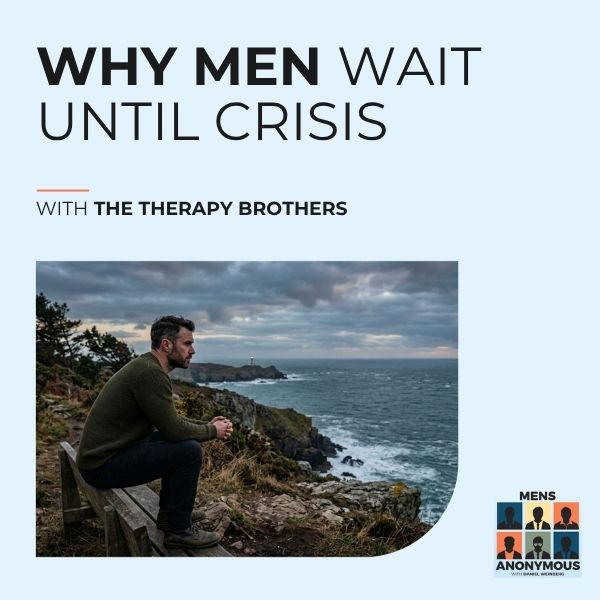
Why do men so often wait until their lives are in the “red zone” before seeking help? Whether it’s a failing marriage, a career collapse, or the fallout from an affair, men frequently hit a point of total implosion before they finally walk into a therapist’s office.
In this episode, we sit down with the Therapy Brothers, Brannon and Tyler Patrick, to pull back the curtain on the harsh realities of male emotional illiteracy. We dive deep into why men are socialized to “shove it down,” the damaging power of the “masks” men wear to prove their worth, and the psychology behind why men avoid being proactive with their mental health.
If you’ve ever felt like you’re “not good enough,” or if you’re living a double life behind a façade of strength, this conversation is for you. We explore:
- The Crisis Threshold: Why men view therapy as a last resort rather than a preventative tool.
- The Shame Cycle: How the belief that you “aren’t enough” drives isolation and infidelity.
- Reclaiming Your Heart: Why reaching your breaking point might just be the necessary catalyst to finally becoming an authentic, healthy, and connected man.
True growth doesn’t come from changing who you are; it comes from having the courage to reclaim the person you were meant to be. Discover how to move past the crisis and start living the life you deserve.
—
Watch the episode here
Listen to the podcast here
Why Men Wait Until Crisis With The Therapy Brothers
On this episode of the show, we have the Therapy Brothers, where we talk about why men wait until crisis.
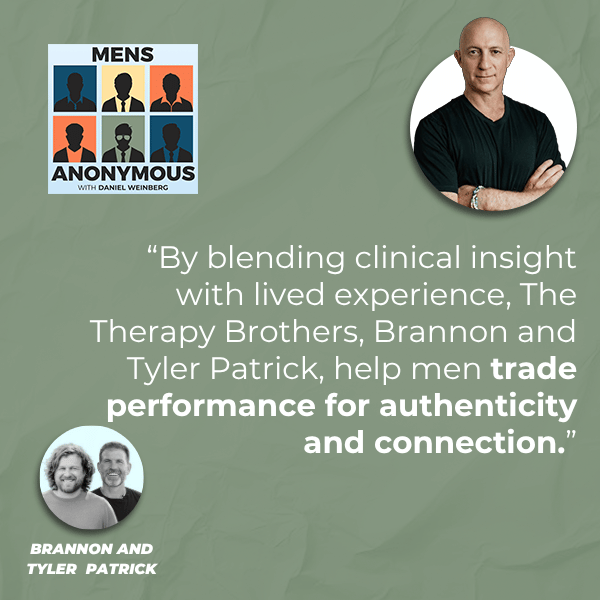
The Therapy Brothers, it’s so good to have you guys on the show.
It is good to be here.
It is awesome to be here with you, Daniel.
Your real brothers, right? This is not like a gimmicky thing, right?
Who do you think is older?
Because you asked the question, you are like saying, “I look younger, but I am the older one.”
I am actually a year younger. He has got the little brother complex. That is why he said that. We are real brothers for sure.
You are serious podcasters. You do a lot of great work, particularly in the men’s space, etc. I am very excited for the conversation. I am going to dig in, and I will go straight to it. In both your experiences, what is the breaking point that brings a man finally to therapy? They’re more reluctant than women are, let’s say. What do you see as the breaking point?
The Breaking Point Bringing Men To Therapy
It is true that men are less likely to seek out therapy than women. In our situation, with what we do and what we specialize in, a lot of the time, it is the fear of losing a relationship when things have finally broken open, when secrets have been found out, when problems cannot be dealt with on their own anymore, and they’re at risk of losing something big like their family or their job. That is when they seem to seek out help from us a lot of the time. It is more because they feel like there is nowhere else to turn, or it is almost like a forced hand at this point, than just trying to deal with it on their own.
Men are less likely to seek out therapy than women. Share on XIn other words, when the woman gets involved and says, “We have to address this,” then the man often goes and gets help. One of the issues is that as men, we have this fear, this question about whether I am strong enough. Am I good? It is hard to stop and say I am broken. I need to admit that I am broken. There is stuff here I have to work on. Now we have plenty of men who come in for help that do not have just a rupture in a relationship, because they just want to seek help, just because they have plenty of them.
When you say they want to seek help, my impression is that men, when it comes to this type of help, that men are not doing preventative. They’re not being proactive in trying to, “I am going to do some work on myself because I want to make sure I am going to be a better man so I do not fail, or I do not have a mental breakdown, or I do not ruin my relationships.” They’re not exactly studying it. My impression is that is why I wanted to collab with you, because they’re coming to you when it is all in. It is pretty much at implosion. It is in the red zone.
That is who we see. Daniel, we’re talking to the wrong men right now on your audience on this podcast because those are probably men trying to figure themselves out, being proactive. For the most part, what we see is when that catastrophe happens, they’re in our office the next week. That is fine. We start there, and then we see where the motivation goes from there. That is usually the pain point that pushes them in.
Their Personal Journey Into Therapy And Recovery
Two brothers who have pursued a very successful career in this type of work and therapy, etc. What was the experience you both had in your upbringing, family-wise, that led you to want to pursue this path? It is quite unique.
We had a perfect family, Daniel. No issues, no problems, nothing. Tyler, you can take that one.
Pass the football.
We grew up in a middle-class family in Salt Lake City, Utah, in the United States. One of the things that was a little bit different about our home was that our parents were really open to having other people in and out of our house, living with us. We had several different foster children coming through our home. We had several different kids in the neighborhood who were coming from other situational problems that ended up in our home for months or years at a time. It opened us up to this idea that we’re helpers.
Even though we had our own family with our own big problems too, you know, it’s like you cannot just be one or the other. Everybody is a little bit of both, and growing up that way, we had a mom who was also into mental health and a therapist, and so I think that probably informed us a little bit, too. After we grew up and got out of school, that’s really where things started to grow. I felt called to be a marriage and family therapist. I was going to help save marriages. Was going to specifically help men to become strong, open, authentic, and better men.
I went to graduate school first because I was the oldest. Brandon actually went a different route and went into economics. We got done with his economics degree. He was still feeling a little bit unsettled and decided to start looking around for what’s a good business opportunity? At the time, we were both graduating. There was not really anybody doing a whole lot with affairs and fidelity, pornography, and sexual addiction.
He called me and said, “Tyler, we should look at going into business together and doing a therapy practice here in this specific niche.” What he did not know was that his business mind was also hitting straight on where I was at because I was in the midst of my own recovery from sexual addiction. He did not know that. All of a sudden, we’re coming together in the same world, doing the same work, and it just ended up that we ended up in the same place together.
That’s phenomenal. On my show, I’ve had a specialist in sexual addiction, and I’ve actually had two guests who went through and never recovered since, and a very active, I feel in paying it forward as well in trying to help others, which may be part of those who do the work, I think end up becoming like buddies or mentors, etc. I’ve found that quite fascinating, actually. I want to get into male emotional illiteracy. I’m going to talk in January cause you guys have lots of obviously individual cases, but why do you think men are so disconnected from what they actually feel?
Understanding Male Emotional Illiteracy
We’ve been socialized for generations to shove it down because of your feelings. Again, back to what I was saying earlier about a man needing to act strong. We’ve been socialized that showing your emotions is an actual weakness, like I need to just be shut off. That’s shifting quite a bit, actually. It’s just shifting in my lifetime. It seems like when I was born, it was still a very patriarchal system that would just say men should just be basically rational, logical robots that get stuff done.
I’m glad to see that just the fact that you’d ask us that question, I think, is awesome. The way a man processes emotions is different than a woman. That needs to be explored. What’s it like for us men, and not all men are the same. We’re all a bit different, and we do it differently, but most men have emotions. How do you process them? What do you do with them? How do you recognize them and actually be effective in channeling those things and using that energy for goodness in your life? That’s my answer to that.
The emotional illiteracy leads men to suffer not only with themselves, but also in the relationships they have. This plays out in different ways. I really want to understand, because you guys are really focused on this area of psychology around male infidelity. What’s on your mind? If there are some common themes that you see in the men who come to you who do the cheating, we’ll talk about the men who are cheating or having extramarital affairs, etc. Tell me the psychology behind the common themes of what’s going on with a man who, instead of confronting their relationship at home and communicating or being open or what’s going on.
The Psychology Behind Male Infidelity
There are several reasons that men end up having extramarital affairs, and I’ll just hit a couple of them, maybe the main one that I’m thinking about, too. One of them is that we know about extramarital affairs. One of the differences between men and women is that women will tend to start having a sexual affair when they’ve already started to hedge their bets, and they’re looking to get out of the relationship. Whereas men often are still looking to keep their relationship, but they’re looking for something else, some fire, some passion, some fantasy, some novelty in their lives.
In a sense, their lives and their hearts are numbed out and dead, and they’re looking for something to help bring them alive again. That is one reason. The other bigger reason that men often have affairs goes back to the first question that you asked, which is that they are struggling inside of their own relationships, and part of the reason for that is because they do not have the emotional literacy to be able to speak. They’ve been trained to be a certain way to not get left or abandoned.
When they are that way, and it does not measure up, and they never quite get it right, and they never quite feel like they’re valued or respected, they start to feel like they’re failing. They turn to other places to go and find their value, and those other places are going to become workaholics or maybe substance addiction, or in some cases, they find someone else who is actually starting to look at them and say, “You’re amazing. You’re incredible. I love to be with you.”
That feeling of validation feels like it’s putting a salve on a wound that has been open for a really long time. A lot of men are misunderstood because they’re always looked at as the dirty, cheating person who just cannot keep it in their pants. When in reality, it comes right back to that. They do not know how to express and cope with their emotions and communicate those effectively in their relationships, and so they’re looking for another way to get the answer that they’re good enough.
Many men are judged for their behavior without understanding the pain beneath it. Often, they’re not seeking pleasure—they’re seeking validation because they never learned how to process emotions or communicate their needs. Share on XIn your experience, of men who get exposed for infidelity, what percentage of them would you say are able to recover their primary relationship?
That’s a tough question to answer percentage-wise.
The people that you see. I’ll ask you a different way. The men who come to you who’ve gone through this. How much of a challenge is it for you to help them to save their primary relationship?
I would say that probably about 70% of the couples that we work with stay together. Now that staying together is different than salvaging the relationship because some people are together and it’s more toxic than if they were to actually get a divorce. I would say probably about 50%, and Tyler, you can correct me if I’m wrong, couples can move forward and really heal. That requires a lot of different things. It’s not all up to the man, even if he was the one who did the damage. That’s one thing that a lot of people do not understand. He could be very remorseful, very sorry, really kick into gear with his own work, make a bunch of changes, and still not salvage the relationship. Which makes sense.
Which makes sense. When something like that happens, that breach of trust at that level when you’re carrying on a relationship in particular, I think it would take a lot for your partner to overcome that one, but even if they are, they do take you back. I do not foresee how they wouldn’t be putting it in your face on a regular basis or a trigger by certain things. You would almost have to behave. Your own behavior would have to change so drastically to almost reinforce where you’re going to compromise your natural self because you’re going to have to be holier than thou.
That is one of the struggles early on. It’s a real struggle because you’re absolutely right. The woman, if you’re the man who cheated, has to go through a grieving process. Part of that grieving process is anger. Part of it’s like depression. There are all kinds of stuff that she’ll go through when she discovers she was cheated on. It’s this tough space because the man who’s cheated is already broken from before he got caught, and now he needs to be strong enough to hold space for her to empathize and hold that space to salvage the relationship. It can feel really overwhelming, and yet it can be done. This is why good therapy and good support groups it is so vital because it’s really difficult to do, but it’s possible.
Daniel, if I can, I’ll just add something to what Brandon was saying and go back to the original question that you asked. It is a difficult process. One of the reasons it’s difficult is that by the time people are coming into our office, it’s the affair or the infidelity that is the focus of the relationship, because that’s what feels like it’s done all the damage. In order to heal from the affair and the infidelity, it’s actually got a lot deeper work to do, where there’s shame work to do, there’s trauma work to do, there’s identity work to do, there’s accountability work to do, and there’s cultivating a life of humility and empathy.
If I’m willing to do those things, then I actually give myself a really good shot at becoming the exact partner that anybody would want to be married to. Most people are focusing on that pain point. When they come in, and we’re like, “We got to focus on the pain point, but we actually have to go to this stuff too, a lot of people are like, “That’s deep, hard stuff.” It takes a little convincing sometimes to help them see how they all connect.
When they do, that’s the work that actually starts to speak trust to the betrayed spouse who has had their world rocked. They’re like, “I do not know if I can ever trust you again. I do not know what else you’re lying to me about, and everything else.” When consistent effort and action over time start to take place, that’s the best chance you give on your side to start becoming a safe place for your partner.
What are the actions that you’re taking or the work that you’re doing to get this, the spouse who’s been cheated on, to buy into this? It’s like you said, it’s like the explosion. It’s what they’re just literally there’s shrapnel everywhere.
What are the actions that I’m taking as a therapist? Is that what you’re asking?
The Skill Of Supporting The Betrayed Partner
Yes. How are you influencing the situation as a therapist to convince them to buy into the process of even trying to go through, like, “Let me give this a chance.”
I love this question because we do not get to talk about this very often in terms of what Tyler and I do. It’s probably one of the most skillful things that we do. They talk about art. The art of therapy is like it’s so delicate. When a woman comes in, who has been betrayed, to both validate her pain, hold space for her to build rapport with her, but also help her see that she’s going to have to do her own work to heal. There is a timing thing. You can sense it, you can feel it, you start to nudge her, you start to push her because eventually, if her man, if her husband is like doing all the right things and going from being an untrustworthy person to a trustworthy person, eventually she’s going to have to take some risks herself.
She’s going to have to try to trust again, try to be vulnerable again. We hold that for her, we guide her, we help her know what to look for, what real recovery actually feels like. We get really clear with that. Have her do her own trauma work, her own grief work, her own really deep work so that she can step into all of it. Having healthy boundaries, being a powerful woman, and being a partner that can be trusted again. It is definitely a skill, and it’s very delicate. Right, Tyler?
Yes. When a betrayed partner comes into our office, they’re already on edge, especially coming to another man of like, “I’m going to be the one who’s told that I need to forgive him or I need to have sex more. I need to do this.” What we try to do is provide a safe container with some proper energy to say, “You can have your own process. We’re not going to try to force you to do anything. It’s actually helping them to see a pathway to their freedom. If they start to see that they need to go to a new destination, that is for them.
A lot of times, they feel like they’re being manipulated into being for their partner or healing it or pressure to forgive, and helping them to see there’s a path for them. We operate on a model of three recoveries. There’s his recovery, there’s her recovery, which, even though it’s not her fault, she has a wounded heart that needs sincere attention, care, and healing. If both recoveries work, then we get an hour recovery, the third recovery. Trying to help them see the bigger, broader picture rather than who’s at fault and who needs to heal. It’s like, “Man, you’re hurting. How do we help you suffer less? How do we help you find more joy more quickly?”
To add to that, Daniel, when you’re dealing with sex addiction, it’s not a foregone conclusion that the sex addict is going to choose his wife and his family over the addiction. With a partner, we call it the messy middle, and we help them sit in that space of not knowing. Am I going to stay married? I’m not sure if I am healthy. I might exit this relationship. They’re in a watch-and-see and just feel out whether recovery is going to happen or not, which can be really uncomfortable. We help them in that space. We help them so that they know what direction to go in.
I was once told this framework that when a man cheats, have a good chance of winning your partner back. When a woman cheats on a man, if he takes her back, she will never truly respect him for taking her back. What are your thoughts on that? You must have clients, for example, who have been cheated on and are coming to you and are trying to save it from that perspective. How would you describe the difference between the men who pursue those who are actually the protagonists in the infidelity and those who are on the receiving end of infidelity?
One of my best friends is actually in this process right now, where it’s a constant battle with that very quote you just shared, where he says those things to me. I really want this to work, but if I take her back, she’ll never respect me because I need to stand on principle. The truth is that in a relationship, it is true that oftentimes a woman, this is the catch-22. She wants her man to live according to principle, even more than just saying yes to her all of the time.
That’s based on some level of truth. Inside a relationship, a woman wants to be with a man who is strong and stands by his principles. The way that you get to that is to realize, like in my friend’s situation that if he’s choosing to stay he’s still making his choices based off of his values and his principles and he can start to emanate those values and principles back into his relationship and stand on those things in the same strength that he would if he were to just hang it up and quit.
Inside a relationship, a woman wants to be with a man who is strong and stands by his principles. Share on XIf he’s saying that, that’s what he wants to do. It’s hoping to help him rephrase that he’s still strong, that he’s still standing according to a principle, he’s still acting using his agency and choice as a man who’s making his own decisions, and those things can start to thread themselves back into the relationship in a way where there’s still some hope there for them.
Maybe this is me being a little cynical here. In that scenario, he’s damned if he does and he’s damned if he does not. I’ll fight for my family, and I’ll stay well, you loser, you’re weak. Couldn’t we keep turning that around and saying well as a woman, why are you staying with a man that you do not respect? Do you see what I’m saying? It’s like at some point somebody’s going to have to say, “I’m going to forgive. I’m going to actually believe in you that you’re doing the best that you can.”
Whether you’re a man or a woman, that’s how we actually heal. I guess what I’m saying is I actually agree with that statement, and I think it’s unfair. I think it’s unfair, and I think if she’s going to stay in the relationship, then she should do the work to actually start to believe in him, and then he has to step into his masculinity, and he can stay in the relationship at the same time.
I was obviously generalizing there, but in terms of just that coming back to the way the masculine is defined or portrayed by society in general, and that then gets reflected into the way the woman experiences that’s what I was trying to highlight.
It’s true, yeah.
It’s interesting, isn’t it?
Now I want to talk about shame. How many men are living double lives? When I say that, there’s obviously a spectrum here. That is, it goes from literally leading double lines, but even all the way to the other end of the spectrum, where it’s the need to tell little white lies, just skirting around the edges, etc. It obviously captures a much wider spectrum than literally double lines. It’s really pointing at why you think men cannot be fully honest and transparent in their relationships?
The Role Of Shame In Leading Double Lives
This is part of the human condition if we’re talking about men specifically. There’s a concept that says that we, as men and boys, are born with this single burning question inside. “Do I have what it takes? Am I enough? Do I measure up?” Very quickly into our lives, we start to have experiences that tell us otherwise, whether that’s from other men and boys, whether that’s from our father figures, coaches, teachers. We start to have emotionally painful experiences, which tell us that in our current state, we’re not good enough.
We start to learn how to use what are our natural strengths, but we start to use them in ways that we think are performances to be able to not get rejected. Brandon and I refer to those sometimes as our masks. We put on different kinds of masks. One of my favorite masks growing up was the over performer. I’m the older brother. I have to be good at everything. I have to be a good example. I have to make my dad proud. I excel at everything that I do. I only do things that I’m going to be really good at.
That became a mask because then people would come to me and say, “Tyler, you’re amazing at this.” On the inside, I would be like, “If you only knew.” I cannot accept that goodness because I had other experiences that said I wasn’t good enough. I was going to try to prove to people that I was so that I could keep them just close enough to not reject me. Maybe I layer three or four different masks on top of each other. I’m the overperformer, and I’m a workaholic, but I’m also the guy who puts a smile on my face all the time, even though I’m depressed and suicidal.
I might become the guy who’s like the most spiritual guy at church, and people will see that I’m good enough somehow. All underneath it is still this core feeling and belief that if people really knew what’s underneath this, they would actually choose to reject me or judge me. That performance is maybe what you’re referring to as the double life. Now that could go way to the end of the spectrum of true double life, but all of us are probably living in some version of this right now, subconsciously not even realizing that it’s costing us connection with other people.
Compared to women?
Our shame is different. It manifests differently. Tyler was talking about this. As men, we just feel like we’re not good enough, and we do not want anybody to see that. We’re not strong enough. We’re not capable. Women feel like “No matter what I do, I’m going to fail. If I embrace my body the way that it is, then it does not meet the standards. If I work out a ton and try harder, then I’m the woman who does not love or accept myself. If I go to work and then I’m neglecting my kids, and if I stay at home as a mom, then I’m not living my purpose.”
For men, I see a lot of it is early on, especially with sexuality, you start to develop as a sexual being. Just some of the subtleties in society and systems start to say, “Sex is naughty, it’s bad, it’s wrong. You discover certain things, and quickly you start to believe this narrative. Nobody will love me as I am. I need to hide something in order to be accepted. I need to be careful about being found out. That’s where that double life starts. It just goes from there, and it builds on itself until eventually, like you’re a puppet out in the world and in your relationships, just posing everywhere you are with masks on and feeling completely awful inside. That’s really what shame is.
At what point do men ultimately tell the truth?
It comes back to the beginning of our episode when things finally are not working after all they can do, they’ve scrambled, they’ve done everything. “I’m okay.” Actually, it’s “I’m not okay anymore.” They come with a little bit more of, call it a brokenness, but brokenness in a good way. They say, “I got to figure something else out.” When they do, when they start to meet things with a willingness to look at life from a different perspective, that’s the beginning.
They need to start to have, at least in our experience, and the reason we do things the way that we do is that they need to start to have actual experiences that are emotionally corrective to the things that they learned in the first place. For instance, a man will come into one of our groups, and he’ll share something like a project, like his whole sexual history that he’s so ashamed of, and he’ll share it in front of 8 or 10 or 15 other guys, and he’ll be thinking, “No, I am going to lose all my friends now. I am never going back to that group again.”
When he gets done, he’s like shaking and trembling, and three dudes jump up and go give him a hug. Two guys are crying, and one guy’s like, “Dude, that’s my story. I love you so much for that. I am so glad you shared that I do not feel alone anymore in this world.” There’s that emotional corrective experience now that is going, “Wait a second, I’m supposed to get rejected when I share this stuff, and now I’m getting more love. I’m getting more appreciation. I’m feeling more connected.” Something in the whole organism of the being starts to say, “Maybe I’ve been living wrong this whole time. Maybe I can be a little bit more authentic in the way that I live my life. There are people out there who will love me as I am.”
I can certainly relate to that. You’re right. If I were to reflect on my own journey, it is that point where you get to a point where it’s taking the masks off and revealing to other men what I experienced was when you end up making yourself vulnerable to others, usually helps the other shed their mask, and they start making themselves more vulnerable to you. Ultimately, you end up forming these deeper friendships, male bonds, than you ever had before through that process.
When you tell that story, I can totally see how that would just be a weight off that man’s shoulders to the point where you’d be like, “Is this how you do it?” It’d be like, “He’ll just own up. He’ll just own all of it.” Knowing that nothing’s going to happen if he just owns up to it as opposed to, “People are not going to like me. I’m going to get rejected, and all these bad things are going to happen.”
When you realise that when you do it, and nothing happens, actually something positive happens. You realise that’s the way. Do you think you need to experience that point to understand if you took a twenty-year-old man now and he has not gone through the life that we’ve experienced, do you think you could teach them how to be like that? Do you think you need to go through that whole experience, really, to truly feel it in your soul? You really understand it’s not academic or intellectual. It’s lived.
Yes, and yes. I actually think it’s the point of life, a little bit. We named our program Reclaim Your Heart for a reason. Everyone’s juggling, you’re like juggling it all. All of a sudden, they start dropping the ball. It’s like, “Shoot, maybe what I’m doing is not working.” All of a sudden, all this chaos and consequences all around you, and then you get to go through this really deep healing experience of facing your shame. It’s a beautiful thing, and I actually think we’re all designed to go through something like that.
We spent our childhood building our ego systems around us and building all these masks up, and we hopefully, if you’re willing and you’re a person who really wants to know yourself, you spend your adulthood deconstructing that and actually tapping into who you really are. The pathway to do that is through consistent acts of courage. It’s through like, “I’m not, I’m going to stop running from the beast. I’m going to turn, I’m going to face it, and I’m going to deal with it, and then who am I as an authentic human being? If I put myself out there, I might get rejected, but I’m going to be free now because I’m going to put myself out there.” That’s the work that we’re all doing. It’s an awesome process that we go through.
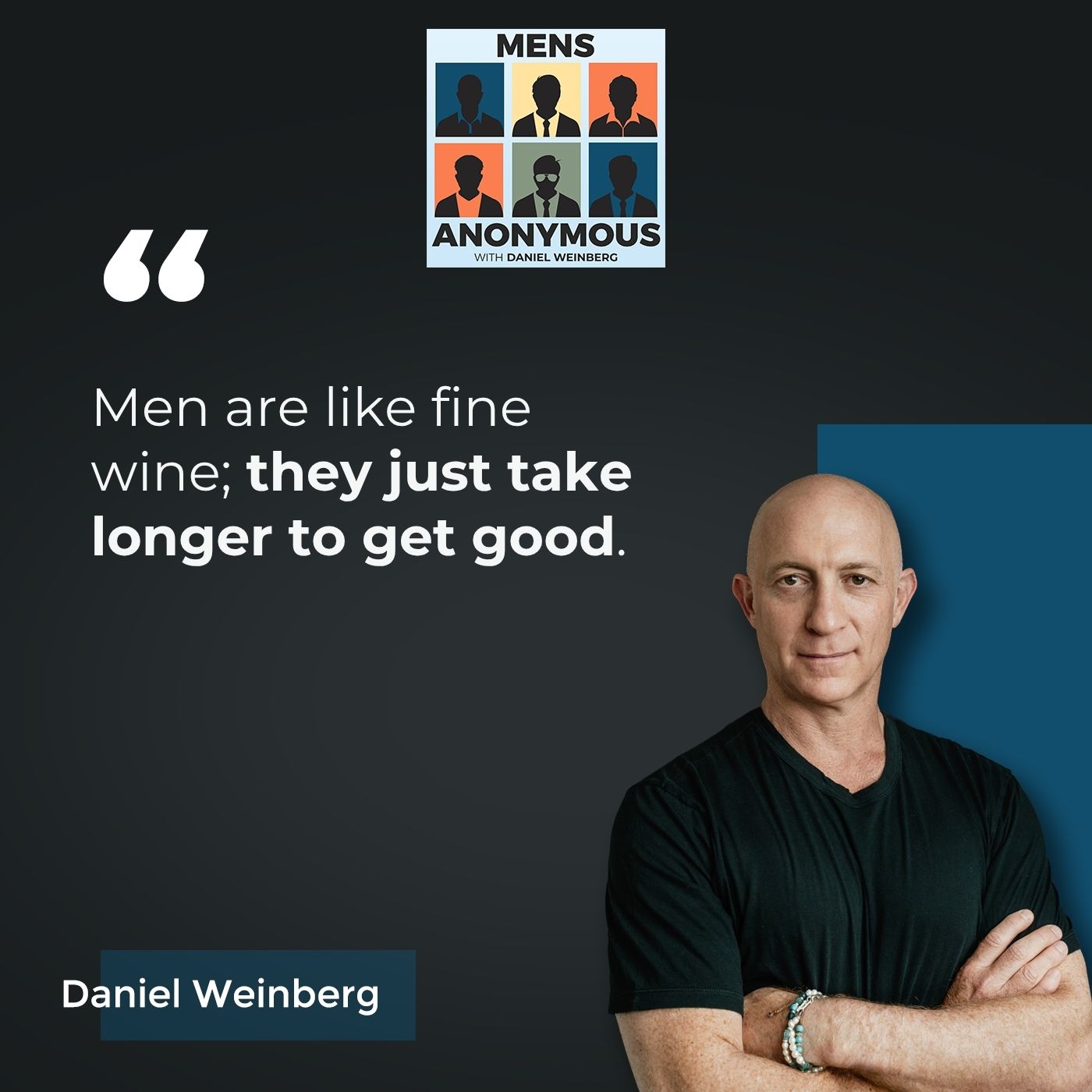
We spend our childhood building masks and ego defenses. The real work of adulthood is taking them apart and discovering who we truly are. Share on XI’ve said this before. I feel like men are like fine wines. They just take a long time to get good. That’s why I was asking you. If I had met you guys as a twenty-year-old man and I came to you and I told you what’s up, I do not know whether you would have been able to teach me or give me the really all the tools I would need? You would teach me stuff that I wouldn’t even understand. As I said, I’d understand it academically, but I do not think I understand how to apply it. I have not had the experience of relationships and issues, and this thing, good things and bad things. I do not think you know it until you get put through the wringer.
Daniel, I have two sons, and I’d love to go to them and just be an authentic human and just live free and be honest. I’m already watching them naturally, start to lie and start to hide things, and I’m like, “They get to go on their journey, and I’ll be here to support them through all of it. I wish I could, but you’re talking about development. We’re developing creatures.
What I’m saying is maybe it’s just the age, but I’m more aware, and you will see it. This evolution or this work that you’re talking about, I’ll generally see it in the 45 to 55 range of where that starts. It usually revolves around some midlife crisis, whether it’s career, whether it’s the relationships gotten to a point where we’ve been in it for a while, and it’s stale, or like whatever, it could be financial, or like some crisis within their life happens.
To use the analogy of The Lion King, I think most of us can relate to that story. That’s why it was such a popular movie when it came out. Here’s this kid who has everything. He’s the chosen son. All of a sudden, he has a falling out with his own life, and his shame sends him into the wilderness with a couple of boys to party with for a few years until he becomes mature. The old wise one comes along and smacks him in the head with a stick and says, “You’ve got to remember who your dad is.” He has this experience with his dad, where his dad reminds him who he is.
All of a sudden, his purpose comes to light. You’re right, Daniel, that no matter what we do, I think we can do some good in the world with our young men if we could teach them some emotional literacy and if we could teach them some tools, but we will never stop them from having to navigate their own experiences like Simba losing his father and feeling responsible. When they have to navigate those things, and this is what men do not understand, they get kicked around a couple of times, and they find themselves on the sidelines of life sitting in a cubicle, numbed out, needing to go have a beer tonight and look at some porn on the internet.
When in reality what they needed to do was get back in the lot in their life and say, “What I’m sitting on right now is a gold mine if I’m willing to go do the mining.” That midlife crisis sometimes is the stick on the head that’s like, “You’ve got to go mining now, buddy. You’ve got to go find out who you are.” Some of your life experiences are going to be so valuable to yourself and other people if you’re willing to go cultivate the treasure.
Rediscovering Peace Through Authentic Identity
Brandon.I’m going to finish off with one last question. I am starting with you first. Can men really change from the core person that they are? Can they be changed?
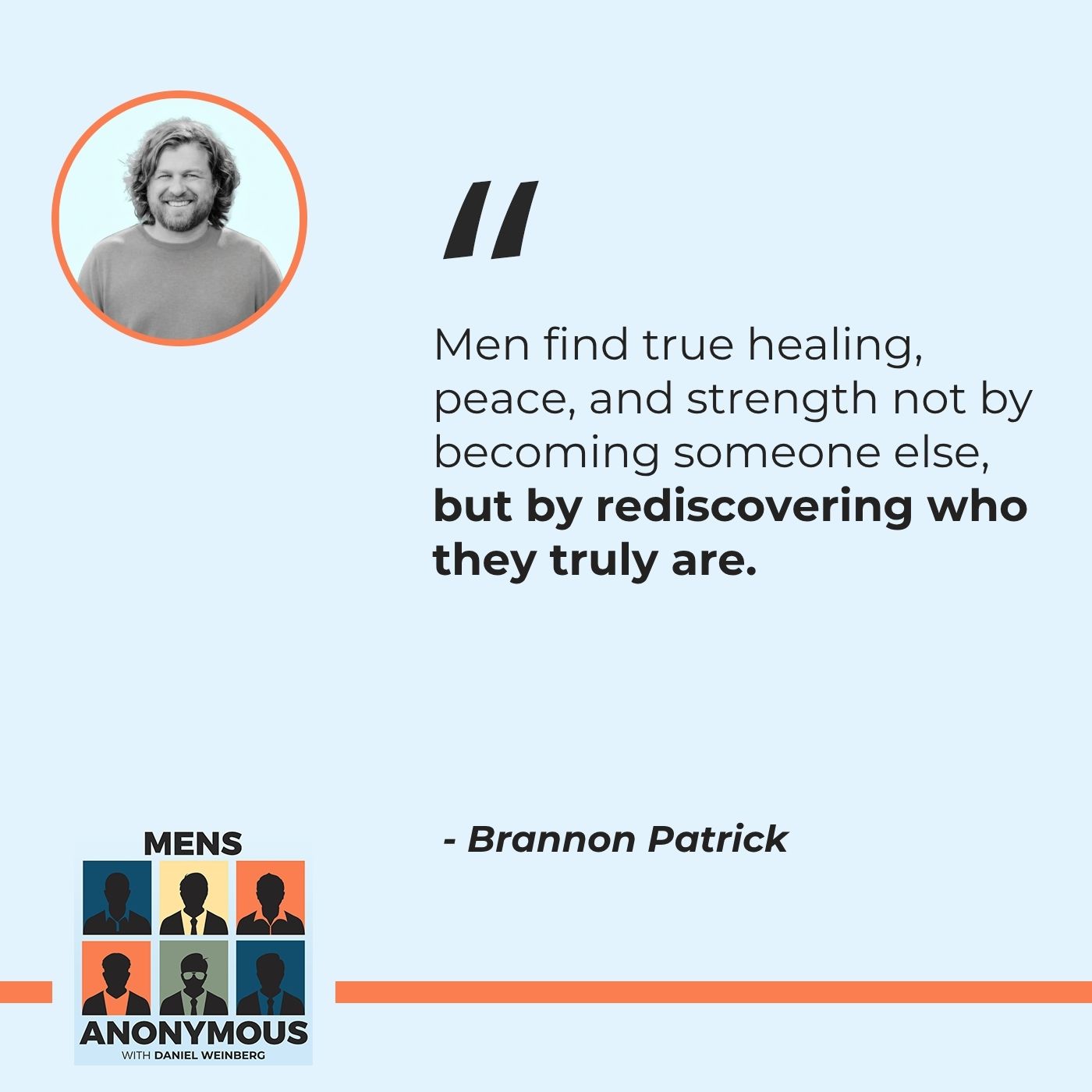
I’m going to answer that in a way that the answer is yes. What we see is that men actually find peace and healing, and like to resonate in a state of real power and peace. Not when they change everything about themselves, but when they actually rediscover who they really are. Goodness is already in them. Their worth is already in them. Their ability to love is already in them. That change that we see is actually a coming back to self, and like knowing and getting grounded.
Version 3.0.
Tyler and I, I am so blessed, Daniel, for my life and my career. We get to see it firsthand. We see men break down, and we see men build up, and we see men create amazing things, and just go from the darkness and hell to actually living in a state of light and creating good relationships and all kinds of good stuff in their lives. The answer is yes, and it’s a beautiful thing to witness.
Tyler, concur?
I 100% concur. We just had an event this weekend. I did not get to make it because of my daughter’s graduation, but we were living the answer to your question this weekend with a group of men who got together simply to get together and go have an adventure. We climbed some mountains, did some cold plunging, some sauna, some fly fishing, but the best part of it was the nighttime around dinner time when the guys could get together and just finally open up and be themselves.
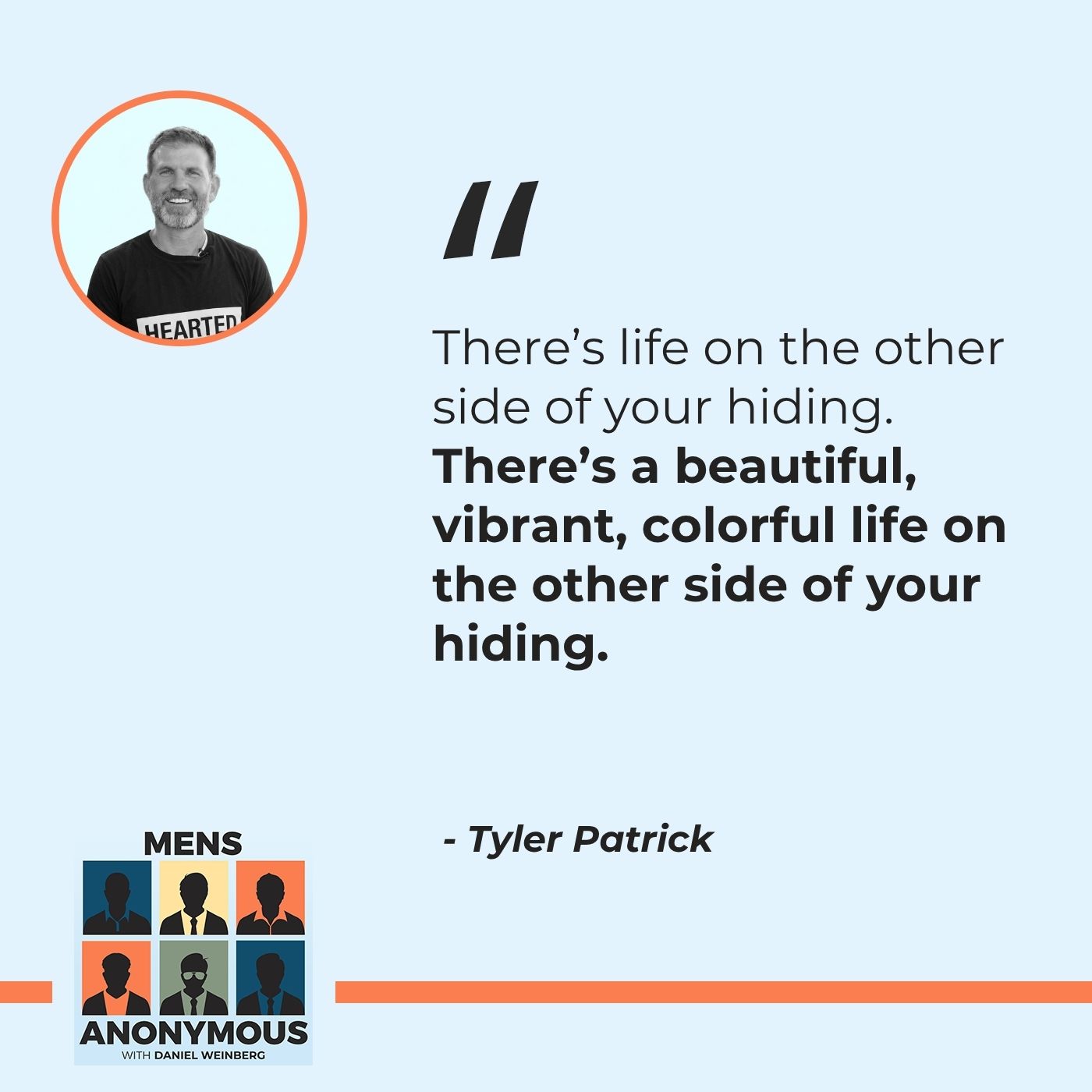
We see this day in and day out, and I’m looking at myself in the mirror, and I’m going, I’m a totally different person today than I was twenty years ago when I was lying to my wife and keeping a double life. There is life on the other side of your hiding. There’s a beautiful, vibrant, colorful life on the other side of your hiding.
The Therapy Brothers love it. I ask you at the end of every one of my shows, I ask five rapid questions. I’ll ask them. Brandon will go first, and Tyler will answer second. Just to make it smooth. I’ll start off with the first one. Who would you like to say sorry to, given the chance? I got a lot of them.
I would say, honestly, this is a random answer. Some of my old business partners, I was young, I was naive. I wouldn’t mind an apology back, but that’s not a good apology. Some of my old business partners, I’d love to sit down with them and just say, “Water under the bridge. I’m sorry about the things that I did.”
Tyler?
The first name that comes to mind is a guy named Joseph Shive. I have never been able to find him. If you’re tuning in, Joseph, I hope you are. You found Daniel in his goodness. I’m sorry for everything that I did as a kid to treat you the way that I did. If you ever hear this, I hope that you find it in your heart to forgive me.
Beautiful. What are you proud of being or doing in your life?
I am proud of stepping into Vulnerability and courage every day, and I’m really proud of myself for that. Some of the arenas that I’ve stepped into include things like going into a church and talking about porn and sex and giving a presentation on that, or sitting in a really difficult, tough group with clients, and where there’s a lot of emotion going on. I own that arena. Step into that. I’m proud of myself for that.
I’m proud of being a father of four daughters and feeling the calling as a father of four daughters to be in the arena of helping fine and train the men that my daughters can and want to marry. I get to do that every single day, and it fills me with passion.
When did you receive kindness while needing it most and expecting it least?
Honestly, this is at the forefront of my mind. I’m going through a lot right now in my life, and actually, I’m needing some kindness, and I do not tell anybody that. I was in a therapy session last week, and I got out, and a friend who lives about 25 minutes away texted me he’s like, “I just dropped by your office, and I left you an iced coffee in the fridge. Enjoy.” That meant so much more to me than just like a little iced coffee that he got me. That little gesture was massive for me.
I’m thinking of the time when my wife finally found out about my double life, and I was all crashing down, and I found myself in a church leader’s office confessing all of my problems and sins, expecting massive church discipline and complete judgment and rejection. Instead, with tears in his eyes, he came across his desk and put his arms around me and gave me a hug, and told me that he loved me. Something in that shifted me completely.
What did your mother or father teach you that you frequently remind yourself of?
For good or bad. Every time I see a big meal. My father taught me that food is good. Something about my dad is that he had an eye. He was always looking to serve and help and look for the downtrodden, and he was one of the only ones that I could see who would actually step up and follow through and truly go help people in need. He was over at all the widows’ houses in our neighborhood all the time, just serving and helping them. My mom is coming back to what I said about stepping into arenas of courage, like that’s her. She has a bad ass. She would step into things. She set a great example of not shying away from the hard. I’m really grateful for both of them.
Right along the same lines. When we were young boys, I was probably eleven, and Brandon was ten or so. My dad went out to the store with us, bought a lawn mower, and then brought it home and put it with bungee cords to the back of our bike and said, “Go down the street. You got a new lawn job. I’m going to go teach you how to mow lawns.” Years later, we were mowing several lawns. Got into a commercial business together through college.
One day, I came home, and we were late, and we were traveling, and it had been raining, and I showed up after school. When I was driving by our house, we went by one of our lawn jobs, and my mom was out there mowing one of our lawns for us because we were so far behind. My parents were just people who loved to serve, and I think they planted that in our hearts, and planted it in my heart, and that’s probably my biggest lesson.
Finally, what’s your superpower?
Simply put, it is connecting to other people. I’m not trying to brag, but I got three phone calls from people in need, and I’m a safe space to listen, and I think that’s a superpower.
My superpower is just being really genuine with people. I’m not the smartest guy in the world. I’m a pretty hard worker, not the hardest one in the world, but what I am is pure of heart, and that’s what people are drawn to. That’s my superpower.
I love it. The Therapy Brothers really appreciate you coming on the show, and it was just a really good chat. Thank you.
Thank you, Daniel.
Thank you. It’s a pleasure.
Important Links
- Brannon Patrick
- Therapy Brothers
- Therapy Brothers on Instagram
- Therapy Brothers on YouTube
- Reclaim Your Heart
About Brannon and Tyler Patrick
 Brannon Patrick, LCSW, and Tyler Patrick, LMFT, are brothers and licensed clinicians who help individuals and couples heal after infidelity, addiction, and the trust rupture that follows. With more than 20 years each in addiction and trauma work, they bring depth, honesty, and practical insight to the healing process, translating complex psychology into clear next steps people can use immediately.
Together, they host The Therapy Brothers, a weekly call-in show where real people work through betrayal, shame, trauma, and addiction in real time. With over 500 episodes and nearly 2 million downloads, their approach centres on heart work: healing the underlying trauma and shame so couples can rebuild trust through honesty, accountability, empathy, and healthy strength.