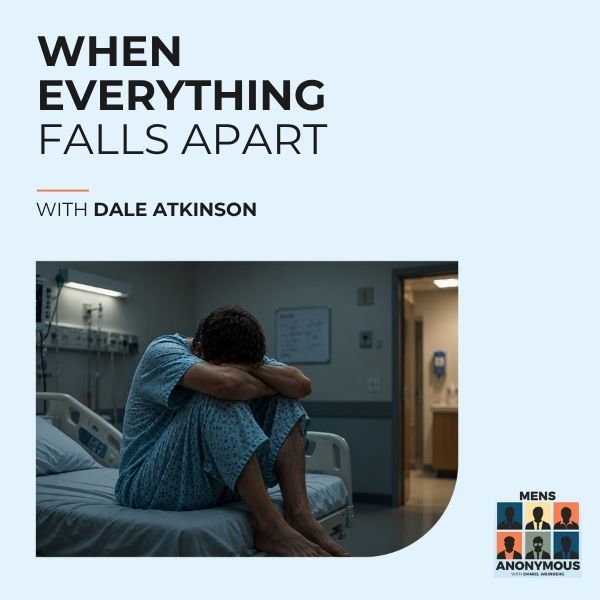
When Dale Atkinson was handed a terminal stage four esophageal cancer diagnosis, he didn’t just accept the prognosis—he audited it. A former finance executive, Dale applied his high-level analytical skills to build a rigorous cancer treatment strategy that defied medical expectations. Joining host Dan, Dale shares his journey from palliative care to “no evidence of disease,” detailing the integrative approach that saved his life. Through his work with Clear Signal Partners and Peak Health and Fitness, Dale now helps others navigate the complex healthcare system and reclaim agency when the experts offer limited options. This conversation is an essential roadmap for anyone facing a health crisis, proving that rock bottom is not a destination, but a foundation for a new beginning.
—
Watch the episode here
Listen to the podcast here
When Everything Falls Apart With Dale Atkinson
Facing The Terminal Diagnosis: A Journey Of Self-Advocacy
On this episode, we have Dale Atkinson, with whom we talk about what happens in life when everything falls apart.
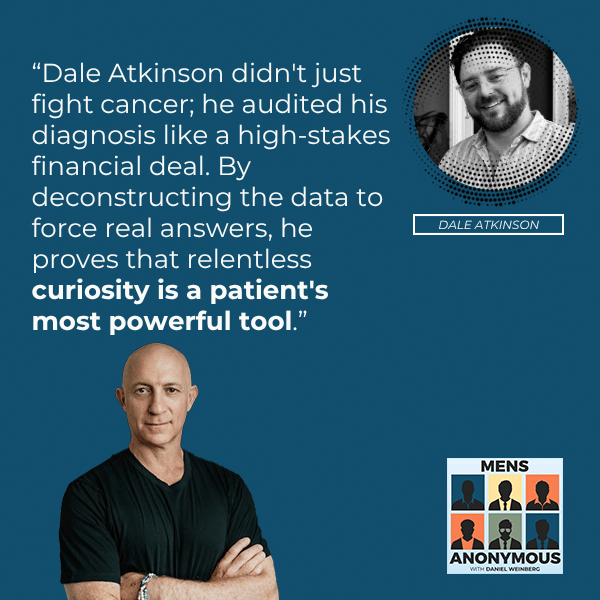
Dale, so good to have you on the show.
Good morning, sir. Thank you very much for having me.
This is great. This is quite an intense story with a really positive ending, to just frame it for the audience. It is not all negative. It is a negative that provided the gift, many other gifts to you and your family. I am going to dive straight in and just set the scene. How long ago are we talking about when you were told about your cancer?
It is probably important to note that, in the summer of 2024, before my cancer, it was actually my partner. She had a funny turn in the summer of 2024. They thought she had had a heart attack, took her into hospital, full blues and twos, lights flashing, paramedics on her thing. Though she had had a heart attack, she ran some tests, and they found out she had lung cancer. Very much before my journey, my partner actually then went in and had a full lobectomy. The entire upper right lobe of her lung was removed. It was twelve days later that we found mine.
Your cancer was, if my memory serves me correctly, a stage four cancer, and they were telling you to prepare for your end of life. Is that correct?
Yes, exactly. I had a stage four esophageal adenocarcinoma. Essentially, at the junction between your esophagus and your stomach, I had a nearly 10-centimeter tumor, and then it had metastasized quite heavily across my inside. There were lymph nodes and all sorts of other bits and pieces all over the place. Unfortunately, they gave me an eleven-and-a-half-month prognosis and told me I probably would not make it much past that. The chances of even making it two years were bought at a lottery ticket level.
You are here talking about the future.
I am.
I want to ask you, just as a starting point. When you were told that you had the end of it to start preparing for the end of life, tell me what was harder. I really want the audience to understand. Was it harder being told you had cancer? Was it harder telling your partner? Was it harder thinking about how you are going to tell your sons? Talk us through psychologically where you were at that moment.
At that point in time, my cancer was actually found on my youngest son’s first birthday. On the 15th of October, 2024, my son was turning one, and I was having my endoscopy. He was not really old enough, and my eldest was only just about to turn three. They were not really old enough to understand anyway. Telling them was not too much of an issue. My partner was actually in the room with me when we got the diagnosis. We had some family over because she had just had her lung operation. We had her parents over from the US.
They were looking after the kids when she came in with me. It’s very unfortunate for me as well. A couple of days before, I was actually given the news that I was in palliative care only, do not pass go, terminal cancer, all these sorts of things. My mother actually passed. On Sunday night, my mother passed. We found out on my eldest little boy’s third birthday, which was Monday morning. On Thursday that week, suffering with grief with a partner who had just been through their own lung cancer journey, not knowing what was ahead of me, I walked into my oncologist’s office.
They shook my hand, sat me down, and said, “Look, really sorry, Mr. Atkinson and Mrs. Atkinson.” Anna and I are not married, but we call each other married. “I am really sorry, Mr. and Mrs. Atkinson. It is terminal. It is stage four esophageal cancer. We can only offer palliative care. There is no curative option for this. I am really sorry. It is terminal. This is the end of the line sort of thing.” They handed us a children’s book called Mummy Goes to Hospital in which the mum gets chemotherapy, gets cancer, has chemotherapy, gets treated, and is kind of fine.
We went, “That is not really the story you are telling us. We are going to live.” We took that home for the kids. The kids fell in love with it just because it resembled the reality for them at that point in time, and we wanted to give them a bit of hope. It is a very strange situation. In all honesty, I do not recall any of it being particularly much harder than the next bit because it was all pretty bad as it was. I think in that whole situation, probably the worst single bit for me was after the endoscopy, where they actually found the cancer, and I already knew it was cancer. They told me.
Before I had the diagnosis, I went up to tell my mother. My mom was unfortunately unwell herself at that point in time. Ironically, she was a palliative care nurse for her entire career. Telling her, because we were not on the best of terms at that point, as families do, have our fallout, telling her was the hardest bit out of it. Unfortunately, I told her on Wednesday, ready to go in and hear what it was the following Thursday, and she died that Sunday. That was the hardest bit for me was coming to terms with that.
From Finance Executive To Patient: Redefining Success
That is full on. Let us rewind a little bit because I just want to show the dichotomy of life. If we rewind just a little bit before that, you were doing really quite well in your career. You sold the home already. You are thinking about moving to Spain, raising your young boys by the beach, and just building financial security. If you go back then, what did success mean to you back then?
Back then, I had come from a nearly twenty-year career in finance. I had sat on the board of multiple big entities, from HSBC’s Alternative Investments through to doing projects for Deutsche Bank, BMW, Mellon, for all of these huge companies. I was paid thousands upon thousands of pounds a day, not a month, not a week, not a day sort of thing. I was living a really nice life. We had everything we could want. We went on a holiday whenever we wanted. We had a nice big house. We had a Great Dane puppy at that point in time. We had everything.
Did you think about health at all, in how valuable health was, or was it more taken for just assuming that it is all good?
It was not even just that. I used to play rugby at a relatively high level when I was a kid. You can see this is actually my old gym, as you can probably tell by the punching bag, the boxing gloves, and I have a treadmill next to me. We took health relatively seriously enough to have one of the rooms in our house dedicated as a gym. I was 6 foot three, 120 kilos, in the gym every other day of the week. At that point, I was a big guy. I was doing a lot of exercise. I was doing everything right. I was a vegetarian and did not eat massive amounts of carbs.
120 kilos and vegetarian.
Yes. It is not the biggest. I was either. I have got up to about 130-odd kilos as a vegetarian athlete. I played rugby to a semi-professional level. I was in the Bath Academy team and all this stuff. It is one of those. I have always been able to be big. It is part of my genetics. I have always been relatively fit. I did have a period like we all do, where I smoked and drank too much as an early twenties. I had sorted that out. I had quit. I had gotten fit, especially during my eldest boy’s pregnancy. I was super fit, athlete-level fit. I was carrying about 9%, 10% body fat. I was really super fit.
120 kilos, 9%, or 10% body fat. Sorry to digress, how do you maintain so much muscle mass as a vegetarian? What were you eating?
Lots of halloumi. Lots of nuts, lots of halloumi, lots of fiber. I got a decent amount of protein, but I was not one to watch my macros. I was not one to sit there and obsess over how much protein I was getting in order to build myself. I was just trying to keep fit. I was just trying to get myself into a position where I felt happier and more comfortable with my body. I have always been a big guy ever since I was a kid. I have never really eaten meat, not even since I was teeny tiny. It is just not in my diet, despite being from a farming family, very controversial.
I have got a brother who is a chef and a mother who was from a very long farming lineage. Everybody in my household ate copious amounts of meat. My dad is Ugandan as well. He is very much meat, meat, meat. There was, I would say, little old me, but a big old me who was a vegetarian. I have always been big. I have always been able to put on muscle very easily. Even now, whilst I am recovering from treatment, etc., you can see I am not little. I have got a decent set of shoulders, etc., on me. That has all been rebuilt after chemo and everything else. It is just my natural state for some reason.
Hitting Rock Bottom And Finding The Will To Fight
That is amazing. Let us go to the day that everything changed. You have the endoscopy, you hear the words, it is cancer, stage four, incurable, inoperable. Palliative care only. It is like do not pass go, go straight to ground, go straight to jail. I really want to dig in here. What happens psychologically when you are given such dark news? What happens in that first 24 hours? You get the news, you go into the process of processing all this information. What is going through your head? What are you thinking? What are you feeling? Do you go into fear? Do you go into denial? Do you go into anger? Do you go into action? Did you cry? What happens? Talk us through it.
I am not a crier. I never have been. Not being out of some masculinity thing. I am just, I am not a crier. I may take a deep breath and excuse my language, but get on with it. That is who I am, that is part of my nature, that is how I have always been.
You are highly resilient in general.
That is partly born from my mum, to be honest with you, where she was a palliative care nurse, where she was a district nurse, where she had been a nurse during things like the Brixton riots and all these sorts of things. She was a tomboy and somebody who, no matter what, got up and got on with it. She modeled that for me. My dad was very much the same. They both, no matter what was going on, got up and got on with it. It was hell, high water. You would get out, walk the dog, and you just get on with life.
Those are the values that you were brought up with at home.
Had modeled for me. There was no other choice at that point in time for me than to do the same. In terms of the emotions I felt, I do not think there was that much space in my head for all of it at that point.
Did you have anger? What was it?
It is a bit hard to describe, but essentially, with my partner, she was literally in recovery. It was a three-month recovery. She could not pick the kids up, blah, blah, blah. There was me going in and out of the hospital, then my endoscopy, then my mother dying, then me being told I was terminal, all in the space of three weeks. I was 19, maybe 20 days in total between all of that. It was overwhelming.
Instead of any singular emotion, I went into overload with all of it. I came home, I opened a bottle of wine, and I sat there just quietly, just sipping a glass of wine for about an hour, two hours, just letting everything that happened play through my head. I do not think there was space for any singular emotion at that point because it was a melting pot of everything. I had, first of all, a bit of relief.
Are you feeling sick? You are feeling like you have no energy, a little lethargic, fatigued? You are not feeling any of that from them, even though they have diagnosed you. The physical effects have not taken place yet.
The first thing I felt, to be honest with you, was relief. After the shock, after the whack of it hitting me, which was very much in the oncologist’s office, they blurted it out, you would say, “Do you have any questions?” I went rabbit in the headlights, “No,” and walked out like that, sat down, had my glass of wine, and the first thing that came over me was relief in a very weird sense. Not relief at, “I am terminal, that is great, I am going to die,” but relief because in my head, I had built up this scenario walking into my oncologist’s office. You do not know what is going to happen, you do not know how you are going to feel, you do not know if you are going to break.
It was a relief that it had happened. Now I have that information, and I am somebody who bases everything on information. Information is my life. I like details and data. It is one of those that I now have a data point to start from. It was very much a, “This is where we start. Where are we going to end up?” It was, “Do I focus on my quality of life and just go and not have chemotherapy, go and enjoy my time with my little boys, and go on every holiday we could possibly imagine as quickly as we can because I might not have much time?” They were telling me it was sub a year.
No points of darkness?
Not at that point. After getting towards my mom’s funeral, very much so. The big dark turning point for me was when we actually had to hand back our Great Dane. We had a two-year-old, absolutely just amazing Harlequin Great Dane puppy, whom I had spent so much time training. He was my heart. I loved that dog so dearly. We gave it back on his second birthday on the 8th of November because I was hospitalized more than I was home. My partner could not pick up even. She could not pick up our kids, let alone take a Great Dane at 70 kilos for a walk.
The poor dog was either locked in his crate because my partner was dealing with a 1-year-old and a 3-year-old, and a very ill partner who she was coming out to pick up from the hospital at two in the morning, or drop off, or whichever, all the time. She was barely sleeping. We had no family nearby. Her parents had flown back to the US. My dad was over in the Channel Islands, where he lives. My brothers live in Australia, and my mum had popped her clogs. We had no support network. We had only just moved to our village a year or two beforehand.
With setting up business at that point, with Anna’s health journey in mind, we had not had time to make friends. We had nobody and nothing to support us. We were not aware at that point of any charities to help us with the dog or anything else. Nobody had popped up and told us yet. The only logical decision we could make was to ring the breeder and say, “Look, this has happened. This is where we are. I am very unwell. I was told at that point that I would be in a hospice by January.”
They had Sue Ryder, the nurses from the hospice, coming to see us at our house, knocking on our door, going, “Look, we really think you should book ASAP. You need to book a bed in, you need to book a bed in.” They turned up like three or four times. They were quite persistent with the fact that I was going to need a bed pretty damn soon. We had to. The darkest thoughts set in around that. We handed back Duke on his second birthday. I took my little boy, Axel, with me to go and drop him off because I could not do it alone. It broke me.
Just mentally destroyed me with the grief of my mother, then losing my dog. Hearing him howling at the top of his lungs as I walked away from the breeder’s house, it wrenched inside of me. Two days later, I ended up in a palliative ward. I started having pain issues. My tumor was actually pressing against the same cluster of nerves that twitch when you have angina or a heart attack. It was pressing against it, so I had 24/7 heart attack pain. Constant. It was the same pain as a heart attack 24/7. I was in massive amounts of pain.
At that point, nothing, because I had, as part of my own journey, already started taking things like low-dose naltrexone, which is formerly used to get people off of heroin, but in very low doses, has antitumor effects, and there is the low-dose naltrexone trust around trying to get information out about it all these sorts of things. I contacted them, and they got me onto low-dose naltrexone because that interacts with the opioids. I could not take anything. I was on a bit of paracetamol at most, and I was then in hospital for these pain issues.
They did not put down any of my medical stuff on the paper, and gave me a huge, whacking great thing of morphine. They gave me pregabalin. They gave me all of these very lovely and wonderful addictive opioid drugs. It made me feel absolutely horrendous because they all interacted with the low-dose naltrexone, so I was feeling horrible, but getting very little pain relief, and feeling horrible from these things. I was on like 3 or 4 times the normal dose of morphine for somebody just walking in. They had to get the palliative care team involved, and I had to be put into the palliative ward. People are dying in beds next to me, and I was whacked out on opioids.
At that point, I very seriously considered multiple times ending my own life. I was sitting in that bed thinking, “If this is how it is going to be, this is not how I am going out.” I had seen our old boy in his eighties screaming all night long next to me in the bed. He very loudly died with nobody coming to his aid, with the screaming. It was a good hour or two after he died before anybody came to see if he was okay. Public institution. This is in the NHS. Please do not get me wrong. I am not hating the NHS in any way, shape, or form, but this is just my experience. I love the NHS. I use the NHS.
It is a wonderful institution, but it is one of those. Nobody came to see this guy because he was obviously screaming a lot constantly for days, and nobody thought, “Maybe something has happened because he has gone quiet,” and he had soiled himself. You could smell it all in the ward. I was three feet away from him, and he died very loudly. I woke up in the morning. I did not sleep for about 3 or 4 days. I also had not eaten because I had a 10-centimeter tumor.
The only thing that I was being offered to eat was plain cheese sandwiches, and obviously bread getting past a massive tumor, not a thing at all. I did not eat for that whole period, so I was starving. I was whacked out on morphine. I was listening to people screaming, dying next to me in the night. It was not a pleasant experience, and I had not slept for days. Every time I fell asleep, a doctor would come and prod me to ask me questions that were generally unnecessary.
I was in the worst, horrible, most insanely broken place mentally. At that point, that is where the emotion came through. It was the emotion of absolute despair. It was, “This cannot be my life. This cannot be how I go, and this will not be what happens to me.” That was also very much the turning point of all of this. It is when I realized that that is the bottom.
This cannot be my life. This cannot be how I go, and this will not be what happens to me. Share on XThat was your low point.
It was rock bottom.
You did what with that rock bottom piece?
Applying Investigative Skills to Decode Medical Data
I used that on top of the grief that I had been going through at that point in time. Plus, I was very lucky to have a very particular skill set, not to sound like Liam Neeson, but having spent a career in compliance, my job was to read through massive things of regulations. It was to research, it was to find the needle in the haystack. I have investigated presidents and prime ministers. I have investigated money launderers and fraudsters globally. I was nearly employed by a certain government down south of the equator in order to go and investigate their former prime minister and all this stuff.
I am very good at what I do, and I am very detail-oriented and very research-led because of it. It means that I can interpret language better than most, in that I can understand things that are written in legal language, which very quickly translates across to understanding things in medical language, and being able to pick through huge amounts of data and research in order to find those needles in a haystack. I took a brief look.
This is pre-AI engines, etc.
No, this is about the time that AI was, I think we were on version two, maybe three of ChatGPT. It was a very hallucinatory land. You would put in something, and it would get very confused. It would give you a roughly correct-sounding answer, but not quite enough to be actually true. I did try going the AI route at various points at that time. I did use it for research as well, but I actually created my own custom GPT in order to do that because I had to create the guard rails that ChatGPT did not necessarily have.
I had to focus it on a very specific dataset, and it helped. To be honest, it was more to identify potential to read myself rather than actually extrapolate the data or do anything like that. It was, “Can you find me the five newest research papers on this tiny little bit of science that is very fringe, and it is really difficult to find?” It was that side, not the “Please tell me exactly what to do. Create me a protocol of wonderful unicorn things, and I will be fine.” Unfortunately, it was not that advanced. I cannot remember what we got to.
You got to your low point, and you decided to fuck this. I am taking control here of what happened. You guys are all clowns. You are not giving me the full data set here. You just basically give me some limited options.
An interesting point on that in terms of not giving me the full data set. I had also, at that point, and it was a week or so after I had ended up in a hospital at that time, I went and had a two and a bit hour long meeting with my oncologist in which they brought in senior nurses, they brought in a nutritionist. The nutritionist sat me down and very firmly told me that I needed to eat as much chocolate and ice cream as humanly possible, despite the fact that the science very much says, and there is a Nobel Prize-winning piece of science around how cancer is glycolytic, called the Warburg effect.
It was written by a guy in the 1930s called Otto Warburg, who proved that cancer, in most cases, not all, was glycolytic. It is why we do PET scans, where we feed radioactive sugar into the body to trace where it goes, because cancer sucks up sugar more than anything else. You can trace cancer through sugar. Cancer is known to be fed by sugar.
A high-sugar diet is the worst thing you can do for cancer and for inflammation as well, because the glucose causes basically a corrosive effect inside your body. It is really not good for us. It is why, in this modern era, where we have lots of glucose and hidden sugars in our foods, it is why there is so much inflammation, and there are more and more chronic illnesses around. It is because of the amount of sugar.
Sitting there and hearing a professional, very credible professional sit there and tell me, “No, you are very wrong to want to do a low sugar diet. You need to do the opposite. You have lost 50 kilos. You need to eat lots of sugar because that is how you will get through chemotherapy,” despite the fact that science said the worst thing you can do for chemotherapy is harbor lots and lots of inflammation and therefore sugar was a really bad idea. On top of that, they sat there in front of my care.
Did you have the right data to engage with them in these discussions at that point? Were you arguing with them, or did you just accept what they were saying?
No, it ended up a two and a bit hour meeting where they threatened to pull my care because I was arguing with them. I understood the science at that point in time. I had spent sixteen hours a day, pretty much not long after my mum’s death, and I found out I was palliative. I had already started researching and reading at that point. I had really gone into it after that hospital stay. I had decided that I had to basically find ways to make the experience better, that I could not end up on a palliative ward like that. I had to try to find ways to improve my life as it was.
I was 16, 17, 18, sometimes even 20 plus hours a day, buried in research and understanding exactly what things were happening in me. I had already then come across next-generation sequencing to get my genome mapped to work out exactly which pathways my cancer had. I had already started reading and gone through Jane McClelland’s seminal book, How to Starve Cancer. I had already reached out and spoken to the likes of Thomas Seyfried over at Boston University, a very famous metabolic researcher who has been on Diary of a CEO and all these sorts of things.
I had spoken to 30 or 40-odd integrative oncologists globally. I knew not a hundred percent, not enough to go, “I know better,” but enough to go, “What you are saying does not make sense to me. What you are saying does not match the science. It does not match the NHS’s own guidelines, let alone anything else. Actually, why are you saying this? What is your basis for it?” Rather than going, “This is what I think,” I was going, “Why do you think that? Tell me what your information is,” so that I could gather that in, process it, and make the decision myself rather than relying on them too.
Of everything that has happened during my cancer, I would say the one thing that I always need to get across to people is that it is never about the protocol that you design necessarily. It is not about the individual, “I took this drug and did this, this, and this.” In most cases, it is about that self-agency. It is about the mindset of, “I will survive this.”
It is never about the protocol you design. In most cases, it is about self-agency. It is about the mindset of: 'I will survive this.’ Share on XThere are so many survivors with different approaches, different protocols, different takes. The one thing that comes across in all of them, as is covered in Kelly Turner’s seminal book, Radical Remission, is mindset. It is that belief, that self-advocacy, the willingness to stand up for yourself because you are the one who needs to survive, and you are the one responsible for your own health. Having that self-advocacy is amazing, and it is one of the best things you can do.
I am smiling because I recorded an episode with a Harvard Medical School professor whose focus is on mindfulness. He has been studying it for decades, and he talks about lifespan and longevity. He has been able to prove that you can increase it and have a happier life with mindfulness. The issue is it does not pay.
Pays Joe Dispenza pretty well, I think. It does not pay the pharmaceutical companies.
You cannot commercialize it. That is right.
One of the best things you can do for yourself is mindfulness. It is Wim Hof breathing in the morning. It is meditation in the evenings. It is journaling if that is your thing. All of these things are fantastic for you, and they really help to get your head in the right place to then be resilient and to fight back and to have questions for yourself and to be able to not put your agenda across, as it were, but to be able to fight for yourself in the way that you need to. The only way you can do that is by having the right frame of mind and the right drive.
Why do you think some people surrender while others fight?
A lot of us are taught that the system is right. Unfortunately for me, had my mother been alive, I think I would have gone a little bit that route as well. My mother, having been an NHS nurse for her entire career, since she was about sixteen years old, when she was in the NHS. She was very much a believer, especially on her own terminal journey with an immune disease. Her philosophy was, “I listen to the doctor.”
Even when she knew what they were saying was incorrect, “I listen to my doctor.” I think had she been alive, I think I would have had more drive to do the same. It was only through her death, through the grief, through the frustration, the anger, the despair, that all of the emotions you mentioned earlier, I think, just pile them all in together. It was that as fuel that allowed me to stray from that path. Otherwise, I would not have gotten to where I am.
Engineering A Bespoke, Data-Driven Cancer Protocol
What was your protocol? Talk us through what you did. You said that everyone has their own bespoke protocol. There are many things to choose from. I am curious to know. What was your menu? Talk to us through your daily protocol.
Mine is a very long list. What I think is probably an easier way to point it out is I started with data. I went to next-generation sequencing and got my genome mapped. As part of that, I used a company called Astron Health, which then ran that through their own proprietary AI and database of off-label medications, of chemo sensitivity, of all these sorts of things. They were able to provide me with a report of exactly which pathways my cancer specifically had, using my biopsy and a blood biopsy.
The genome mapping story, tell me what the point of doing that is?
They essentially took the biopsy that the NHS took of my tumor. They got hold of a copy of it from the NHS. They also take blood, which is known as a liquid biopsy, and they run that through a system that essentially breaks that down into the genetics, the DNA, and it maps out the individual genomes within my cancer itself. It looks at whether my cancer is glycolytic or whether, like most prostate cancers, are not glycolytic, they are fed on amino acids, so a high-fat diet, a keto diet, would be bad for prostate cancers. It looked at whether glutamate or glutamine was a feeder.
It looked at cortisol, which, in mine, cortisol being the stress hormone by the way, in mine, was a huge driver for my cancer, which was stress. The stress hormone cortisol was massively up there. It looks at whether there is differentiation in it, and looks at what possible treatments will work for my exact genetic setup. It provided, first of all, a list of which chemotherapies and standard treatments would be best. We then pushed to have my standard of care with the NHS aligned with that. They offered one chemo originally, and I said no and showed them my next-generation sequencing, and we managed to get it agreed because it was a standard treatment that I could switch to another one. It helped to inform us.
What was the company called that you said did it?
Astron Health. There were lots of companies.
They were born out of sequencing on a biopsy, basically.
Exactly. They provide a full AI run-through. Essentially, they break that down into the pathways and find the right drugs for those pathways. They pass it off to an integrative oncologist. I used a guy called Dr. Hariharan Kuhan, who was truly and honestly just incredible. He runs Alucio Health, a clinic here in London, and he is just brilliant. I would go as far as to say he is probably one of the very best integrative oncologists.
Say it again. I want to hear it really clearly.
Dr. Hariharan Kuhan.
He is based in London.
He is.
What is the name of the clinic?
Lucio Health. He is just truly brilliant. He then took that report, took blood tests, and took every bit of information the NHS had given me at that point. Looking at whether I had Lynch syndrome, looking at microsatellite instability, whether I had the BRCA gene, I did not, all these sorts of things. My PD-L1 score, which is an indicator for immunotherapy, he took all of that, and he then helped me to create my own protocol of off-label medications.
Using things like metformin, a diabetes drug to lower blood sugar, which essentially starves the tumor of sugar. We used propranolol, which is a beta blocker, in order to lower adrenaline and therefore lower cortisol. We used everything from ivermectin and all these things you hear about, not as anti-parasitics. We use them specifically for the pathways they block, and the combination of them allows me to essentially put pressure from multiple angles onto my tumor.
Do you know much about all these GLP-1, GLP-2, GLP-3s that come out like retatrutide? Would that also fall into the category of blood sugar management?
GLPs work slightly differently. They work by upregulating specific hormones within your gut that then fire off to your brain and tell your brain essentially whether you are hungry and what to do, and to change certain things, and slow down motility, and all these sorts of things. They are not normally suggested for people with cancer, unless you are hugely overweight. They do have specific mechanisms that are quite good.
GLPs work by upregulating specific hormones within your gut that then fire off to your brain and tell your brain essentially whether you are hungry and what to do. Share on XBecause of the osteoporosis risk, because of the various other problems that can cause with different gut bacteria as well, and they are realizing more and more, especially with the research into Akkermansia, which is a probiotic, they are realizing that the gut bacteria and gut flora itself can actually dictate the outcomes of cancer treatments. It can make huge gains, Akkermansia specifically, in immunotherapies. It can nearly triple, I think it is, the efficacy of some immunotherapies. It can also dictate, to a varying degree, your success in chemotherapy and your overall chances of survival through cancer in general.
I personally, from my research, stayed well away from GLP-1 inhibitors and GLP-1 insiders because they would mess too much with that really delicate gut biome. For me, and that is the secondary part, after the off-label medications, I went to a naturopath, a brilliant lady called Dr. Amanda King, who trained with Nasha Winters, who is a very famous naturopath. I looked at what is called the terrain. I looked at not just the cancer markers and how to beat cancer, but also how to look at my holistic health and how to put my body in the best possible position to, first of all, fight, second of all, increase my quality of life and lower the side effects from the chemo itself, and then third of all, to recover.
On the naturopath, what did the naturopath introduce into your protocol? What are some of the components there that helped you, let us say, rebuild your immunity and your energy, etc.?
My naturopath is also a nutritionist as well. She helped me to design a specific diet with macros around my dietary needs. She is normally quite heavily keto and carnivore-focused for a lot of these sorts of things because it has the most evidence for fighting cancer. In my case, because I was a vegetarian, she helped me to modify it.
You did not switch?
No, because I did not have the right enzymes to break down certain foodstuffs. By switching, it would have caused multiple issues in my gut. It would have caused lots of other things that could potentially have spurred the cancer to grow. It was not worth the switch. It would have made me more ill than it would have helped in any way, shape, or form. We found a way to adapt my diet to push things forward in the way I needed to, to adapt a vegetarian keto diet as close as we could get to the macros. I focused on that through the nutritional side and then the naturopathy side. My other half retrained in January 2025 as a phlebotomist in order to be able to take.
A what?
Phlebotomist, a blood taker, a vampire. She was able to cannulate me at home and give me IVs at home. She was able to take my blood, etc. We then took my blood every single month, sometimes even up to twice a month, and ran full blood panels. From that, you would pick out everything from drops in vitamin B12 to even the slightest bit of anemia. What was happening with my liver, my kidneys, my everything? Monitored hundreds and hundreds of different markers.
Do that like twice a year, and that is like a big deal. You are telling me you are doing that sometimes, up to twice a month, and then you are adjusting your levels on things based on that.
It was just a constant adjustment. It was making sure that everything was as optimized as it could be. Think of it like a race car. I went from the very worst prognosis you could get. What else was I going to do? I was going to tweak and tweak and tweak until it was perfect. Amanda was brilliant. Her brain is something else. She would piece together these three little tiny things in the corner up here.
Half an hour later, she would find something over here. An hour later, she would find something over here, and she would go, “Actually, this, this, and this. This is the knock-on effect for this. If we look at this, we find mold here, and actually, your MTHFR gene, the one Gary Brecka talks about all the time, is not firing properly.”
“You are not turning your B12 and folate properly using ferritin through the right process, the methylation process in order to produce glutathione or NAC, N-acetyl cysteine, and then turning it into glutathione, which is the body’s master antioxidant. You are not actually detoxing because of this, this, and this. If you fix this, if we change this, if we do this, then we will create this outcome over the next six weeks,” and all this kind of stuff. We went really heavily into the data, and she was just amazing for that.
Are you having enough energy at this time to be doing push-ups and exercising and stuff, or are you still quite weight building yourself up in this process?
I was undergoing chemotherapy at that point, so I was pretty weak from the chemo, etc. I was not doing much exercise. I bought a vibration plate specifically to lower the actual physical exercise. It allowed me to do very light weights and certain compound movements on the vibration plate, which gave two benefits. One is it does some level of lymphatic drainage, although the evidence there is a bit shaky sometimes. Second of all, it allowed me to keep up a relative level of health and not lose muscle mass without trying to exhaust myself all the time. I maintained relative.
Integrating Fasting, Autophagy, And Adjunct Therapies
Often, when it comes to chemo, it is said that you can win the battle, but lose the war, because it is blasting everything. What was your experience? You are trying to counter it. You are trying to counter it by trying to rebuild everything at the same time. Are you like, because you have nuclear, you are basically nuclearing everything inside, good and bad. What are your thoughts on or your experience with that?
That had initially been one of my focuses: increasing my quality of life and my ability to withstand chemo. We found a huge number of things, everything from intermittent fasting. I also did prolonged water fasts. I did a ten-day one before going into my first round of chemo.
Ten-day water fast.
Yes. I have done up to eighteen days as well during this journey. I recently did one.
The idea is to starve the cancer effectively.
There are a few different mechanisms at that time, and for the period I was doing chemo, the fasting was actually for its cell protection benefits. Because cells have a couple of different states, and they can essentially go into a dormant state where they protect themselves from toxins, from all sorts. They are busy cleaning themselves. They are busy detoxing and getting rid of stuff they do not need to because the body is in that starvation period and undergoing autophagy, which is its cleanup process, where it eats dead cells.
If you are in that stage, when you go into chemo, there is some evidence, and it is becoming quite a significant body of evidence, especially if you look at the stuff being released by Valter Longo around the fact that it can protect you quite heavily from chemo. It means that the cells do not take up the cytotoxicity there, the free-floating nastiness that is chemotherapy, the cells shut themselves down. They are not as open to receiving new stuff. Therefore, the chemotherapy has a greater chance to focus on the cancer itself, and it has less effect on the body. I employed things like that.
I used certain drugs as well, certain approaches. I did a keto-focused diet. I was detoxing through a sauna as well. There were lots of different little mechanisms and bits and pieces from high dose vitamin C, hyperbaric oxygen, red light therapy, pulsed EMF, lots of these little bits and pieces and adjunct therapies that I used in order to first of all, limit the side effects of the chemotherapy, second of all, to detox from the chemotherapy, and third of all, in order to increase the efficacy of it as well. For me, that is part of where I got some of the gains from focusing on trying not to let it damage me and destroy me completely.
At that point, I should also point out that it was very much about increasing quality of life, not about trying to cure myself. It was not, “I have got a chance of living through this.” It was, “I want to be as present and give as much time and effort to my children as possible. I want to spend as much time on my feet and not in a hospice as I can. I want to really try and make some memories, spend some time, live as long as I possibly can in as good a state so that my kids do not remember me as a whole.” As you see chemo patients on television, that drawn and sickly, I did not want to be that. I used all of these tools to stop that from happening.
Where are we today? Give us the current status.
The Timeline Of Recovery: Moving Toward Remission
I will give you one better. I will give you a rough timeline of things because I think it is a little bit important. I was diagnosed in October of 2024. I started dieting, fasting, and using adjunct therapies in November 2024. It then took me until January to have my next-generation sequencing back and to begin on an off-label protocol from my doctor, Hari Kuhan. From there, I went from being hospitalized more than 50% of the time over Christmas.
I nearly spent Christmas in the hospital. We gave up our dog. We do all sorts of things. It was not a nice place to be. From January through to March, my metastasis had vanished. My last scan had been in January, and by the end of March, when my next scan was, all of my metastasis, all of the twelve-plus lymph nodes, and the potential secondaries that were noted on my scans had all vanished. My primary tumor dropped by 20%.
That was during chemo, or that was during chemo?
That was after a couple of rounds of chemo. That was not directly attributed to the chemo. It was a mixture of all of it. I am the first one to say it was not the off-label use. It was not the singular thing that worked. It was the combination of all of it. It was using them as an adjunct, not as an alternative. It was the standard of care that gave me the tools. It was then the off-labels that allowed me to craft those tools into something precise. In March, I was very much on the path to recovery. By the end of the summer last year, there was some distal thickening of my esophageal wall that was remaining, and that was it.
Unfortunately, as we all do, I got complacent at that point. I went, “Great, I am nearly cancer-free. It is soon going to be NED, which is no evidence of disease. Now I am going to build a cancer clinic for everybody else.” I went, great, hell to the leather. Let us spend hours a day doing this. Let us go and do investor meetings all over London. While still an active treatment, this was. I still am at the moment, and it broke me. I went way too far over the top.
I was not eating very well. I was not in my protocol. I was not looking after myself, and it started to come back. At Christmas time, there were lymph nodes lit up. There was cancer coming back. There was more thickening of the esophageal wall, and I had to stop. Unfortunately, the concept I was working on at that point, I had to take a step back and refocus on the protocol, double down on what I was doing. As I sit here now, my last scan, which was in April, showed no visible disease.
There is absolutely nothing left. I have had no surgery. I did have chemo. I did have immunotherapy. I have done everything else I have talked about, plus a few others as well. I know no visible disease, hoping to get my PET scan, hopefully in the next couple of months, to show that I have no evidence of disease, which is as close to remission as they will give me. They cast me as incurable, inoperable, and they will never put me as cancer-free. There is always just no evidence of disease. That is the best I will get, and I will hopefully be there in the next few months.
Any drugs?
What sort of drugs do you mean? I have got medicinal marijuana. I have got some off-label medications. I still have a protocol. I am still using off-label medications in order to keep the pressure on the cancer. I will be for several years still. I am still on immunotherapy as we speak, but I finished chemo at the end of last summer. I will be continuing to use it. I have bought a hyperbaric chamber.
I have got an infrared sauna. I have red light panels and pulsed EMF mats. I am sitting on a grounding mat beneath my feet as we speak. I use all of these daily. The same as you get grounding sheets for your bed. It is essentially much like what people like Gary Brecka and all of the biohackers online talk about, which is making a connection with the earth. That is grounding. Getting out and putting your feet on soil is classed as grounded.
You got like a little mat filled with soil.
I will show you.
Show us.
Here in the UK, we have our electrics actually plugged through to a ground wire in the earth outside, which taps into that. It is attached to a plug socket, and it essentially gives me a longer range version that is tapped into the soil. It means any charge, and because we are beings of energy. Do not mean to get too spiritual, but we are literally beings of energy.
We are beings of energy. Sometimes, there is a buildup of energy that we need to expel. The best way to balance out the body is to make contact with nature. Share on XOur thought process, our mind, our brain, our synapses run on energy. Sometimes there is a buildup of energy that we need to expel somehow. The best way for our bodies to do that, and this is scientifically proven by the way, is to make contact with soil because of the negative charge in soil or the positive charge, depending on where you are and what, it helps to balance out the body essentially. This works on that same principle. Blown your head off.
You have definitely blown my head off. I want to bring it all together. If there is one of my audience out there who might be facing cancer, divorce, maybe sitting alone in his car, wondering how much more he can take just from life, what would Dale tell him?
We can tie that into lots of different things. Ignoring my journey, I think having sat on the board of mental health charities, having been involved with lots of mental health things in the past, having had friends commit suicide, having had friends just go through the most horrid, torrid time you can possibly imagine through various things, and then having had this happen in my own life. The one thing I would say to everybody out there is that rock bottom is a starting place. It is not a destination.
It is not where you need to end up, but where you should stop. It is a place to build from, and every great tower is built on solid foundations, and those solid foundations start as low in the ground as you can get them. If you are going through the shittiest possible time at the moment, there are always better days to come. You just need to keep going, and you need to advocate and believe in yourself in order to get there.
That is a really good place to wrap everything up. I am like, it is going to take me a while to process everything we have just gone through.
There is lots more to it than that as well.
It is a phenomenal story. What is your current focus? To finish it all off, describe your life. What you are focusing on is the family dynamic. Talk me through the whole, paint the picture for us, where you are at.
Entrepreneurship And Healthcare Innovation: Giving Back
There are a couple of things to that, I think. First of all, along my journey, especially given my finance background, I realized that there are a few gaps in healthcare. I used to audit businesses, look at risk, assess risk, look at enterprise-wide risk assessments, all these things for big companies. I have realized that healthcare does not use any of those tools. I have started a company in order to help, especially private health clinics, private healthcare companies, and health tech companies, to assess patient trust and then to quantify it because businesses need a revenue metric to quantify it in terms of revenue.
The main focus of it, although it does help businesses find more money and to retain patients and to better trust signals, the main focus is to try and help patients have a better experience with healthcare companies who are quite often built by doctors from a doctor’s perspective to solve an issue, but they do not always take into account exactly how the patient is feeling and what it means to a patient.
That is the first thing I am doing. The second is, while sitting in a chemo chair last year, I made the crazy decision to buy a health and fitness business, selling all the modalities and therapies that I use during my journey. We are about to launch hyperbaric oxygen chambers. We have infrared saunas, we have ice baths, we have red light panels, and we have pulsed EMF devices. We are about to launch a huge slew of new products.
What is the company called?
That one is called Peak Health and Fitness, and it is a UK company, so PeakHealthAndFitness.co.uk. The other one is called Clear Signal Partners. Clear Signal Partners is a trust auditing business where we help businesses to increase revenue through patient trust. I additionally have a couple of charities. First of all is around Hyperbaric Oxygen, helping people to get access to Hyperbaric Oxygen. The second is just awaiting the Charities Commission sign-off, which is a charity in a joint venture with Jane Mclelland, the author.
We are looking to campaign in the healthcare industry and healthcare institutions, so the NHS primarily, and then we are going to move on to the US globally, to push for change in the way that they look at and view evidence-based medicine. At the moment, the standard of care narrows itself in terms of what it considers, and it does not look at many modalities that are already approved and already there for use, things like mistletoe therapy or the use of metformin in oncology. They are evidence-backed and are trial-approved. There is a reason to use them, but the system does not account for them.
We want to push the system to do so in order to give patients the best possible chance at survival. With that, we will be releasing education, we will be releasing information, we will be trying to help individuals as well, as well as just to better the landscape for cancer patients and their ability to survive. Of course, top, Adam. More to write about stuff, which is The Life Organic. Now I can say that I am also a writer, and I also push out my story and information that I come across and research via my blog, which is TheLifeOrganic.com.
You are going to need to provide all of these links for the show’s bio or whatever it is, so I have got some notes, podcast notes so that people can actually follow. This is a lot of, I think, highly valuable information that could be relevant to so many people out there. You have done a lot of work up front. We can keep talking. I really want to keep throwing things at you here. Your views on whether you accessed any form of stem cell therapy during this whole process?
No, I did not use stem cell therapy. What I did instead was look at ways in order to increase my own ability to produce stem cells. There was some really fascinating research around prolonged water fasting and how, after around three days, when autophagy starts to peak, or they believe autophagy starts to peak, there is an uptick in stem cells produced within the gut itself that, if you then refeed properly and treat your body properly, those stem cells can help to bolster your immune system.
When I was having things like neutropenia, which is a huge drop in white blood cells, etc., I used that in order to help to increase and rebuild my immune system and to build it back again. I also used that in order to increase just overall stem cell activity and to then kick the immunotherapy on top and get that to really fight the cancer. Not in a standard way, but yes, I did take into account stem cells, and I did research them heavily.
Any natural killer cell infusions?
No.
NK therapies?
No. I did that naturally as well. You can increase NK cells via fasting. You can increase NK cells via various different modalities, so the modalities I used, but none were specifically designed to increase NK cells directly.
Finally, you have spoken quite a bit about this hyperbaric chamber situation. What are the deemed benefits of using hyperbaric chambers, and how often should you be using them?
First of all, the caveat is always speak to a healthcare professional. Everybody’s specific circumstances are very different, so what worked for me and my protocol will be very different from those of the next person and their circumstances. In my case, though, we did a lot of what we called kill cycles. We used high-dose vitamin C. It inspires a hydrogen peroxide reaction, and we are talking 100 grams via an IV in a session, massive whacking great dose for me. Always make sure you get a G6PD test before you do anything like this because it could be potentially fatal for anybody who does not.
Yes, I high-dose vitamin C, which pushes the vitamin C via the same pathway as glucose, and the tumor gets confused, pulls that in. The vitamin C starts to, at that level, create a pro-oxidation effect. Although vitamin C is known as an antioxidant, it can be pro-oxidant in high doses. That then creates a hydrogen peroxide reaction inside the tumor itself, which does two things. It first of all alerts the immune system to the fact that the tumor is there because it gives off the signals that its cells are breaking down.
Second of all, it burns away essentially from the inside of it, hydrogen peroxide being extremely acidic. With that, I then added in artemisinin, which is artesunate, or I think it is black walnuts, or whichever one you want to put it in, wormwood. It helps to inspire the hydrogen side of that reaction. Getting straight into a hyperbaric chamber increases the availability of oxygen for that hydrogen peroxide reaction as well. It forces that reaction to be more effective and more efficient, producing more hydrogen peroxide and therefore more breakdown of the tumor, therefore more alert to the immune system, etc. I used it for those sorts of things.
On top of that, I use it on separate protocols for dropping the immune markers, the inflammation markers, not immune markers, and increasing the immune system as well, around fasting. The one thing I would note for the audience is that hyperbaric oxygen is not one of those that you should use all day, every day. Do not listen to the likes of Bryan Johnson, who says he uses it every day because your body actually gets used to it, especially in a chronic illness setting, and your body and your metaphysiology can actually adapt around the hyperbaric oxygen, meaning that you can turn a tumor from being anaerobic.
Much like alcohol fermentation is without oxygen, anaerobic is a lack of oxygen. Most tumors act in a low oxygen environment and therefore are anaerobic by nature. You can actually switch them to being aerobic, which is not a good thing, and can make them far more resistant to treatment if you try to use hyperbaric oxygen without getting a professional who knows what they are talking about to actually help you design a protocol around it. On top of that, it can also have a knock-on effect on the standard of care treatments.
It can cause effects with chemotherapy and immunotherapy if you do not time it properly, etc. Always work with a professional. These things are amazing if used properly, but always make sure that you understand what you are doing and why you are doing it. Do not just go, “Somebody else did it, it worked, and therefore I am going to do it.” Understand how it interacts with your physiology, your medications, and your treatment plan, and then consider it. Do not just do it blindly.
Always work with a professional. These things are amazing if used properly, but always make sure that you understand what you are doing and why you are doing it. Share on XDale, great story. I am so glad that we got to chat, and it is, like I said in the beginning, so wonderful to hear there is a positive ending to what was quite a dark story. There is just so much to take away from this in terms of, in terms of the mindset required to deal with the significant challenges we all have in life, and we are all going to face them at some point in some form. It is inspirational to hear your story and to learn about your way of dealing with these sorts of things. Thank you. I really appreciate your time. Thank you too. I have got five questions that I ask my guests after every show, the end of every show, so I am going to shoot, and you are going to give me what your gut response is. Who would you like to say sorry to, given the chance?
Addressing The Hard Questions: Resilience And Mentorship
My mother. I would like to hug her one last time, say sorry because we fell out right before she died, and she died knowing I had cancer, not knowing that this was going to happen and that I was going to be okay. I would say sorry to her.
What are you proud of being or doing in your life?
A father. The whole reason I have gotten through this is because of my little boys. They have been the love, the fuel, the undying goodness in all of this, and I will survive for them.
When did you receive kindness while needing it most and expecting it least?
That has happened lots and lots of times along this journey. The one person who probably embodies that most is an old nurse friend called Jo. I met Jo out in the Channel Islands some 10 or 15 years ago. We used to go partying together, and we reached out to her, realizing via Facebook that she was five minutes down the road, and she came and helped us through some of the hardest possible times. She came and oversaw my partner cannulating me for high-dose vitamin C. She came and oversaw and helped us when I was in really problematic times, helped me to avoid the hospital, and helped me to just be able to get back on my feet. She has been one of the most amazing human beings along this journey.
What did your mother or father teach you that you frequently remind yourself of?
I recently put out a post on this one. It is non illegetimi carborundum, which roughly translates as “Do not let the bastards get you down.” It was my dad’s favorite saying. He says it at every opportunity he possibly can. It has been how I have lived this whole journey. I take everything as an informational input. I do not let anybody’s opinion affect me, because in 99% of cases, a doctor’s opinion, what they are telling you is only an opinion. I do not let it hurt me. Whether that is you have less than twelve months to live, whether that is it is back growing, whether it is whatever, I have never let that affect, cloud my judgment, and break me as such, so that is the biggest learning.
Finally, you got the t-shirt. What is your superpower?
Self-advocacy. It is the ability to ask questions. Because of my career, because of my background, which was very much investigating, anti-money laundering, fraudsters, all this stuff, it taught me to ask the hard questions. It taught me that even though the other person might be uncomfortable with it, to ask it anyway. I have taken that into this. I have never stopped asking questions. Even now, I walk in, my poor oncologist sighs as I walk into the room every time, because she knows it is going to come with a massive, long list of questions. I am glad of that.
I am happy to be the difficult patient because it gets me the answers I need, which allows me to make the decisions that I have to make. I am the one who takes responsibility for my healthcare. She now comes to me and says, “We’re thinking of doing radiotherapy. What are your thoughts?” Instead of before, where it was, “We’re going to do radiotherapy. When do you want it?” I am very much the person who decides, very much the person in control. My doctors are now very much aware of that because I do not let them forget it. They are on my journey. I am not on theirs.
My doctors are now very much aware of that because I do not let them forget it. They are on my journey. I am not on theirs. Share on XHave you had a lot of other cancer patients reach out to you?
Yes. I get somewhere around 20 to 30 messages pretty much every single day. I speak to 3, 4, 5, 10 cancer patients most days of the week now.
You are somewhat of a mentor now within. You have got a particular set of skills.
Accidentally so. It is not for me to give out a protocol to somebody.
It is more about guiding and mentoring, and you should speak to this person. These are the decisions you need to make to work this stuff out for yourself, but you are basically. You are being a shepherd.
That is exactly what I am trying to do. I have been through this. I know where the pitfalls are. I have researched things. I know that soursop is not all it is cracked up to be. I know that cancer has nothing to do with parasites, but anti-parasitic drugs can be part of a protocol. I know all these things. I have been through them. I have gone down the rabbit holes. I have spent lots of money on things that turned out to be snake oil. I now see it as my role to try to help others with the information and the advice that I did not get at the beginning, which did not exist for me. I am trying to create that and trying to show people that it exists.
Dale, really grateful for our conversation and really appreciate you giving us the time, and you are doing phenomenal work. I will do my best to blast as much as I can for what you have done. You are paying it forward in a huge way. I just want to wish you the best and as much support as I can give you in trying to get your message across to the world because you have a lot. You have got a lot to give, and you have lived it. Hats off to you, and very grateful to have you on the show, so thank you.
Thank you, Dan. It has been an absolute pleasure. It’s very much appreciated for having me.
Important Links
- Dale Atkinson on LinkedIn
- Mummy Goes to Hospital
- How to Starve Cancer
- Radical Remission
- Peak Health and Fitness
- Clear Signal Partners
- The Life Organic
About Dale Atkinson
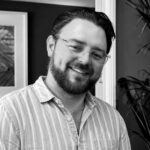 Dale Atkinson is the founder of Clear Signal Partners, a healthcare consultancy that helps healthcare providers identify where trust breaks down throughout the patient journey through its Patient Trust Audit methodology. Before entering healthcare, he spent nearly two decades in compliance, governance, and financial crime leadership roles at organizations including HSBC, Wellington Management, Schroders, and Deutsche Bank.
Following a Stage IV oesophageal cancer diagnosis in 2024, Dale gained firsthand experience navigating both private and public healthcare systems, shaping his perspective on patient trust, care delivery, and healthcare accountability. He is also a speaker, writer, and advocate for more patient-centered healthcare, having spoken at HIMSS Europe 2026 and contributed research and commentary on integrative cancer care, healthcare trust, and patient experience.